
成骨细胞特异性缺失Fgfr1可抑制FGF23。
Osteocyte-specific deletion of Fgfr1 suppresses FGF23.
作者信息
Xiao Zhousheng, Huang Jinsong, Cao Li, Liang Yingjuan, Han Xiaobin, Quarles Leigh Darryl
机构信息
University of Tennessee Health Science Center, Memphis, Tennessee, United States of America.
出版信息
PLoS One. 2014 Aug 4;9(8):e104154. doi: 10.1371/journal.pone.0104154. eCollection 2014.
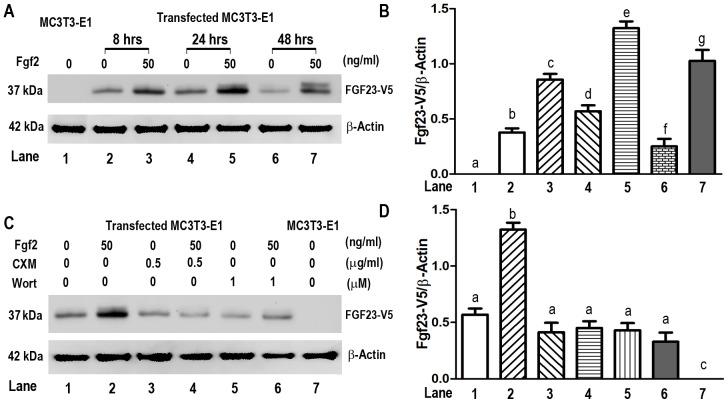
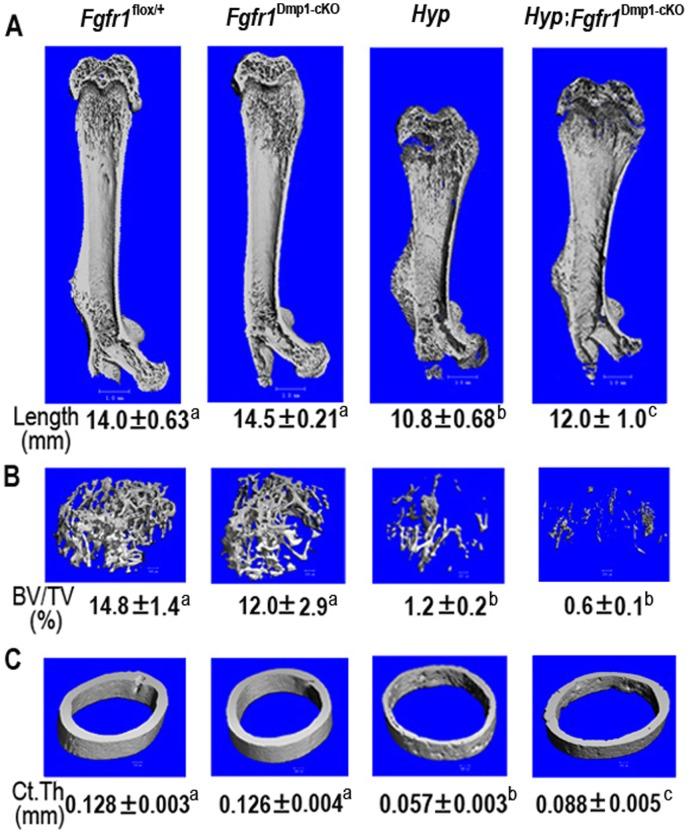
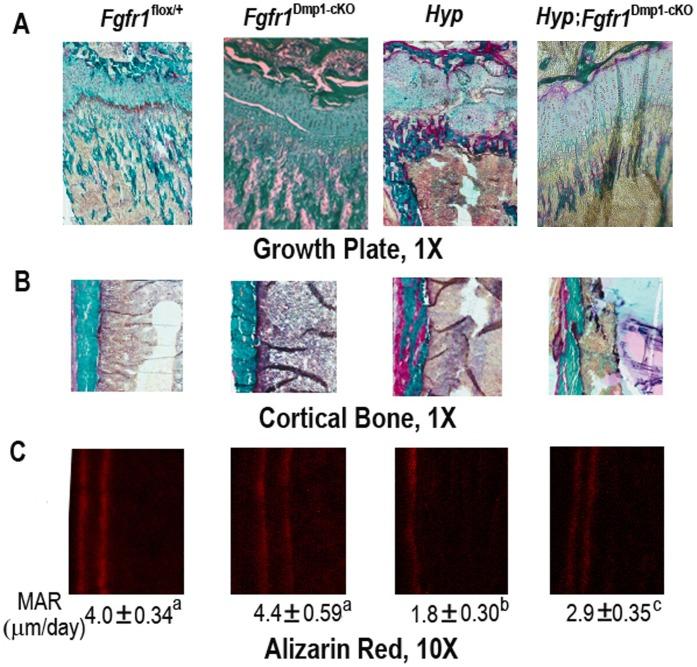
Increases in fibroblastic growth factor 23 (FGF23 or Fgf23) production by osteocytes result in hypophosphatemia and rickets in the Hyp mouse homologue of X-linked hypophosphatemia (XLH). Fibroblastic growth factor (FGF) signaling has been implicated in the pathogenesis of Hyp. Here, we conditionally deleted FGF receptor 1 (FGFR1 or Fgfr1) in osteocytes of Hyp mice to investigate the role of autocrine/paracrine FGFR signaling in regulating FGF23 production by osteocytes. Crossing dentin matrix protein 1 (Dmp1)-Cre;Fgfr1null/+ mice with female Hyp;Fgfr1flox/flox mice created Hyp and Fgfr1 (Fgfr1Dmp1-cKO)-null mice (Hyp;Fgfr1Dmp1-cKO) with a 70% decrease in bone Fgfr1 transcripts. Fgfr1Dmp1-cKO-null mice exhibited a 50% reduction in FGF23 expression in bone and 3-fold reduction in serum FGF23 concentrations, as well as reductions in sclerostin (Sost), phosphate regulating endopeptidase on X chromosome (PHEX or Phex), matrix extracellular phosphoglycoprotein (Mepe), and Dmp1 transcripts, but had no demonstrable alterations in phosphate or vitamin D homeostasis or skeletal morphology. Hyp mice had hypophosphatemia, reductions in 1,25(OH)2D levels, rickets/osteomalacia and elevated FGF2 expression in bone. Compared to Hyp mice, compound Hyp;Fgfr1Dmp1-cKO-null mice had significant improvement in rickets and osteomalacia in association with a decrease in serum FGF23 (3607 to 1099 pg/ml), an increase in serum phosphate (6.0 mg/dl to 9.3 mg/dl) and 1,25(OH)2D (121±23 to 192±34 pg/ml) levels, but only a 30% reduction in bone FGF23 mRNA expression. FGF23 promoter activity in osteoblasts was stimulated by FGFR1 activation and inhibited by overexpression of a dominant negative FGFR1(TK-), PLCγ and MAPK inhibitors. FGF2 also stimulated the translation of an FGF23 cDNA transfected into osteoblasts via a FGFR1 and PI3K/Akt-dependent mechanism. Thus, activation of autocrine/paracrine FGF pathways is involved in the pathogenesis of Hyp through FGFR1-dependent regulation of FGF23 by both transcriptional and post-transcriptional mechanisms. This may serve to link local bone metabolism with systemic phosphate and vitamin D homeostasis.
在X连锁低磷血症(XLH)的Hyp小鼠同源物中,骨细胞产生的成纤维细胞生长因子23(FGF23)增加会导致低磷血症和佝偻病。成纤维细胞生长因子(FGF)信号传导与Hyp的发病机制有关。在此,我们有条件地删除了Hyp小鼠骨细胞中的FGF受体1(FGFR1),以研究自分泌/旁分泌FGFR信号传导在调节骨细胞产生FGF23中的作用。将牙本质基质蛋白1(Dmp1)-Cre;Fgfr1null/+小鼠与雌性Hyp;Fgfr1flox/flox小鼠杂交,产生了骨Fgfr1转录本减少70%的Hyp和Fgfr1(Fgfr1Dmp1-cKO)缺失小鼠(Hyp;Fgfr1Dmp1-cKO)。Fgfr1Dmp1-cKO缺失小鼠的骨FGF23表达降低了50%,血清FGF23浓度降低了3倍,同时硬化蛋白(Sost)、X染色体上的磷酸盐调节内肽酶(PHEX或Phex)、基质细胞外磷酸糖蛋白(Mepe)和Dmp1转录本也减少,但磷酸盐或维生素D稳态及骨骼形态没有明显改变。Hyp小鼠有低磷血症、1,25(OH)2D水平降低、佝偻病/骨软化症以及骨中FGF2表达升高。与Hyp小鼠相比,复合Hyp;Fgfr1Dmp1-cKO缺失小鼠的佝偻病和骨软化症有显著改善,同时血清FGF23降低(从3607降至1099 pg/ml),血清磷酸盐升高(从6.0 mg/dl升至9.3 mg/dl),1,25(OH)2D升高(从121±23升至192±34 pg/ml),但骨FGF23 mRNA表达仅降低30%。FGFR1激活刺激成骨细胞中FGF23启动子活性,而显性负性FGFR1(TK-)、PLCγ和MAPK抑制剂的过表达则抑制该活性。FGF2还通过FGFR1和PI3K/Akt依赖性机制刺激转染到成骨细胞中的FGF23 cDNA的翻译。因此,自分泌/旁分泌FGF途径的激活通过FGFR1依赖的转录和转录后机制调节FGF23参与了Hyp的发病机制。这可能有助于将局部骨代谢与全身磷酸盐和维生素D稳态联系起来。



 Zotero 插件