
2009-2013 年印度加尔各答伤寒和副伤寒 A 血清型沙门氏菌血分离株的耐药性、毒力谱和分子亚型。
Antimicrobial resistance, virulence profiles and molecular subtypes of Salmonella enterica serovars Typhi and Paratyphi A blood isolates from Kolkata, India during 2009-2013.
机构信息
National Institute of Cholera and Enteric Diseases, Kolkata, India.
Calcutta Medical Research Institute, Kolkata, India.
出版信息
PLoS One. 2014 Aug 6;9(8):e101347. doi: 10.1371/journal.pone.0101347. eCollection 2014.
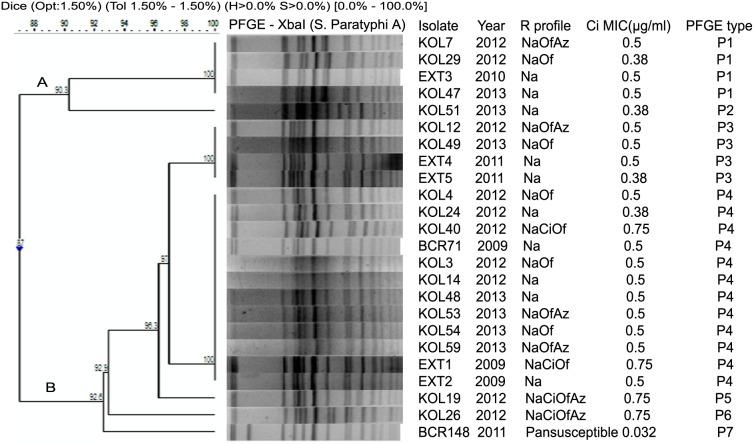
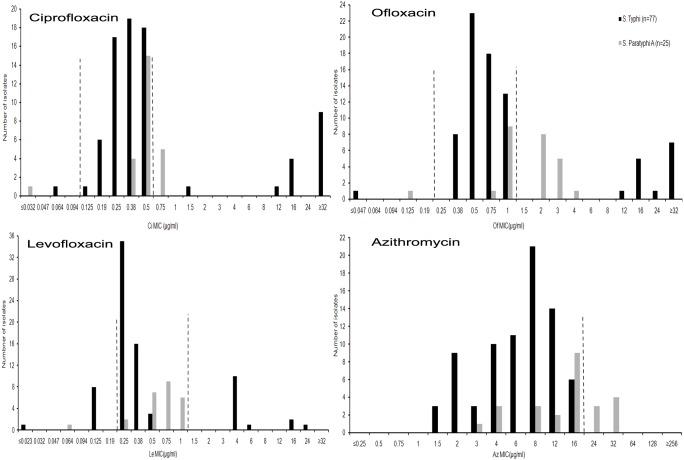
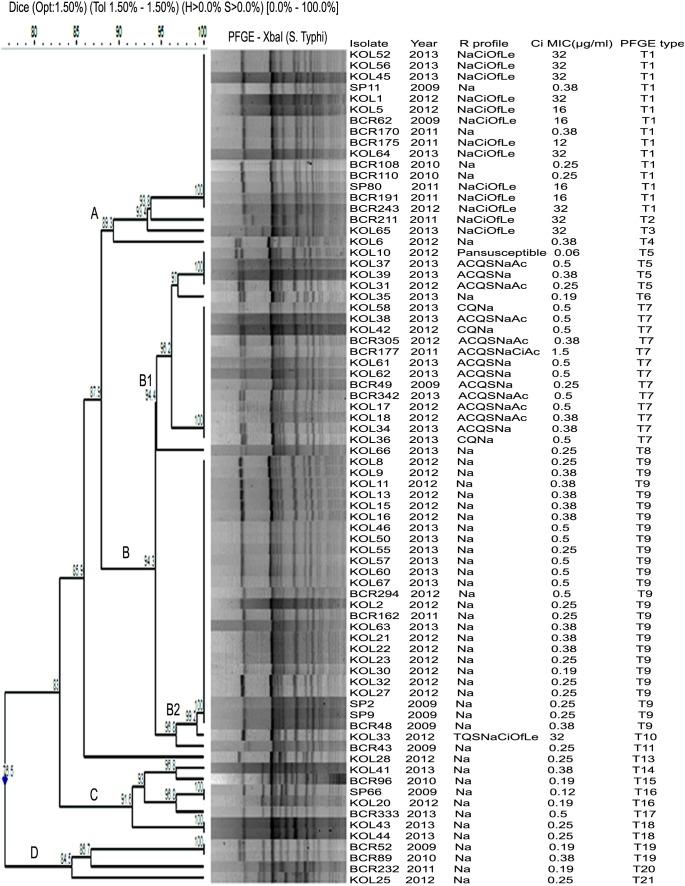
Enteric fever, caused by Salmonella enterica, remains an unresolved public health problem in India and antimicrobial therapy is the main mode of treatment. The objective of this study was to characterize the Salmonella enterica isolates from Kolkata with respect to their antimicrobial resistance (AMR), virulence profiles and molecular subtypes. Salmonella enterica blood isolates were collected from clinically suspected enteric fever patients attending various hospitals in Kolkata, India from January 2009 to June 2013 and were tested for AMR profiles by standard protocols; for resistance gene transfer by conjugation; for resistance and virulence genes profiles by PCR; and for molecular subtypes by Pulsed Field Gel Electrophoresis (PFGE). A total of 77 Salmonella enterica serovar Typhi (S. Typhi) and 25 Salmonella enterica serovar Paratyphi A (S. Paratyphi A) from Kolkata were included in this study. Although multidrug resistance (resistance to chloramphenicol, ampicillin, co-trimoxazole) was decreasing in S. Typhi (18.2%) and absent in S. Paratyphi A, increased resistance to fluoroquinolone, the current drug of choice, caused growing concern for typhoid treatment. A single, non-conjugative non-IncHI1 plasmid of 180 kb was found in 71.4% multidrug resistant (MDR) S. Typhi; the remaining 28.6% isolates were without plasmid. Various AMR markers (blaTEM-1, catA, sul1, sul2, dfrA15, strA-strB) and class 1 integron with dfrA7 gene were detected in MDR S. Typhi by PCR and sequencing. Most of the study isolates were likely to be virulent due to the presence of virulence markers. Major diversity was not noticed among S. Typhi and S. Paratyphi A from Kolkata by PFGE. The observed association between AMR profiles and S. Typhi pulsotypes might be useful in controlling the spread of the organism by appropriate intervention. The study reiterated the importance of continuous monitoring of AMR and molecular subtypes of Salmonella isolates from endemic regions for better understanding of the disease epidemiology.
肠热病是由沙门氏菌引起的,在印度仍然是一个未解决的公共卫生问题,抗菌治疗是主要的治疗方式。本研究的目的是研究来自加尔各答的沙门氏菌分离株的抗菌药物耐药性(AMR)、毒力谱和分子亚型。从 2009 年 1 月至 2013 年 6 月,从印度加尔各答的多家医院就诊的疑似肠热病患者中采集了沙门氏菌血液分离株,并通过标准方案检测 AMR 谱;通过接合检测耐药基因转移;通过 PCR 检测耐药和毒力基因谱;通过脉冲场凝胶电泳(PFGE)检测分子亚型。本研究共纳入 77 株伤寒沙门氏菌(S. Typhi)和 25 株甲型副伤寒沙门氏菌(S. Paratyphi A)。尽管 S. Typhi 的多药耐药性(对氯霉素、氨苄西林、复方新诺明耐药)呈下降趋势(18.2%),而 S. Paratyphi A 则无耐药性,但对氟喹诺酮类药物(目前的首选药物)的耐药性增加,这对伤寒的治疗越来越令人担忧。在 71.4%的多药耐药(MDR)S. Typhi 中发现了一种 180kb 的非接合非 IncHI1 质粒;其余 28.6%的分离株无质粒。通过 PCR 和测序,在 MDR S. Typhi 中检测到各种 AMR 标记(blaTEM-1、catA、sul1、sul2、dfrA15、strA-strB)和带有 dfrA7 基因的 I 类整合子。大多数研究分离株由于存在毒力标记物,可能具有毒力。通过 PFGE 未观察到来自加尔各答的 S. Typhi 和 S. Paratyphi A 之间的主要多样性。观察到 AMR 谱与 S. Typhi 脉冲型之间的关联可能有助于通过适当的干预控制该病原体的传播。该研究强调了持续监测来自流行地区的沙门氏菌分离株的 AMR 和分子亚型的重要性,以便更好地了解疾病的流行病学。

 Zotero 插件