
丝氨酸蛋白酶抑制剂B3/B4在特应性皮炎实验小鼠模型中导致早期炎症和屏障功能障碍。
SERPINB3/B4 contributes to early inflammation and barrier dysfunction in an experimental murine model of atopic dermatitis.
作者信息
Sivaprasad Umasundari, Kinker Kayla G, Ericksen Mark B, Lindsey Mark, Gibson Aaron M, Bass Stacey A, Hershey Nicolas S, Deng Jingyuan, Medvedovic Mario, Khurana Hershey Gurjit K
机构信息
Division of Asthma Research, Cincinnati Children's Hospital Medical Center, Department of Pediatrics, University of Cincinnati, Cincinnati, Ohio, USA.
Department of Environmental Health, University of Cincinnati, Cincinnati, Ohio, USA.
出版信息
J Invest Dermatol. 2015 Jan;135(1):160-169. doi: 10.1038/jid.2014.353. Epub 2014 Aug 11.
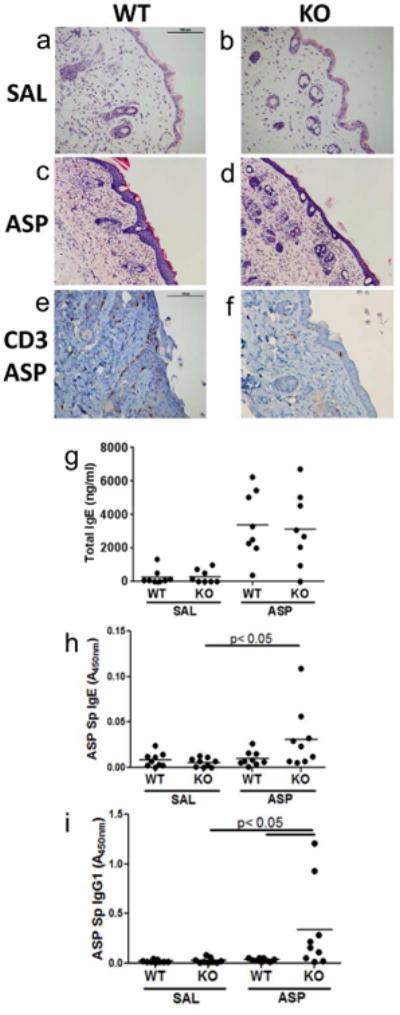
Serine proteases are critical for epidermal barrier homeostasis, and their aberrant expression and/or activity is associated with chronic skin diseases. Elevated levels of the serine protease inhibitors SERPINB3 and SERPINB4 are seen in patients with atopic dermatitis and psoriasis. However, their mechanistic role in the skin is unknown. To evaluate the contribution of Serpinb3a (mouse homolog of SERPINB3 and SERPINB4) in atopic dermatitis, we examined the effect of topical Aspergillus fumigatus extract exposure in wild-type and Serpinb3a-null mice on transepidermal water loss (TEWL), sensitization, and inflammation. Allergen exposure induced Serpinb3a expression in the skin, along with increased TEWL, epidermal thickness, and skin inflammation, all of which were attenuated in the absence of Serpinb3a. Attenuated TEWL correlated with decreased expression of the pro-inflammatory marker S100A8. Silencing of SERPINB3/B4 in human keratinocytes decreased S100A8 expression, supporting a role for SERPINB3/B4 in the initiation of the acute inflammatory response. RNA-seq analysis following allergen exposure identified a network of pro-inflammatory genes induced in wild-type mice that was absent in Serpinb3a-null mice. In conclusion, Serpinb3a deficiency attenuates barrier dysfunction and the early inflammatory response following cutaneous allergen exposure, supporting a role for Serpinb3a (mice) and SERPINB3/B4 (humans) early in atopic dermatitis.
丝氨酸蛋白酶对表皮屏障稳态至关重要,其异常表达和/或活性与慢性皮肤病相关。特应性皮炎和银屑病患者中丝氨酸蛋白酶抑制剂SERPINB3和SERPINB4水平升高。然而,它们在皮肤中的作用机制尚不清楚。为了评估Serpinb3a(SERPINB3和SERPINB4的小鼠同源物)在特应性皮炎中的作用,我们检测了野生型和Serpinb3a基因敲除小鼠局部暴露烟曲霉菌提取物对经表皮水分流失(TEWL)、致敏和炎症的影响。变应原暴露诱导皮肤中Serpinb3a表达,同时伴有TEWL增加、表皮厚度增加和皮肤炎症,在没有Serpinb3a的情况下,所有这些都有所减轻。TEWL的减轻与促炎标志物S100A8表达的降低相关。人角质形成细胞中SERPINB3/B4的沉默降低了S100A8的表达,支持SERPINB3/B4在急性炎症反应起始中的作用。变应原暴露后的RNA测序分析确定了野生型小鼠中诱导的一个促炎基因网络,而Serpinb3a基因敲除小鼠中不存在该网络。总之,Serpinb3a缺乏减轻了皮肤变应原暴露后的屏障功能障碍和早期炎症反应,支持Serpinb3a(小鼠)和SERPINB3/B4(人类)在特应性皮炎早期的作用。




 Zotero 插件