
两种连续血糖监测系统的准确性:临床研究中心和日常生活条件下的直接比较。
Accuracy of two continuous glucose monitoring systems: a head-to-head comparison under clinical research centre and daily life conditions.
作者信息
Kropff J, Bruttomesso D, Doll W, Farret A, Galasso S, Luijf Y M, Mader J K, Place J, Boscari F, Pieber T R, Renard E, DeVries J H
机构信息
Department of Internal Medicine, Academic Medical Center, University of Amsterdam, Amsterdam, the Netherlands.
出版信息
Diabetes Obes Metab. 2015 Apr;17(4):343-9. doi: 10.1111/dom.12378. Epub 2014 Sep 10.
AIMS
To assess the accuracy and reliability of the two most widely used continuous glucose monitoring (CGM) systems.
METHODS
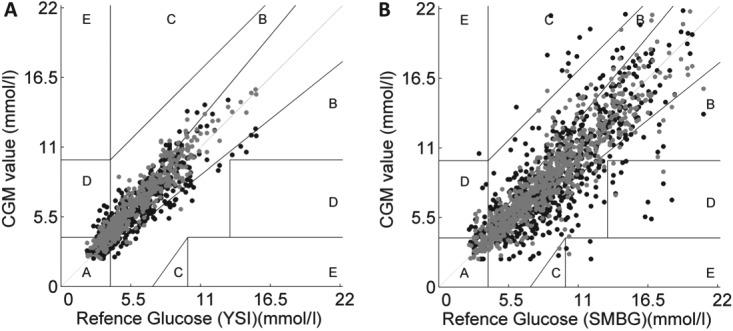
We studied the Dexcom®G4 Platinum (DG4P; Dexcom, San Diego, CA, USA) and Medtronic Paradigm Veo Enlite system (ENL; Medtronic, Northridge, CA, USA) CGM systems, in 24 patients with type 1 diabetes. The CGM systems were tested during 6-day home use and a nested 6-h clinical research centre (CRC) visit. During the CRC visit, frequent venous blood glucose samples were used as reference while patients received a meal with an increased insulin bolus to induce an aggravated postprandial glucose nadir. At home, patients performed at least six reference capillary blood measurements per day. A Wilcoxon signed-rank test was performed using all data points ≥15 min apart.
RESULTS
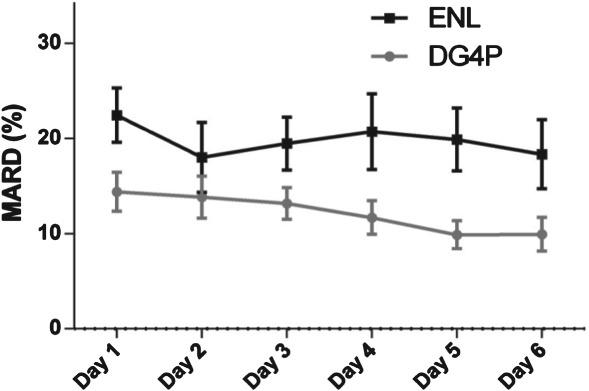
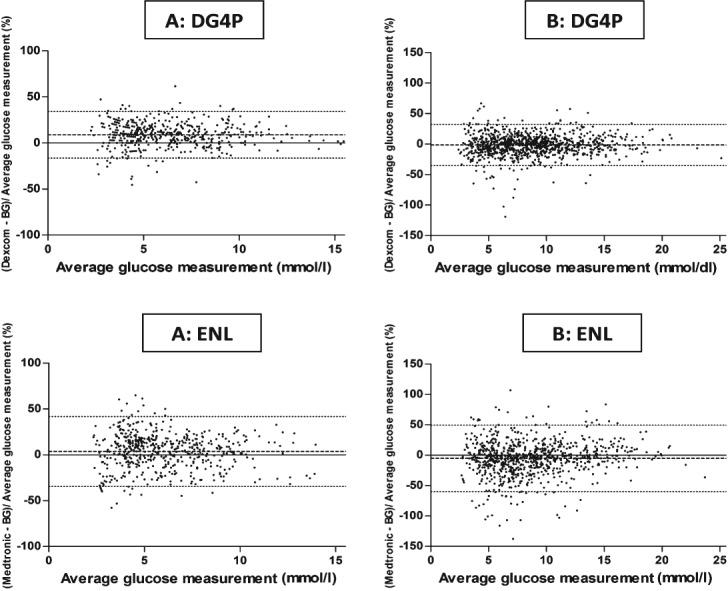
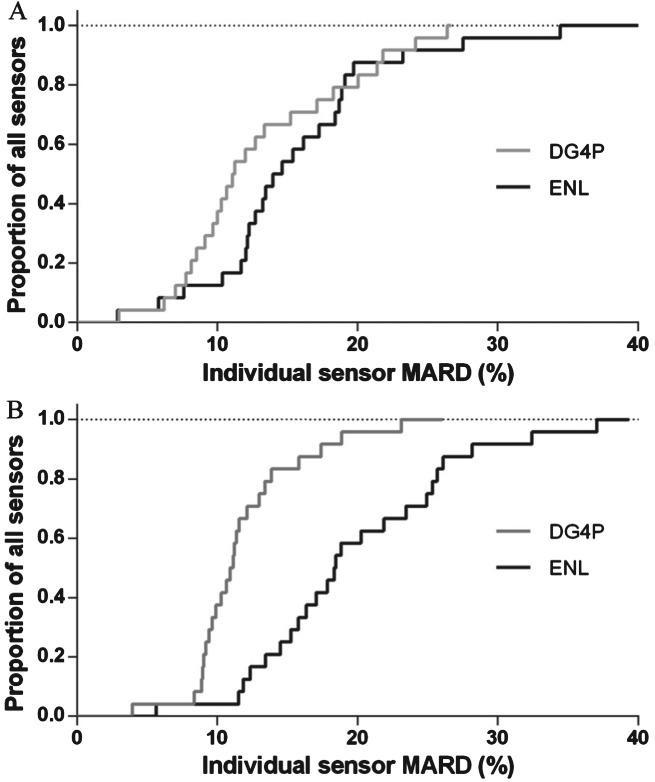
The overall mean absolute relative difference (MARD) value [standard deviation (s.d.)] measured at the CRC was 13.6 (11.0)% for the DG4P and 16.6 (13.5)% for the ENL [p < 0.0002, confidence interval of difference (CI Δ) 1.7-4.3%, n = 530]. The overall MARD assessed at home was 12.2 (12.0)% for the DG4P and 19.9 (20.5)% for the ENL (p < 0.0001, CI Δ = 5.8-8.7%, n = 839). During the CRC visit, the MARD in the hypoglycaemic range [≤3.9 mmol/l (70 mg/dl)], was 17.6 (12.2)% for the DG4P and 24.6 (18.8)% for the ENL (p = 0.005, CI Δ 3.1-10.7%, n = 117). Both sensors showed higher MARD values during hypoglycaemia than during euglycaemia [3.9-10 mmol/l (70-180 mg/dl)]: for the DG4P 17.6 versus 13.0% and for the ENL 24.6 versus 14.2%.
CONCLUSIONS
During circumstances of intended use, including both a CRC and home phase, the ENL was noticeably less accurate than the DG4P sensor. Both sensors showed lower accuracy in the hypoglycaemic range. The DG4P was less affected by this negative effect of hypoglycaemia on sensor accuracy than was the ENL.
目的
评估两种最广泛使用的连续血糖监测(CGM)系统的准确性和可靠性。
方法
我们对24例1型糖尿病患者的德康G4铂金版(DG4P;德康公司,美国加利福尼亚州圣地亚哥)和美敦力Paradigm Veo Enlite系统(ENL;美敦力公司,美国加利福尼亚州北岭)CGM系统进行了研究。CGM系统在6天的家庭使用期间以及嵌套的6小时临床研究中心(CRC)访视期间进行测试。在CRC访视期间,频繁采集静脉血葡萄糖样本作为参考,同时患者接受一顿增加胰岛素推注量的餐食,以诱发更严重的餐后血糖最低点。在家中,患者每天至少进行6次参考毛细血管血糖测量。使用所有间隔≥15分钟的数据点进行Wilcoxon符号秩检验。
结果
在CRC测量时,DG4P的总体平均绝对相对差异(MARD)值[标准差(s.d.)]为13.6(11.0)%,ENL为16.6(13.5)%[p<0.0002,差异置信区间(CIΔ)1.7-4.3%,n = 530]。在家中评估的总体MARD,DG4P为12.2(12.0)%,ENL为19.9(20.5)%(p<0.0001,CIΔ = 5.8-8.7%,n = 839)。在CRC访视期间,低血糖范围[≤3.9 mmol/L(70 mg/dl)]内的MARD,DG4P为17.6(12.2)%,ENL为24.6(18.8)%(p = 0.005,CIΔ 3.1-10.7%,n = 117)。两种传感器在低血糖期间的MARD值均高于正常血糖期间[3.9-10 mmol/L(70-180 mg/dl)]:DG4P分别为17.6%和13.0%,ENL分别为24.6%和14.2%。
结论
在包括CRC和家庭阶段的预期使用情况下,ENL明显不如DG4P传感器准确。两种传感器在低血糖范围内的准确性均较低。与ENL相比,DG4P受低血糖对传感器准确性的这种负面影响较小。
 Zotero 插件