
地诺单抗通过与核因子κB受体活化因子配体(RANKL)上的主要结合位点相互作用,模拟天然诱饵受体骨保护素。
Denosumab mimics the natural decoy receptor osteoprotegerin by interacting with its major binding site on RANKL.
作者信息
Schieferdecker Aneta, Voigt Mareike, Riecken Kristoffer, Braig Friederike, Schinke Thorsten, Loges Sonja, Bokemeyer Carsten, Fehse Boris, Binder Mascha
机构信息
Department of Oncology and Hematology, BMT with section Pneumology, Hubertus Wald Tumorzentrum / UCCH, University Medical Center Hamburg-Eppendorf, Hamburg, Germany.
Research Department Cell and Gene Therapy, Department of Stem Cell Transplantation, University Medical Center Hamburg-Eppendorf, Hamburg, Germany.
出版信息
Oncotarget. 2014 Aug 30;5(16):6647-53. doi: 10.18632/oncotarget.2160.
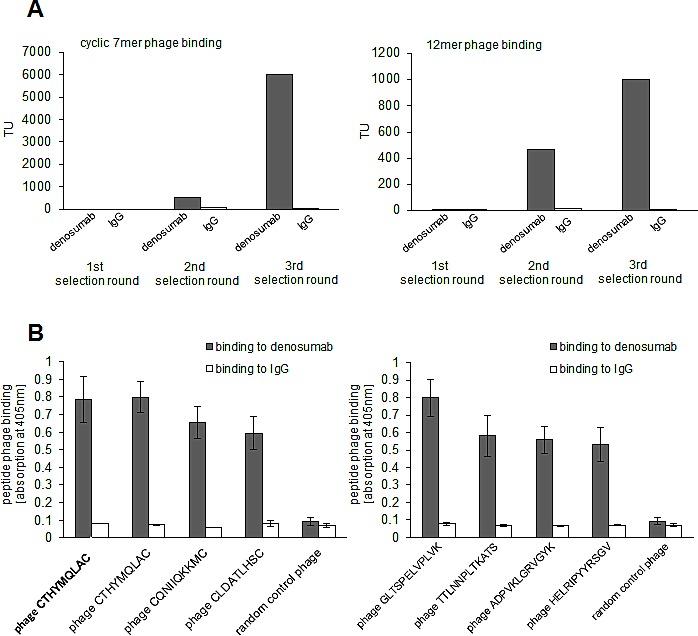
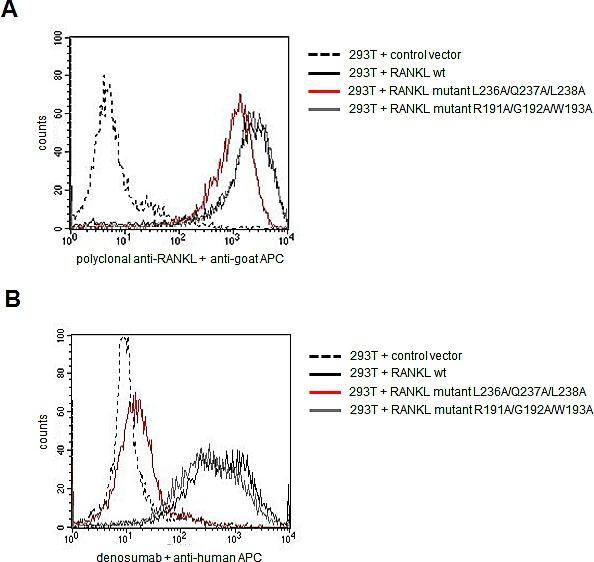
Bone homeostasis critically relies on the RANKL-RANK-OPG axis which can be targeted by the fully human monoclonal antibody denosumab in conditions with increased bone resporption such as bone metastases. The binding site and therefore the molecular mechanism by which this antibody inhibits RANKL has not been characterized so far. Here, we used random peptide phage display library screenings to identify the denosumab epitope on RANKL. Alignments of phage derived peptide sequences with RANKL suggested that this antibody recognized a linear epitope between position T233 and Y241. Mutational analysis confirmed the core residues as critical for this interaction. The spatial localization of this epitope on a 3-dimensional model of RANKL showed that it overlapped with the major binding sites of OPG and RANK on RANKL. We conclude that denosumab inhibits RANKL by both functional and molecular mimicry of the natural decoy receptor OPG.
骨稳态严重依赖于RANKL-RANK-OPG轴,在诸如骨转移等骨吸收增加的情况下,全人源单克隆抗体地诺单抗可作用于该轴。迄今为止,该抗体抑制RANKL的结合位点及分子机制尚未明确。在此,我们利用随机肽噬菌体展示文库筛选来鉴定RANKL上的地诺单抗表位。噬菌体衍生肽序列与RANKL的比对表明,该抗体识别T233位和Y241位之间的线性表位。突变分析证实核心残基对这种相互作用至关重要。该表位在RANKL三维模型上的空间定位显示,它与OPG和RANK在RANKL上的主要结合位点重叠。我们得出结论,地诺单抗通过天然诱饵受体OPG的功能和分子模拟来抑制RANKL。

 Zotero 插件