
埃塞俄比亚索马里民族区域州吉吉加区12至23个月大儿童的免疫接种覆盖率及相关因素
Immunization coverage of 12-23 months old children and associated factors in Jigjiga District, Somali National Regional State, Ethiopia.
作者信息
Mohamud Abdi Nur, Feleke Amsalu, Worku Walelegn, Kifle Manay, Sharma Hardeep Rai
机构信息
Department of Environmental and Occupational Health and Safety, College of Medicine and Health Science, University of Gondar, PO Box No, 196, Gondar, Ethiopia.
出版信息
BMC Public Health. 2014 Aug 22;14:865. doi: 10.1186/1471-2458-14-865.
BACKGROUND
Immunization coverage in Ethiopia is less than the herd immunity level desired to prevent the spread of eight target diseases targeted by the World Health Organization's Expanded Program of Immunization. In particular, the Somali region of the country still has by far the lowest level of immunization coverage. The objective of this study was to measure the immunization coverage of 12-23 months old children and associated factors in the urban and rural areas of Jigjiga district.
METHODS
A community based cross-sectional survey was conducted in 582 households with 12-23 months old children in two urban and four rural wards. The data were collected from mothers or caregivers through interviews based on pre-tested and structured questionnaires and from the review of vaccination cards. Data were processed using SPSS version 16. To identify factors associated with the immunization status of children, bivariate and multiple logistic regression analyses were worked out and the Hoshmer and Lemeshow's goodness-of-fit was used to assess the fitness of multiple logistic regression model.
RESULTS
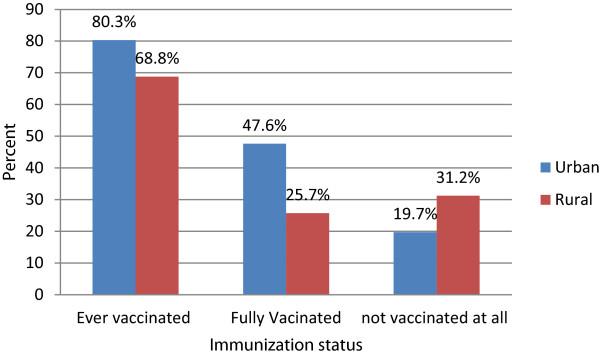
Three-fourth (74.6%) of the children surveyed were ever vaccinated, whereas 36.6% were fully vaccinated. The immunization coverage rate from card assessment for Bacillus Calmette-Guérin was 41.8%, while for Oral Polio Vaccine Zero, Oral Polio Vaccine One /Pentavalent1, Oral Polio Vaccine Two /Pentavalent2, Oral Polio Vaccine Three /Pentavalent3, and measles were 10.4%, 41.1%, 33.9%, 27.5%, and 24.9%, respectively. Maternal literacy (AOR = 3.06, 95% CI = 1.64, 5.71), Tetanus Toxoid Vaccine (AOR = 2.43, 95% CI = 1.56, 3.77), place of delivery (AOR = 2.02, 95% CI = 1.24, 3.28), place of residence (AOR = 2.04, 95% CI = 1.33, 3.13), and household visits by health workers (AOR = 1.92, 95% CI = 1.17, 3.16), were found to be factors significantly associated with full immunization in the multivariate logistic regression analysis.
CONCLUSIONS
The overall immunization coverage was found to be low. Hence, to increase the immunization coverage and reduce the incidences of missed opportunity, delivery in the health institution should be promoted, the outreach activities of the health institutions should be strengthened and greater utilization of health services by mothers should be encouraged.
背景
埃塞俄比亚的免疫接种覆盖率低于世界卫生组织扩大免疫规划所期望的预防八种目标疾病传播的群体免疫水平。特别是该国的索马里地区,免疫接种覆盖率仍然是目前最低的。本研究的目的是测量吉吉加区城乡12至23个月大儿童的免疫接种覆盖率及相关因素。
方法
在两个城市病房和四个农村病房对582户有12至23个月大儿童的家庭进行了基于社区的横断面调查。通过基于预先测试和结构化问卷的访谈从母亲或照顾者那里收集数据,并通过查看疫苗接种卡收集数据。使用SPSS 16版对数据进行处理。为了确定与儿童免疫接种状况相关的因素,进行了二元和多元逻辑回归分析,并使用霍斯默和莱梅肖拟合优度来评估多元逻辑回归模型的拟合度。
结果
接受调查的儿童中有四分之三(74.6%)曾经接种过疫苗,而36.6%的儿童完成了全程接种。卡介苗的卡片评估免疫接种覆盖率为41.8%,而口服脊髓灰质炎疫苗零剂、口服脊髓灰质炎疫苗一剂/五价疫苗1、口服脊髓灰质炎疫苗二剂/五价疫苗2、口服脊髓灰质炎疫苗三剂/五价疫苗3和麻疹疫苗的覆盖率分别为10.4%、41.1%、33.9%、27.5%和24.9%。在多变量逻辑回归分析中,发现母亲识字率(比值比=3.06,95%置信区间=1.64,5.71)、破伤风类毒素疫苗(比值比=2.43,95%置信区间=1.56,3.77)、分娩地点(比值比=2.02,95%置信区间=1.24,3.28)、居住地点(比值比=2.04,95%置信区间=1.33,3.13)以及卫生工作者的家访(比值比=1.92,95%置信区间=1.17,3.16)是与全程免疫显著相关的因素。
结论
发现总体免疫接种覆盖率较低。因此,为了提高免疫接种覆盖率并减少错过接种机会的发生率,应促进在医疗机构分娩,加强医疗机构的外展活动,并鼓励母亲更多地利用卫生服务。
 Zotero 插件