
太行山脉上长裂太行菊和太行菊(太行菊属)的分子系统地理学与种群遗传结构
Molecular phylogeography and population genetic structure of O. longilobus and O. taihangensis (Opisthopappus) on the Taihang mountains.
作者信息
Wang Yiling, Yan Guiqin
机构信息
College of Life Sciences, Shanxi Normal University, Linfen, China.
出版信息
PLoS One. 2014 Aug 22;9(8):e104773. doi: 10.1371/journal.pone.0104773. eCollection 2014.
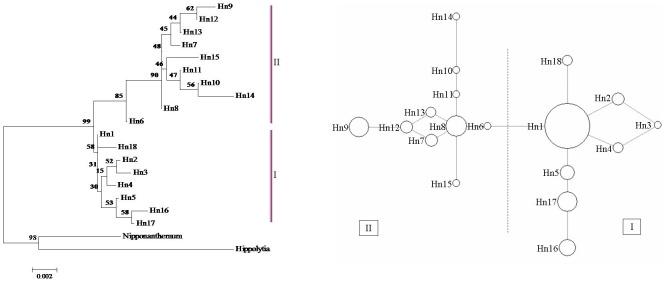
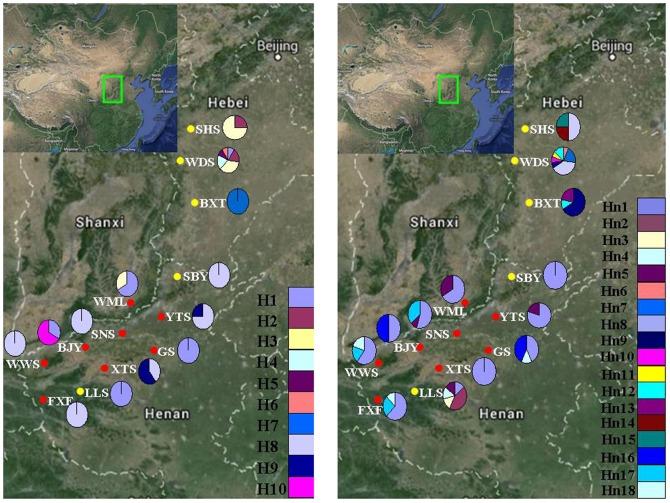
Historic events such as the uplift of mountains and climatic oscillations in the Quaternary periods greatly affected the evolution and modern distribution of the flora. We sequenced the trnL-trnF, ndhJ-trnL and ITS from populations throughout the known distributions of O. longilobus and O. taihangensis to understand the evolutionary history and the divergence related to the past shifts of habitats in the Taihang Mountains regions. The results showed high genetic diversity and pronounced genetic differentiation among the populations of the two species with a significant phylogeographical pattern (NST>GST, P<0.05), which imply restricted gene flow among the populations and significant geographical or environmental isolation. Ten chloroplast DNA (cpDNA) and eighteen nucleus ribosome DNA (nrDNA) haplotypes were identified and clustered into two lineages. Two corresponding refuge areas were revealed across the entire distribution ranges of O. longilobus and at least three refuge areas for O. taihangensis. O. longilobus underwent an evolutionary historical process of long-distance dispersal and colonization, whereas O. taihangensis underwent a population expansion before the main uplift of Taihang Mountains. The differentiation time between O. longilobus and O. taihangensis is estimated to have occurred at the early Pleistocene. Physiographic complexity and paleovegetation transition of Taihang Mountains mainly shaped the specific formation and effected the present distribution of these two species. The results therefore support the inference that Quaternary refugial isolation promoted allopatric speciation in Taihang Mountains. This may help to explain the existence of high diversity and endemism of plant species in central/northern China.
诸如山脉隆起和第四纪气候振荡等历史事件极大地影响了植物区系的演化和现代分布。我们对长柄栎和太行栎已知分布范围内各居群的trnL-trnF、ndhJ-trnL和ITS进行了测序,以了解其演化历史以及与太行山地区过去栖息地变化相关的分化情况。结果表明,这两个物种的居群间具有高遗传多样性和显著的遗传分化,呈现出明显的系统地理学格局(NST>GST,P<0.05),这意味着居群间基因流受限,存在显著的地理或环境隔离。共鉴定出10个叶绿体DNA(cpDNA)单倍型和18个核糖体DNA(nrDNA)单倍型,并聚类为两个谱系。在长柄栎的整个分布范围内揭示了两个相应的避难所区域,太行栎至少有三个避难所区域。长柄栎经历了长距离扩散和定殖的演化历史过程,而太行栎在太行山主要隆升之前经历了种群扩张。长柄栎和太行栎的分化时间估计发生在早更新世。太行山的地形复杂性和古植被变迁主要塑造了这两个物种的特有形成,并影响了它们目前的分布。因此,这些结果支持了第四纪避难所隔离促进太行山异域物种形成的推断。这可能有助于解释中国中部/北部植物物种高多样性和特有性的存在。


 Zotero 插件