
Toll样受体配体可诱导鸡巨噬细胞产生抗病毒反应。
TLR ligands induce antiviral responses in chicken macrophages.
作者信息
Barjesteh Neda, Behboudi Shahriar, Brisbin Jennifer T, Villanueva Alexander Ian, Nagy Eva, Sharif Shayan
机构信息
Department of Pathobiology, University of Guelph, Guelph, Ontario, Canada.
The Pirbright Institute, Compton Laboratory, Newbury, United Kingdom.
出版信息
PLoS One. 2014 Aug 28;9(8):e105713. doi: 10.1371/journal.pone.0105713. eCollection 2014.
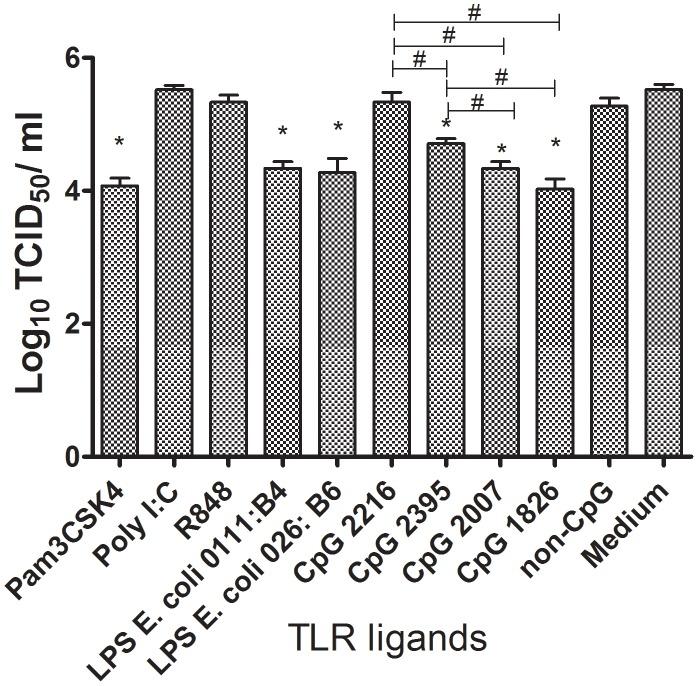
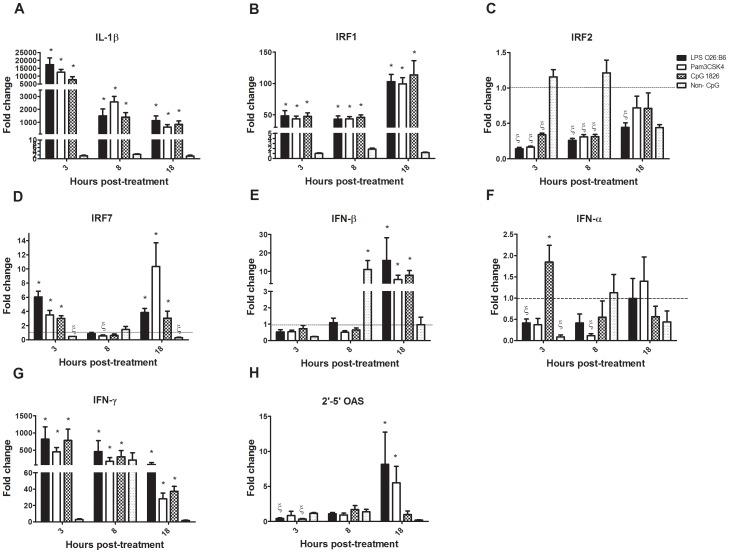
Chicken macrophages express several receptors for recognition of pathogens, including Toll-like receptors (TLRs). TLRs bind to pathogen-associated molecular patterns (PAMPs) derived from bacterial or viral pathogens leading to the activation of macrophages. Macrophages play a critical role in immunity against viruses, including influenza viruses. The present study was designed to test the hypothesis that treatment of chicken macrophages with TLR ligands reduces avian influenza replication. Furthermore, we sought to study the expression of some of the key mediators involved in the TLR-mediated antiviral responses of macrophages. Chicken macrophages were treated with the TLR2, 3, 4, 7 and 21 ligands, Pam3CSK4, poly(I:C), LPS, R848 and CpG ODN, respectively, at different doses and time points pre- and post-H4N6 avian influenza virus (AIV) infection. The results revealed that pre-treatment of macrophages with Pam3CSK4, LPS and CpG ODN reduced the replication of AIV in chicken macrophages. In addition, the relative expression of genes involved in inflammatory and antiviral responses were quantified at 3, 8 and 18 hours post-treatment with the TLR2, 4 and 21 ligands. Pam3CSK4, LPS and CpG ODN increased the expression of interleukin (IL)-1β, interferon (IFN)-γ, IFN-β and interferon regulatory factor (IFR) 7. The expression of these genes correlated with the reduction of viral replication in macrophages. These results shed light on the process of immunity to AIV in chickens.
鸡巨噬细胞表达多种用于识别病原体的受体,包括Toll样受体(TLR)。TLR与源自细菌或病毒病原体的病原体相关分子模式(PAMP)结合,从而导致巨噬细胞的激活。巨噬细胞在针对包括流感病毒在内的病毒的免疫中发挥关键作用。本研究旨在验证用TLR配体处理鸡巨噬细胞可减少禽流感病毒复制这一假说。此外,我们试图研究参与巨噬细胞TLR介导的抗病毒反应的一些关键介质的表达。在感染H4N6禽流感病毒(AIV)之前和之后的不同剂量和时间点,分别用TLR2、3、4、7和21配体Pam3CSK4、聚肌胞苷酸(poly(I:C))、脂多糖(LPS)、R848和CpG寡脱氧核苷酸(CpG ODN)处理鸡巨噬细胞。结果显示,用Pam3CSK4、LPS和CpG ODN预处理巨噬细胞可减少AIV在鸡巨噬细胞中的复制。此外,在用TLR2、4和21配体处理后3、8和18小时,对参与炎症和抗病毒反应的基因的相对表达进行了定量。Pam3CSK4、LPS和CpG ODN增加了白细胞介素(IL)-1β、干扰素(IFN)-γ、IFN-β和干扰素调节因子(IRF)7的表达。这些基因的表达与巨噬细胞中病毒复制的减少相关。这些结果揭示了鸡对AIV的免疫过程。


 Zotero 插件