
唯有去甲肾上腺素转运体:131I-间碘苄胍治疗中去甲肾上腺素转运体表达及疗效综述
Nothing but NET: a review of norepinephrine transporter expression and efficacy of 131I-mIBG therapy.
作者信息
Streby Keri A, Shah Nilay, Ranalli Mark A, Kunkler Anne, Cripe Timothy P
机构信息
Division of Hematology/Oncology/Blood and Marrow Transplant, The Ohio State University, Columbus, Ohio; Center for Childhood Cancer and Blood Diseases, Nationwide Children's Hospital, The Ohio State University, Columbus, Ohio.
出版信息
Pediatr Blood Cancer. 2015 Jan;62(1):5-11. doi: 10.1002/pbc.25200. Epub 2014 Aug 30.
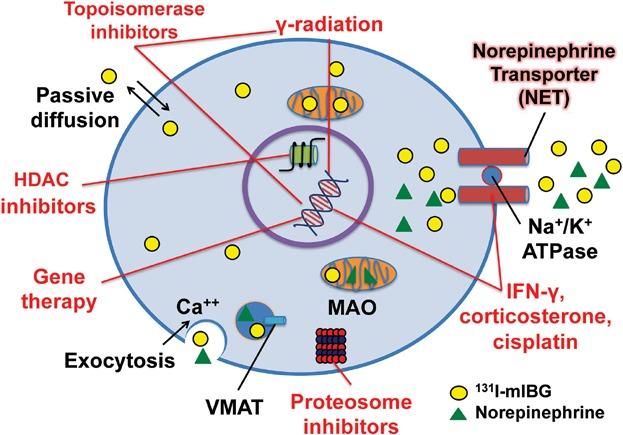
Neuroblastoma is unique amongst common pediatric cancers for its expression of the norepinephrine transporter (NET), enabling tumor-selective imaging and therapy with radioactive analogues of norepinephrine. The majority of neuroblastoma tumors are avid for (123)I-metaiodobenzaguanidine (mIBG) on imaging, yet the therapeutic response to (131) I-mIBG is only 30% in clinical trials, and off-target effects cause short- and long-term morbidity. We review the contemporary understanding of the tumor-selective uptake, retention, and efflux of meta-iodobenzylguanidine (mIBG) and strategies currently in development for improving its efficacy. Combination treatment strategies aimed at enhancing NET are likely necessary to reach the full potential of (131)I-mIBG therapy.
神经母细胞瘤在常见的儿科癌症中独具特色,因为它表达去甲肾上腺素转运体(NET),这使得利用去甲肾上腺素的放射性类似物进行肿瘤选择性成像和治疗成为可能。大多数神经母细胞瘤肿瘤在成像时对(123)I-间碘苄胍(mIBG)摄取良好,但在临床试验中,对(131)I-mIBG的治疗反应仅为30%,且脱靶效应会导致短期和长期发病率。我们综述了目前对间碘苄胍(mIBG)的肿瘤选择性摄取、滞留和外排的认识,以及目前正在开发的提高其疗效的策略。旨在增强NET的联合治疗策略可能是充分发挥(131)I-mIBG治疗潜力所必需的。
 Zotero 插件