
用于有效愈合和再生的组织工程支架:原位研究综述
Tissue engineered scaffolds for an effective healing and regeneration: reviewing orthotopic studies.
作者信息
Baiguera Silvia, Urbani Luca, Del Gaudio Costantino
机构信息
INAIL-DIPIA, Via Alessandria 220E, 00198 Rome, Italy.
Surgery Unit, Institute of Child Health and Great Ormond Street Hospital, University College London, 30 Guilford Street, London WC1N 1EH, UK.
出版信息
Biomed Res Int. 2014;2014:398069. doi: 10.1155/2014/398069. Epub 2014 Aug 27.
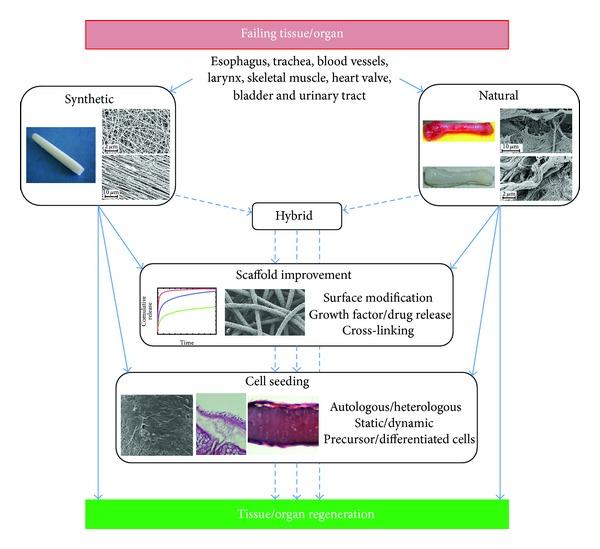
It is commonly stated that tissue engineering is the most promising approach to treat or replace failing tissues/organs. For this aim, a specific strategy should be planned including proper selection of biomaterials, fabrication techniques, cell lines, and signaling cues. A great effort has been pursued to develop suitable scaffolds for the restoration of a variety of tissues and a huge number of protocols ranging from in vitro to in vivo studies, the latter further differentiating into several procedures depending on the type of implantation (i.e., subcutaneous or orthotopic) and the model adopted (i.e., animal or human), have been developed. All together, the published reports demonstrate that the proposed tissue engineering approaches spread toward multiple directions. The critical review of this scenario might suggest, at the same time, that a limited number of studies gave a real improvement to the field, especially referring to in vivo investigations. In this regard, the present paper aims to review the results of in vivo tissue engineering experimentations, focusing on the role of the scaffold and its specificity with respect to the tissue to be regenerated, in order to verify whether an extracellular matrix-like device, as usually stated, could promote an expected positive outcome.
人们普遍认为,组织工程是治疗或替换功能衰竭的组织/器官最具前景的方法。为了实现这一目标,应制定具体策略,包括正确选择生物材料、制造技术、细胞系和信号线索。人们付出了巨大努力来开发适用于多种组织修复的支架,并且已经制定了大量从体外研究到体内研究的方案,后者根据植入类型(即皮下或原位)和采用的模型(即动物或人类)进一步细分为几种程序。总之,已发表的报告表明,所提出的组织工程方法朝着多个方向发展。与此同时,对这种情况的批判性审视可能表明,只有少数研究真正推动了该领域的发展,特别是在体内研究方面。在这方面,本文旨在回顾体内组织工程实验的结果,重点关注支架的作用及其相对于待再生组织的特异性,以验证如通常所说的细胞外基质样装置是否能促进预期的积极结果。

 Zotero 插件