
吉西他滨/顺铂新辅助放化疗联合手术与直接手术治疗可切除胰腺癌的比较:首个前瞻性随机II期试验结果
Neoadjuvant chemoradiation therapy with gemcitabine/cisplatin and surgery versus immediate surgery in resectable pancreatic cancer: results of the first prospective randomized phase II trial.
作者信息
Golcher Henriette, Brunner Thomas B, Witzigmann Helmut, Marti Lukas, Bechstein Wolf-Otto, Bruns Christiane, Jungnickel Henry, Schreiber Stefan, Grabenbauer Gerhard G, Meyer Thomas, Merkel Susanne, Fietkau Rainer, Hohenberger Werner
机构信息
Department of Surgery, University Hospital Erlangen, Krankenhausstr. 12, 91054, Erlangen, Germany,
出版信息
Strahlenther Onkol. 2015 Jan;191(1):7-16. doi: 10.1007/s00066-014-0737-7. Epub 2014 Sep 25.
BACKGROUND
In nonrandomized trials, neoadjuvant treatment was reported to prolong survival in patients with pancreatic cancer. As neoadjuvant chemoradiation is established for the treatment of rectal cancer we examined the value of neoadjuvant chemoradiotherapy in pancreatic cancer in a randomized phase II trial. Radiological staging defining resectability was basic information prior to randomization in contrast to adjuvant therapy trials resting on pathological staging.
PATIENTS AND METHODS
Patients with resectable adenocarcinoma of the pancreatic head were randomized to primary surgery (Arm A) or neoadjuvant chemoradiotherapy followed by surgery (Arm B), which was followed by adjuvant chemotherapy in both arms. A total of 254 patients were required to detect a 4.33-month improvement in median overall survival (mOS).
RESULTS
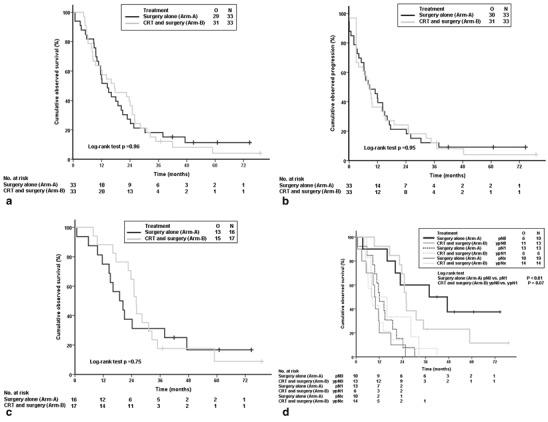
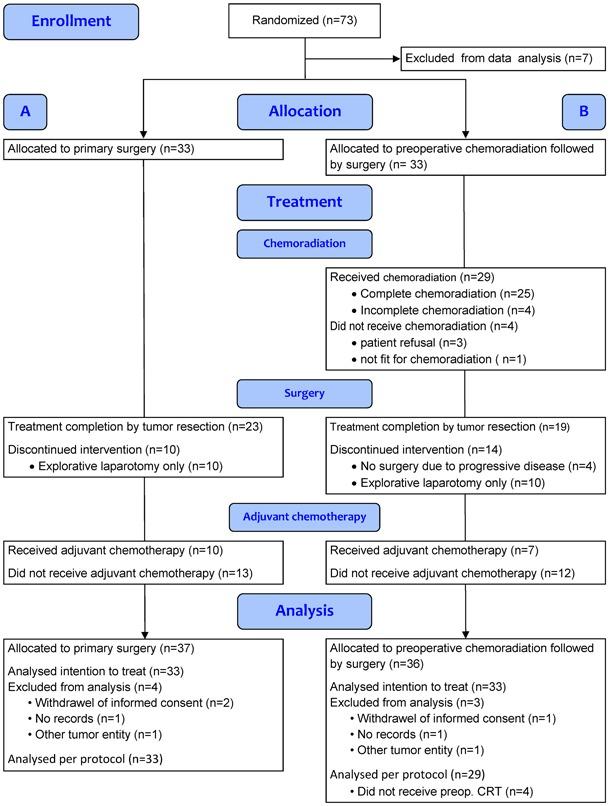
The trial was stopped after 73 patients; 66 patients were eligible for analysis. Twenty nine of 33 allocated patients received chemoradiotherapy. Radiotherapy was completed in all patients. Chemotherapy was changed in 3 patients due to toxicity. Tumor resection was performed in 23 vs. 19 patients (A vs. B). The R0 resection rate was 48% (A) and 52% (B, P = 0.81) and (y)pN0 was 30% (A) vs. 39% (B, P = 0.44), respectively. Postoperative complications were comparable in both groups. mOS was 14.4 vs. 17.4 months (A vs. B; intention-to-treat analysis; P = 0.96). After tumor resection, mOS was 18.9 vs. 25.0 months (A vs. B; P = 0.79).
CONCLUSION
This worldwide first randomized trial for neoadjuvant chemoradiotherapy in pancreatic cancer showed that neoadjuvant chemoradiation is safe with respect to toxicity, perioperative morbidity, and mortality. Nevertheless, the trial was terminated early due to slow recruiting and the results were not significant. ISRCTN78805636; NCT00335543.
背景
在非随机试验中,有报道称新辅助治疗可延长胰腺癌患者的生存期。由于新辅助放化疗已被确立用于直肠癌的治疗,我们在一项随机II期试验中研究了新辅助放化疗在胰腺癌中的价值。与基于病理分期的辅助治疗试验不同,确定可切除性的放射学分期是随机分组前的基本信息。
患者与方法
可切除的胰头腺癌患者被随机分为接受一期手术(A组)或新辅助放化疗后再手术(B组),两组术后均接受辅助化疗。共需要254例患者来检测中位总生存期(mOS)有4.33个月的改善。
结果
在纳入73例患者后试验停止;66例患者符合分析条件。33例被分配的患者中有29例接受了放化疗。所有患者均完成了放疗。3例患者因毒性反应更换了化疗方案。A组和B组分别有23例和19例患者接受了肿瘤切除。R0切除率分别为48%(A组)和52%(B组,P = 0.81),(y)pN0分别为30%(A组)和39%(B组,P = 0.44)。两组术后并发症相当。意向性分析显示,mOS分别为14.4个月和17.4个月(A组 vs. B组;P = 0.96)。肿瘤切除术后,mOS分别为18.9个月和25.0个月(A组 vs. B组;P = 0.79)。
结论
这项全球首个针对胰腺癌新辅助放化疗的随机试验表明,新辅助放化疗在毒性、围手术期发病率和死亡率方面是安全的。然而,由于入组缓慢,该试验提前终止,结果无统计学意义。国际标准随机对照试验编号:ISRCTN78805636;美国国立医学图书馆临床试验注册编号:NCT00335543。
 Zotero 插件