
在哮喘小鼠模型中,肺树突状细胞向促2型辅助性T细胞表型发生成熟和极化:神经生长因子的作用
Lung dendritic cells undergo maturation and polarization towards a T helper type 2-stimulating phenotype in a mouse model of asthma: Role of nerve growth factor.
作者信息
Qin Qingwu, Wang Zhan, Pan Pinhua, Cao Zu, Xia Qing, Tan Hongyi, Hu Chengping
机构信息
Department of Respiratory Medicine, Xiangya Hospital, Central South University, Changsha, Hunan 410008, P.R. China.
Department of Respiratory Medicine, Xiangya Hospital, Central South University, Changsha, Hunan 410008, P.R. China ; Bronchial Asthma Research Center of Hunan Province, Changsha, Hunan 410008, P.R. China.
出版信息
Exp Ther Med. 2014 Nov;8(5):1402-1408. doi: 10.3892/etm.2014.1967. Epub 2014 Sep 15.
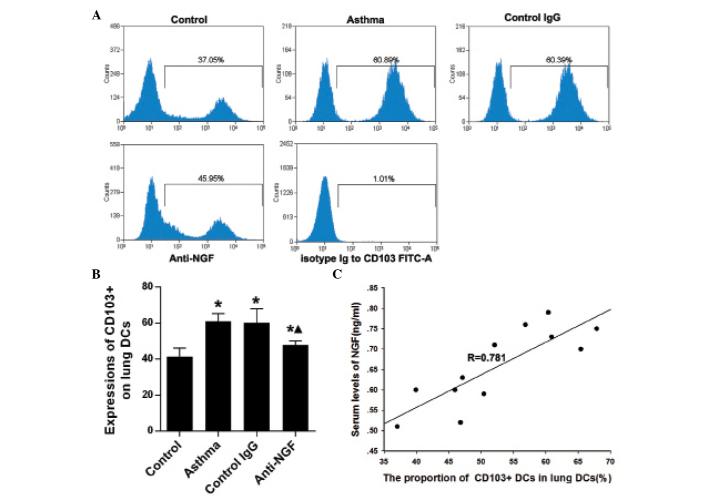
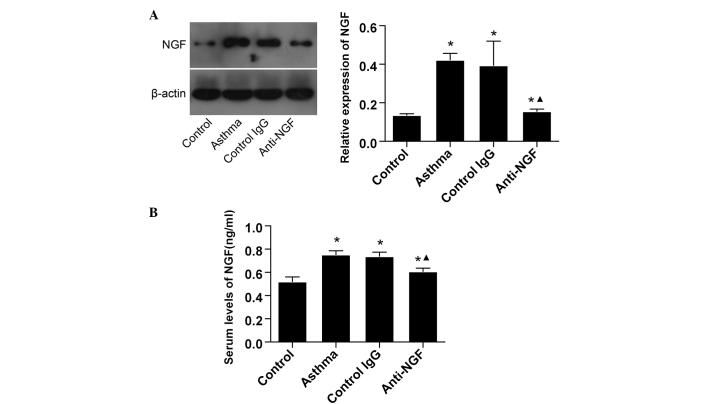
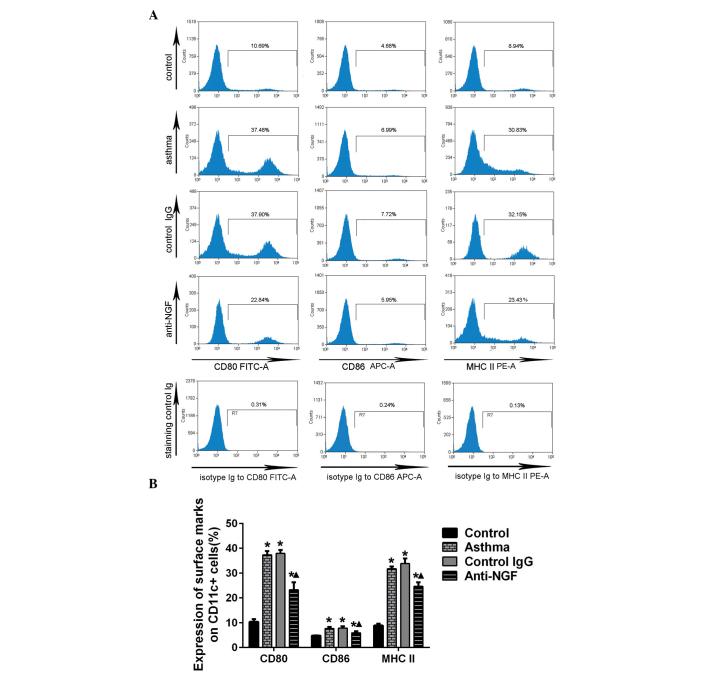
Nerve growth factor (NGF) and dendritic cells (DCs) have been hypothesized to modulate T cell responses in a mouse model of asthma. However, whether NGF plays a role in regulating the maturation and polarization of lung DCs remains unclear. In the present study, the effect of NGF inhibition on the maturation and phenotype of lung DCs was investigated in a mouse model of asthma. BALB/c mice were sensitized and challenged with ovalbumin (OVA), and subsequently received anti-NGF treatment. At 24 h following the last challenge, airway responsiveness and inflammation were examined. The concentrations of NGF, interferon (IFN)-γ and interleukin (IL)-4 were analyzed. In addition, maturation and CD103 expression in the lung DCs were investigated. Anti-NGF treatment was found to significantly reduce airway hyperreactivity and inflammation in asthmatic mice. In addition, a subdued T helper 2 (Th2) response was observed, characterized by the downregulation of IL-4 and the upregulation of IFN-γ. Furthermore, the expression of the DC surface molecules, CD80, CD86 and major histocompatibility complex class II, as well as the proportion of lung CD103 DCs, decreased in the OVA-sensitized and challenged mice. The proportion of lung CD103 DCs also exhibited a positive correlation with the levels of plasma NGF in the mice. These results may provide an explanation for the role of NGF in amplifying the Th2 response in allergic diseases. Therefore, NGF may promote the maturation and polarization towards a Th2-stimulating phenotype of activated DCs, contributing to an amplification of the Th2 response in asthma.
在哮喘小鼠模型中,神经生长因子(NGF)和树突状细胞(DCs)被认为可调节T细胞反应。然而,NGF是否在调节肺DCs的成熟和极化中发挥作用仍不清楚。在本研究中,在哮喘小鼠模型中研究了NGF抑制对肺DCs成熟和表型的影响。用卵清蛋白(OVA)对BALB/c小鼠进行致敏和激发,随后给予抗NGF治疗。在最后一次激发后24小时,检测气道反应性和炎症。分析NGF、干扰素(IFN)-γ和白细胞介素(IL)-4的浓度。此外,研究了肺DCs中的成熟情况和CD103表达。发现抗NGF治疗可显著降低哮喘小鼠的气道高反应性和炎症。此外,观察到T辅助2(Th2)反应减弱,其特征为IL-4下调和IFN-γ上调。此外,在OVA致敏和激发的小鼠中,DC表面分子CD80、CD86和主要组织相容性复合体II类的表达以及肺CD103 DCs的比例降低。肺CD103 DCs的比例也与小鼠血浆NGF水平呈正相关。这些结果可能为NGF在过敏性疾病中放大Th2反应的作用提供解释。因此,NGF可能促进活化DCs向刺激Th2的表型成熟和极化,导致哮喘中Th2反应放大。

 Zotero 插件