
鱼类性别决定的遗传结构:在水产养殖中控制性别比例的应用。
Genetic architecture of sex determination in fish: applications to sex ratio control in aquaculture.
机构信息
Departamento de Genética, Facultad de Veterinaria, Universidad de Santiago de Compostela Lugo, Spain.
Departamento de Genética, Facultad de Biología, Universidad de Santiago de Compostela Santiago de Compostela, Spain.
出版信息
Front Genet. 2014 Sep 29;5:340. doi: 10.3389/fgene.2014.00340. eCollection 2014.
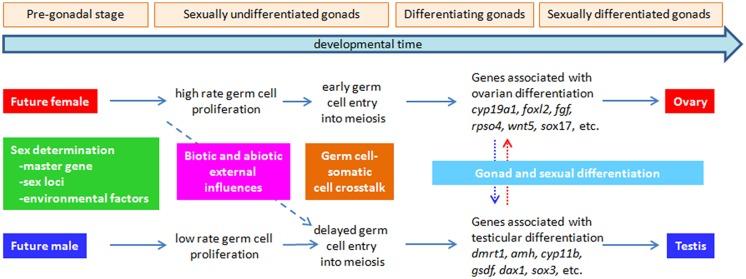
Controlling the sex ratio is essential in finfish farming. A balanced sex ratio is usually good for broodstock management, since it enables to develop appropriate breeding schemes. However, in some species the production of monosex populations is desirable because the existence of sexual dimorphism, primarily in growth or first time of sexual maturation, but also in color or shape, can render one sex more valuable. The knowledge of the genetic architecture of sex determination (SD) is convenient for controlling sex ratio and for the implementation of breeding programs. Unlike mammals and birds, which show highly conserved master genes that control a conserved genetic network responsible for gonad differentiation (GD), a huge diversity of SD mechanisms has been reported in fish. Despite theory predictions, more than one gene is in many cases involved in fish SD and genetic differences have been observed in the GD network. Environmental factors also play a relevant role and epigenetic mechanisms are becoming increasingly recognized for the establishment and maintenance of the GD pathways. Although major genetic factors are frequently involved in fish SD, these observations strongly suggest that SD in this group resembles a complex trait. Accordingly, the application of quantitative genetics combined with genomic tools is desirable to address its study and in fact, when applied, it has frequently demonstrated a multigene trait interacting with environmental factors in model and cultured fish species. This scenario has notable implications for aquaculture and, depending upon the species, from chromosome manipulation or environmental control techniques up to classical selection or marker assisted selection programs, are being applied. In this review, we selected four relevant species or fish groups to illustrate this diversity and hence the technologies that can be used by the industry for the control of sex ratio: turbot and European sea bass, two reference species of the European aquaculture, and salmonids and tilapia, representing the fish for which there are well established breeding programs.
控制鱼类的性别比例对于鱼类养殖至关重要。平衡的性别比例通常有利于亲鱼管理,因为它可以制定适当的繁殖计划。然而,在某些物种中,生产单性种群是可取的,因为存在性二态性,主要表现在生长或第一次性成熟方面,但也表现在颜色或形状方面,使得一种性别更有价值。了解性别决定(SD)的遗传结构对于控制性别比例和实施繁殖计划非常方便。与哺乳动物和鸟类不同,它们显示出高度保守的主基因,控制着一个保守的遗传网络,负责性腺分化(GD),鱼类中已经报道了大量不同的 SD 机制。尽管有理论预测,但在许多情况下,超过一个基因参与鱼类 SD,并且在 GD 网络中观察到遗传差异。环境因素也起着重要的作用,并且表观遗传机制在 GD 途径的建立和维持中越来越受到认可。尽管主要的遗传因素经常参与鱼类 SD,但这些观察结果强烈表明,鱼类的 SD 类似于复杂的特征。因此,结合基因组工具应用数量遗传学是研究鱼类 SD 的理想选择,事实上,当应用于鱼类时,它经常证明是一个多基因特征,与环境因素相互作用,在模型和养殖鱼类中得到了证实。这种情况对水产养殖具有显著影响,并且根据物种的不同,从染色体操作或环境控制技术到经典选择或标记辅助选择计划,都可以应用。在这篇综述中,我们选择了四个相关的物种或鱼类群体来说明这种多样性,以及行业可以用来控制性别比例的技术:大菱鲆和欧洲鲈鱼,这是欧洲水产养殖的两个参考物种,以及鲑鱼和罗非鱼,代表着已经建立了良好繁殖计划的鱼类。


 Zotero 插件