
在东非,主要疟疾媒介嗜人按蚊对拟除虫菊酯和滴滴涕的广泛抗性是由代谢抗性机制驱动的。
Widespread pyrethroid and DDT resistance in the major malaria vector Anopheles funestus in East Africa is driven by metabolic resistance mechanisms.
作者信息
Mulamba Charles, Riveron Jacob M, Ibrahim Sulaiman S, Irving Helen, Barnes Kayla G, Mukwaya Louis G, Birungi Josephine, Wondji Charles S
机构信息
Vector Biology Department, Liverpool School of Tropical Medicine, Pembroke Place, Liverpool, United Kingdom; Uganda Virus Research Institute, Entebbe, Uganda.
Vector Biology Department, Liverpool School of Tropical Medicine, Pembroke Place, Liverpool, United Kingdom.
出版信息
PLoS One. 2014 Oct 15;9(10):e110058. doi: 10.1371/journal.pone.0110058. eCollection 2014.
BACKGROUND
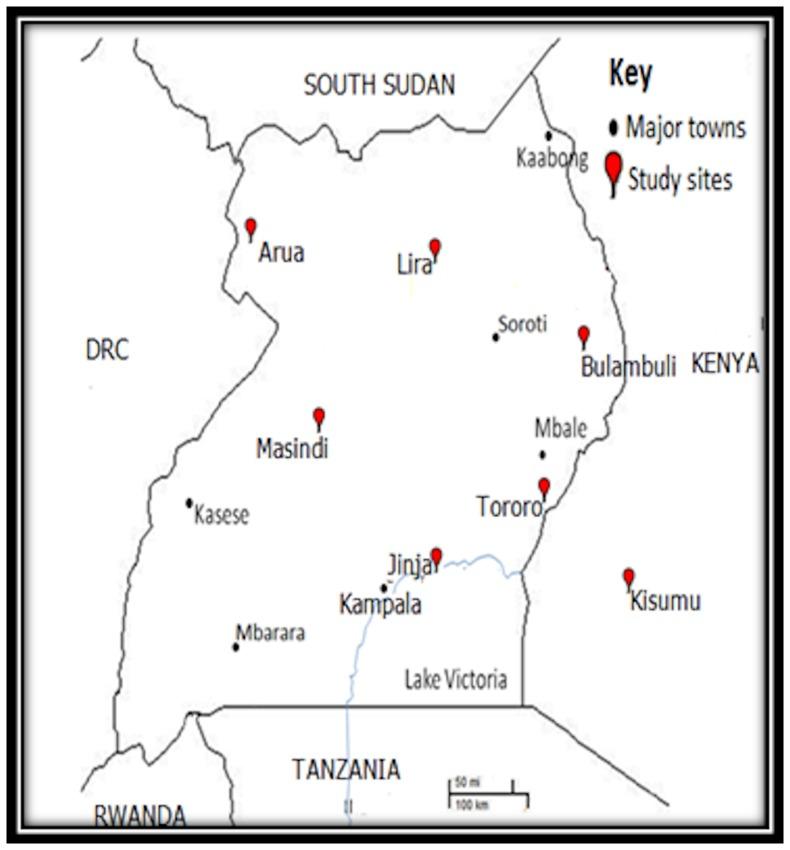
Establishing the extent, geographical distribution and mechanisms of insecticide resistance in malaria vectors is a prerequisite for resistance management. Here, we report a widespread distribution of insecticide resistance in the major malaria vector An. funestus across Uganda and western Kenya under the control of metabolic resistance mechanisms.
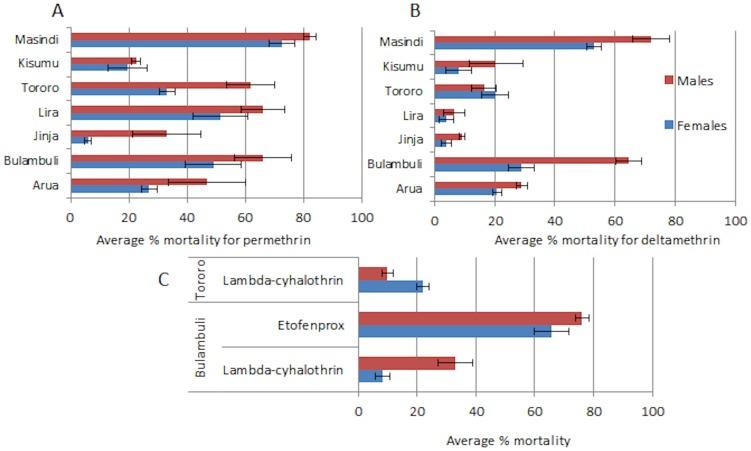
METHODOLOGY/PRINCIPAL FINDINGS: Female An. funestus collected throughout Uganda and western Kenya exhibited a Plasmodium infection rate between 4.2 to 10.4%. Widespread resistance against both type I (permethrin) and II (deltamethrin) pyrethroids and DDT was observed across Uganda and western Kenya. All populations remain highly susceptible to carbamate, organophosphate and dieldrin insecticides. Knockdown resistance plays no role in the pyrethroid and DDT resistance as no kdr mutation associated with resistance was detected despite the presence of a F1021C replacement. Additionally, no signature of selection was observed on the sodium channel gene. Synergist assays and qRT-PCR indicated that metabolic resistance plays a major role notably through elevated expression of cytochrome P450s. DDT resistance mechanisms differ from West Africa as the L119F-GSTe2 mutation only explains a small proportion of the genetic variance to DDT resistance.
CONCLUSION
The extensive distribution of pyrethroid and DDT resistance in East African An. funestus populations represents a challenge to the control of this vector. However, the observed carbamate and organophosphate susceptibility offers alternative solutions for resistance management.
背景
确定疟疾媒介中杀虫剂抗性的程度、地理分布和机制是抗性管理的先决条件。在此,我们报告了在代谢抗性机制控制下,主要疟疾媒介斯氏按蚊在乌干达和肯尼亚西部对杀虫剂抗性的广泛分布情况。
方法/主要发现:在乌干达和肯尼亚西部各地采集的雌性斯氏按蚊的疟原虫感染率在4.2%至10.4%之间。在乌干达和肯尼亚西部观察到对I型(氯菊酯)和II型(溴氰菊酯)拟除虫菊酯以及滴滴涕均存在广泛抗性。所有种群对氨基甲酸酯类、有机磷类和狄氏剂杀虫剂仍高度敏感。击倒抗性在拟除虫菊酯和滴滴涕抗性中不起作用,因为尽管存在F1021C替换,但未检测到与抗性相关的kdr突变。此外,在钠通道基因上未观察到选择特征。增效剂试验和定量逆转录聚合酶链反应表明,代谢抗性起主要作用,尤其是通过细胞色素P450s的表达升高。滴滴涕抗性机制与西非不同,因为L119F - GSTe2突变仅解释了滴滴涕抗性遗传变异的一小部分。
结论
东非斯氏按蚊种群中拟除虫菊酯和滴滴涕抗性的广泛分布对该媒介的控制构成挑战。然而,观察到的对氨基甲酸酯类和有机磷类的敏感性为抗性管理提供了替代解决方案。



 Zotero 插件