
系统评价中的标题和摘要筛选与评估(TASER):医学生进行标题和摘要筛选的一项随机对照试验试点研究
Title and Abstract Screening and Evaluation in Systematic Reviews (TASER): a pilot randomised controlled trial of title and abstract screening by medical students.
作者信息
Ng Lauren, Pitt Veronica, Huckvale Kit, Clavisi Ornella, Turner Tari, Gruen Russell, Elliott Julian H
机构信息
Department of Infectious Diseases, Alfred Hospital and Monash University, 2nd Floor, Burnet Tower, Alfred Hospital, Commercial Road, Melbourne, VIC 3004, Australia.
出版信息
Syst Rev. 2014 Oct 21;3:121. doi: 10.1186/2046-4053-3-121.
BACKGROUND
The production of high quality systematic reviews requires rigorous methods that are time-consuming and resource intensive. Citation screening is a key step in the systematic review process. An opportunity to improve the efficiency of systematic review production involves the use of non-expert groups and new technologies for citation screening. We performed a pilot study of citation screening by medical students using four screening methods and compared students' performance to experienced review authors.
METHODS
The aims of this pilot randomised controlled trial were to provide preliminary data on the accuracy of title and abstract screening by medical students, and on the effect of screening modality on screening accuracy and efficiency. Medical students were randomly allocated to title and abstract screening using one of the four modalities and required to screen 650 citations from a single systematic review update. The four screening modalities were a reference management software program (EndNote), Paper, a web-based systematic review workflow platform (ReGroup) and a mobile screening application (Screen2Go). Screening sensitivity and specificity were analysed in a complete case analysis using a chi-squared test and Kruskal-Wallis rank sum test according to screening modality and compared to a final set of included citations selected by expert review authors.
RESULTS
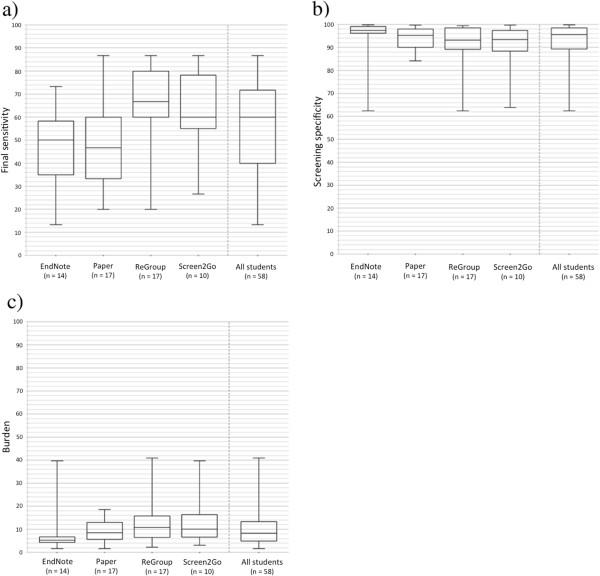
Sensitivity of medical students' screening decisions ranged from 46.7% to 66.7%, with students using the web-based platform performing significantly better than the paper-based group. Specificity ranged from 93.2% to 97.4% with the lowest specificity seen with the web-based platform. There was no significant difference in performance between the other three modalities.
CONCLUSIONS
Medical students are a feasible population to engage in citation screening. Future studies should investigate the effect of incentive systems, training and support and analytical methods on screening performance.
SYSTEMATIC REVIEW REGISTRATION
Cochrane Database CD001048.
背景
高质量系统评价的制作需要严谨的方法,这既耗时又耗费资源。文献筛选是系统评价过程中的关键步骤。提高系统评价制作效率的一个机会在于利用非专业群体和新技术进行文献筛选。我们开展了一项试点研究,让医学生使用四种筛选方法进行文献筛选,并将学生的表现与经验丰富的评价作者进行比较。
方法
这项试点随机对照试验的目的是提供关于医学生进行标题和摘要筛选准确性的初步数据,以及筛选方式对筛选准确性和效率的影响。医学生被随机分配使用四种方式之一进行标题和摘要筛选,并要求从单个系统评价更新中筛选650篇文献。这四种筛选方式分别是一款文献管理软件程序(EndNote)、纸质版、一个基于网络的系统评价工作流程平台(ReGroup)和一个移动筛选应用程序(Screen2Go)。在完整病例分析中,根据筛选方式,使用卡方检验和Kruskal-Wallis秩和检验分析筛选敏感性和特异性,并与专家评价作者最终选定的一组纳入文献进行比较。
结果
医学生筛选决策的敏感性在46.7%至66.7%之间,使用基于网络平台的学生表现明显优于纸质版组。特异性在93.2%至97.4%之间,基于网络平台的特异性最低。其他三种方式的表现没有显著差异。
结论
医学生是参与文献筛选的可行人群。未来的研究应调查激励系统、培训与支持以及分析方法对筛选表现的影响。
系统评价注册
Cochrane数据库CD001048。


 Zotero 插件