
血浆可溶性ST2在住院中国心力衰竭患者中的预后价值。
The prognostic value of plasma soluble ST2 in hospitalized Chinese patients with heart failure.
作者信息
Zhang Rongcheng, Zhang Yuhui, Zhang Jian, An Tao, Huang Yan, Guo Xiao, Januzzi James L, Cappola Thomas P, Yin Shijie, Wang Yunhong, Zhou Qiong, Zou Changhong, Ji Shiming, Lv Rong
机构信息
State Key Laboratory of Cardiovascular Disease, Heart Failure Center Fuwai Hospital, National Center for Cardiovascular Diseases, Chinese Academy of Medical Sciences and Peking Union Medical College, Beijing, China.
Division of Cardiology, Massachusetts General Hospital, Boston, Massachusetts, United States of America.
出版信息
PLoS One. 2014 Oct 27;9(10):e110976. doi: 10.1371/journal.pone.0110976. eCollection 2014.
BACKGROUND
sST2 has been shown to be a risk predictor in heart failure (HF). Our aim was to explore the characteristics and prognostic value of soluble ST2 (sST2) in hospitalized Chinese patients with HF.
METHODS AND RESULTS
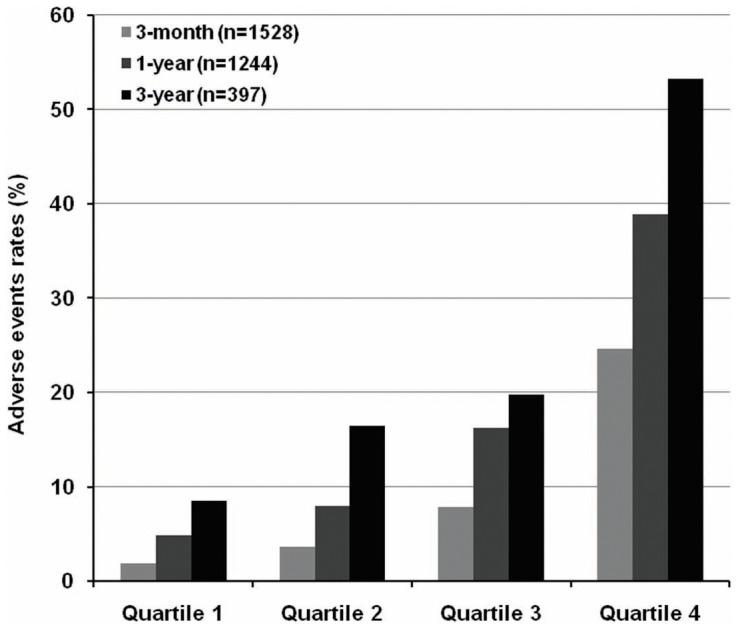
We consecutively enrolled 1528 hospitalized patients with HF. Receiver operating characteristic (ROC) and multivariable Cox proportional hazards analysis were used to assess the prognostic values of sST2. Adverse events were defined as all-cause death and cardiac transplantation. During a median follow-up of 19.1 months, 325 patients experienced adverse events. Compared with patients free of events, sST2 concentrations were significantly higher in patients with events (P<0.001). Univariable and multivariable Cox regression analyses showed sST2 concentrations were significantly associated with adverse events (per 1 log unit, adjusted hazard ratio 1.52, 95% confidence interval: 1.30 to 1.78, P<0.001). An sST2 concentration in the highest quartiles (>55.6 ng/mL) independently predicted events in comparison to the lowest quartile (≤25.2 ng/mL) when adjusted by multivariable model. In ROC analysis, the area under the curve for sST2 was not different from that for NT-proBNP in short and longer term. Over time, sST2 also improved discrimination and reclassification of risk beyond NT-proBNP.
CONCLUSIONS
sST2 is a strong independent risk predictor in Chinese patients hospitalized with HF and can significantly provide additional prognostic value to NT-proBNP in risk prediction.
背景
可溶性ST2(sST2)已被证明是心力衰竭(HF)的风险预测指标。我们的目的是探讨可溶性ST2(sST2)在中国住院HF患者中的特征及预后价值。
方法与结果
我们连续纳入了1528例住院HF患者。采用受试者工作特征(ROC)曲线及多变量Cox比例风险分析评估sST2的预后价值。不良事件定义为全因死亡和心脏移植。在中位随访19.1个月期间,325例患者发生不良事件。与未发生事件的患者相比,发生事件的患者sST2浓度显著更高(P<0.001)。单变量和多变量Cox回归分析显示,sST2浓度与不良事件显著相关(每增加1个对数单位,调整后的风险比为1.52,95%置信区间:1.30至1.78,P<0.001)。经多变量模型调整后,与最低四分位数(≤25.2 ng/mL)相比,最高四分位数(>55.6 ng/mL)的sST2浓度可独立预测事件。在ROC分析中,sST2的短期和长期曲线下面积与N末端B型利钠肽原(NT-proBNP)的曲线下面积无差异。随着时间推移,sST2在风险预测方面对NT-proBNP的判别能力及重新分类能力也有所提高。
结论
sST2是中国住院HF患者强有力的独立风险预测指标,在风险预测方面能显著为NT-proBNP提供额外的预后价值。



 Zotero 插件