
系统发育似然库。
The phylogenetic likelihood library.
作者信息
Flouri T, Izquierdo-Carrasco F, Darriba D, Aberer A J, Nguyen L-T, Minh B Q, Von Haeseler A, Stamatakis A
机构信息
Heidelberg Institute for Theoretical Studies, Heidelberg Institute, 69118 Heidelberg, Germany; Center for Integrative Bioinformatics Vienna, Max F. Perutz Laboratories, University of Vienna, Medical University of Vienna, A-1030 Vienna, Austria; Bioinformatics and Computational Biology, Faculty of Computer Science, University of Vienna, A-1090 Vienna, Austria; and Karlsruhe Institute of Technology, Institute for Theoretical Informatics, Postfach 6980, 76128 Karlsruhe, Germany;
Heidelberg Institute for Theoretical Studies, Heidelberg Institute, 69118 Heidelberg, Germany; Center for Integrative Bioinformatics Vienna, Max F. Perutz Laboratories, University of Vienna, Medical University of Vienna, A-1030 Vienna, Austria; Bioinformatics and Computational Biology, Faculty of Computer Science, University of Vienna, A-1090 Vienna, Austria; and Karlsruhe Institute of Technology, Institute for Theoretical Informatics, Postfach 6980, 76128 Karlsruhe, Germany; Heidelberg Institute for Theoretical Studies, Heidelberg Institute, 69118 Heidelberg, Germany; Center for Integrative Bioinformatics Vienna, Max F. Perutz Laboratories, University of Vienna, Medical University of Vienna, A-1030 Vienna, Austria; Bioinformatics and Computational Biology, Faculty of Computer Science, University of Vienna, A-1090 Vienna, Austria; and Karlsruhe Institute of Technology, Institute for Theoretical Informatics, Postfach 6980, 76128 Karlsruhe, Germany;
出版信息
Syst Biol. 2015 Mar;64(2):356-62. doi: 10.1093/sysbio/syu084. Epub 2014 Oct 30.
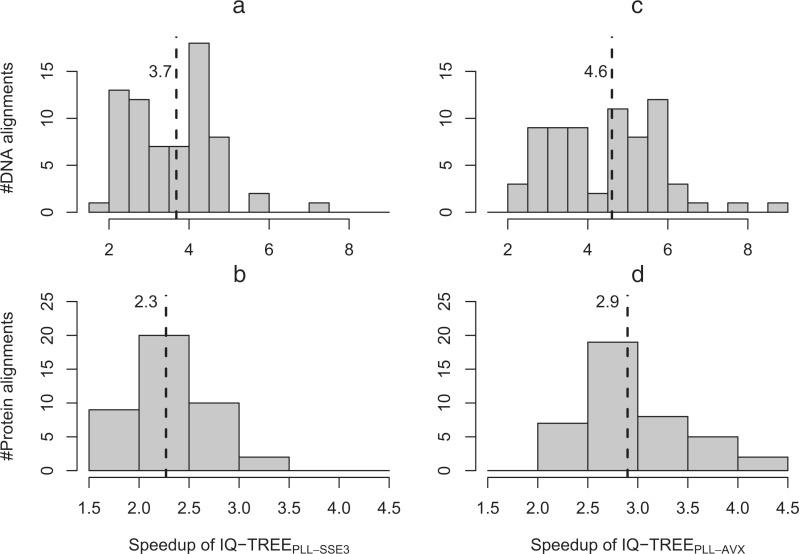
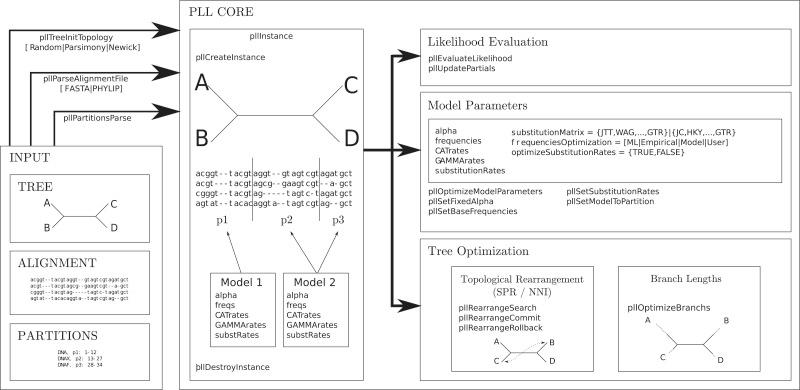
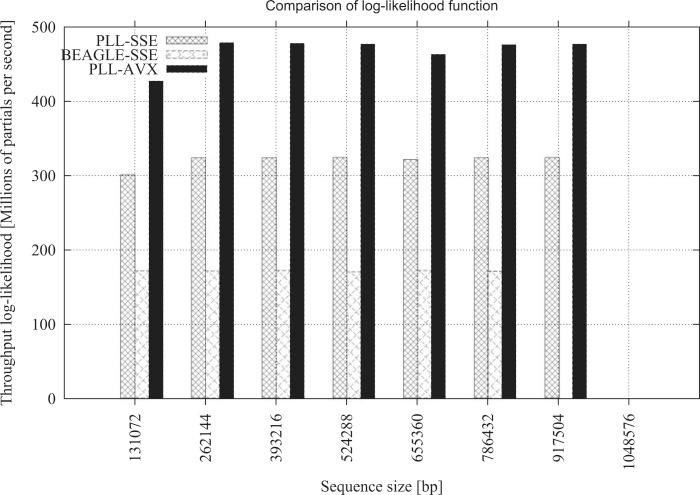
We introduce the Phylogenetic Likelihood Library (PLL), a highly optimized application programming interface for developing likelihood-based phylogenetic inference and postanalysis software. The PLL implements appropriate data structures and functions that allow users to quickly implement common, error-prone, and labor-intensive tasks, such as likelihood calculations, model parameter as well as branch length optimization, and tree space exploration. The highly optimized and parallelized implementation of the phylogenetic likelihood function and a thorough documentation provide a framework for rapid development of scalable parallel phylogenetic software. By example of two likelihood-based phylogenetic codes we show that the PLL improves the sequential performance of current software by a factor of 2-10 while requiring only 1 month of programming time for integration. We show that, when numerical scaling for preventing floating point underflow is enabled, the double precision likelihood calculations in the PLL are up to 1.9 times faster than those in BEAGLE. On an empirical DNA dataset with 2000 taxa the AVX version of PLL is 4 times faster than BEAGLE (scaling enabled and required). The PLL is available at http://www.libpll.org under the GNU General Public License (GPL).
我们引入了系统发育似然库(PLL),这是一个经过高度优化的应用程序编程接口,用于开发基于似然的系统发育推断和后分析软件。PLL实现了适当的数据结构和函数,使用户能够快速实现常见、容易出错且耗费人力的任务,比如似然计算、模型参数以及分支长度优化,还有树空间探索。系统发育似然函数的高度优化和并行化实现以及详尽的文档为快速开发可扩展的并行系统发育软件提供了一个框架。通过两个基于似然的系统发育代码示例,我们表明PLL将当前软件的顺序性能提高了2到10倍,而集成只需1个月的编程时间。我们还表明,当启用防止浮点下溢的数值缩放时,PLL中的双精度似然计算比BEAGLE中的快1.9倍。在一个有2000个分类单元的经验性DNA数据集上,PLL的AVX版本比BEAGLE快4倍(启用并需要缩放)。PLL可在http://www.libpll.org上获取,遵循GNU通用公共许可证(GPL)。
 Zotero 插件