
携带EML4-ALK融合基因的非小细胞肺癌患者的临床病理特征:一项荟萃分析。
Clinicopathologic features of patients with non-small cell lung cancer harboring the EML4-ALK fusion gene: a meta-analysis.
作者信息
Wang Ying, Wang Shumin, Xu Shiguang, Qu Jiaqi, Liu Bo
机构信息
Department of Pathology, Shenyang Medical College, Shenyang, Liaoning, People's Republic of China.
Thoracic Department, General Hospital of Shenyang Military Area Command, Shenyang, Liaoning, People's Republic of China.
出版信息
PLoS One. 2014 Oct 31;9(10):e110617. doi: 10.1371/journal.pone.0110617. eCollection 2014.
BACKGROUND
The frequencies of EML4-ALK fusion gene in non-small cell lung cancer (NSCLC) with different clinicopathologic features described by previous studies are inconsistent. The key demographic and pathologic features associated with EML4-ALK fusion gene have not been definitively established. This meta-analysis was conducted to compare the frequency of the EML4-ALK fusion gene in patients with different clinicopathologic features and to identify an enriched population of patients with NSCLC harboring EML4-ALK fusion gene.
METHODS
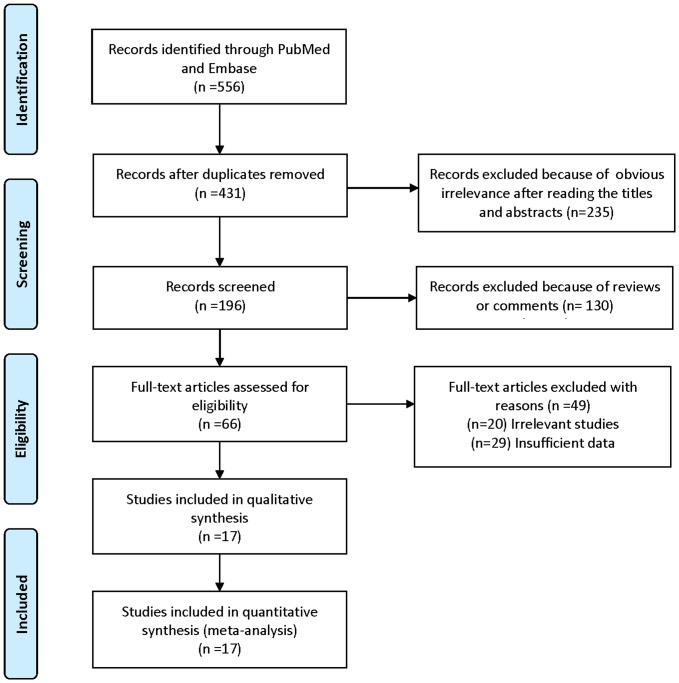
The Pubmed and Embase databases for all studies on EML4-ALK fusion gene in NSCLC patients were searched up to July 2014. A criteria list and exclusion criteria were established to screen the studies. The frequency of the EML4-ALK fusion gene and the clinicopathologic features, including smoking status, pathologic type, gender, and EGFR status were abstracted.
RESULTS
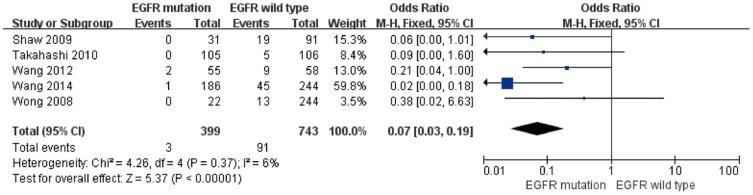
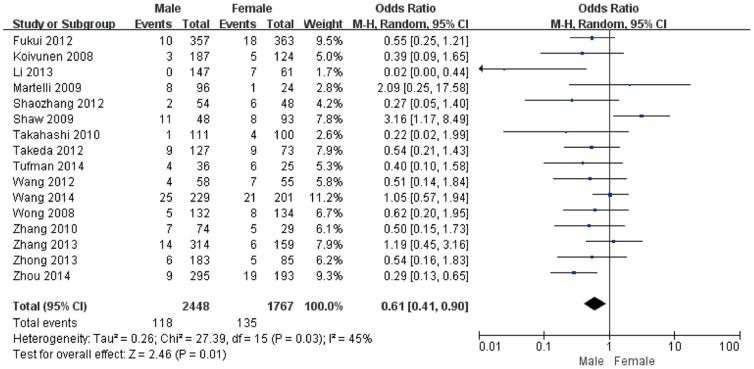
Seventeen articles consisting of 4511 NSCLC cases were included in this meta-analysis. A significant lower EML4-ALK fusion gene positive rate was associated with smokers (pooled OR = 0.40, 95% CI = 0.30-0.54, P<0.00001). A significantly higher EML4-ALK fusion gene positivity rate was associated with adenocarcinomas (pooled OR = 2.53, 95% CI = 1.66-3.86, P<0.0001) and female (pooled OR = 0.61, 95% CI = 0.41-0.90, P = 0.01). We found that a significantly lower EML4-ALK fusion gene positivity rate was associated with EGFR mutation (pooled OR = 0.07, 95% CI = 0.03-0.19, P<0.00001). No publication bias was observed in any meta-analysis (all P value of Egger's test >0.05); however, because of the small sample size, no results were in the meta-analysis regarding EGFR gene status.
CONCLUSION
This meta-analysis revealed that the EML4-ALK fusion gene is highly correlated with a never/light smoking history, female and the pathologic type of adenocarcinoma, and is largely mutually exclusive of EGFR.
背景
既往研究描述的具有不同临床病理特征的非小细胞肺癌(NSCLC)中EML4-ALK融合基因的频率不一致。与EML4-ALK融合基因相关的关键人口统计学和病理学特征尚未明确确立。本荟萃分析旨在比较不同临床病理特征患者中EML4-ALK融合基因的频率,并确定携带EML4-ALK融合基因的NSCLC患者富集人群。
方法
检索截至2014年7月关于NSCLC患者EML4-ALK融合基因的所有研究的Pubmed和Embase数据库。制定纳入标准和排除标准以筛选研究。提取EML4-ALK融合基因的频率以及临床病理特征,包括吸烟状态、病理类型、性别和EGFR状态。
结果
本荟萃分析纳入了17篇文章,共4511例NSCLC病例。吸烟者的EML4-ALK融合基因阳性率显著较低(合并OR = 0.40,95%CI = 0.30 - 0.54,P < 0.00001)。腺癌(合并OR = 2.53,95%CI = 1.66 - 3.86,P < 0.0001)和女性(合并OR = 0.61,95%CI = 0.41 - 0.90,P = 0.01)的EML4-ALK融合基因阳性率显著较高。我们发现EGFR突变与EML4-ALK融合基因阳性率显著较低相关(合并OR = 0.07,95%CI = 0.03 - 0.19,P < 0.00001)。在任何荟萃分析中均未观察到发表偏倚(Egger检验的所有P值>0.05);然而,由于样本量小,荟萃分析中未得出关于EGFR基因状态的结果。
结论
本荟萃分析表明,EML4-ALK融合基因与从不/轻度吸烟史、女性及腺癌病理类型高度相关,且与EGFR在很大程度上相互排斥。


 Zotero 插件