
在自闭症中受到破坏的突触、转录和染色质基因。
Synaptic, transcriptional and chromatin genes disrupted in autism.
作者信息
De Rubeis Silvia, He Xin, Goldberg Arthur P, Poultney Christopher S, Samocha Kaitlin, Cicek A Erucment, Kou Yan, Liu Li, Fromer Menachem, Walker Susan, Singh Tarinder, Klei Lambertus, Kosmicki Jack, Shih-Chen Fu, Aleksic Branko, Biscaldi Monica, Bolton Patrick F, Brownfeld Jessica M, Cai Jinlu, Campbell Nicholas G, Carracedo Angel, Chahrour Maria H, Chiocchetti Andreas G, Coon Hilary, Crawford Emily L, Curran Sarah R, Dawson Geraldine, Duketis Eftichia, Fernandez Bridget A, Gallagher Louise, Geller Evan, Guter Stephen J, Hill R Sean, Ionita-Laza Juliana, Jimenz Gonzalez Patricia, Kilpinen Helena, Klauck Sabine M, Kolevzon Alexander, Lee Irene, Lei Irene, Lei Jing, Lehtimäki Terho, Lin Chiao-Feng, Ma'ayan Avi, Marshall Christian R, McInnes Alison L, Neale Benjamin, Owen Michael J, Ozaki Noriio, Parellada Mara, Parr Jeremy R, Purcell Shaun, Puura Kaija, Rajagopalan Deepthi, Rehnström Karola, Reichenberg Abraham, Sabo Aniko, Sachse Michael, Sanders Stephan J, Schafer Chad, Schulte-Rüther Martin, Skuse David, Stevens Christine, Szatmari Peter, Tammimies Kristiina, Valladares Otto, Voran Annette, Li-San Wang, Weiss Lauren A, Willsey A Jeremy, Yu Timothy W, Yuen Ryan K C, Cook Edwin H, Freitag Christine M, Gill Michael, Hultman Christina M, Lehner Thomas, Palotie Aaarno, Schellenberg Gerard D, Sklar Pamela, State Matthew W, Sutcliffe James S, Walsh Christiopher A, Scherer Stephen W, Zwick Michael E, Barett Jeffrey C, Cutler David J, Roeder Kathryn, Devlin Bernie, Daly Mark J, Buxbaum Joseph D
出版信息
Nature. 2014 Nov 13;515(7526):209-15. doi: 10.1038/nature13772. Epub 2014 Oct 29.
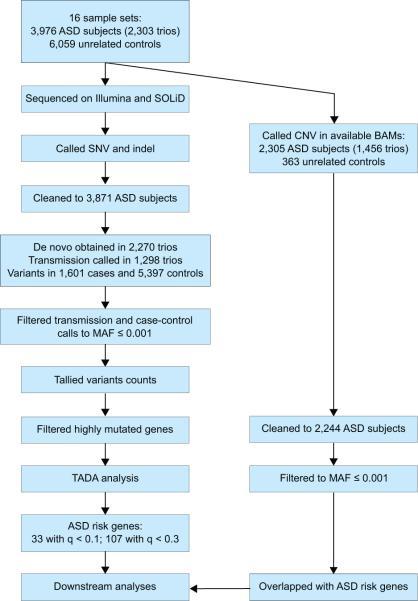
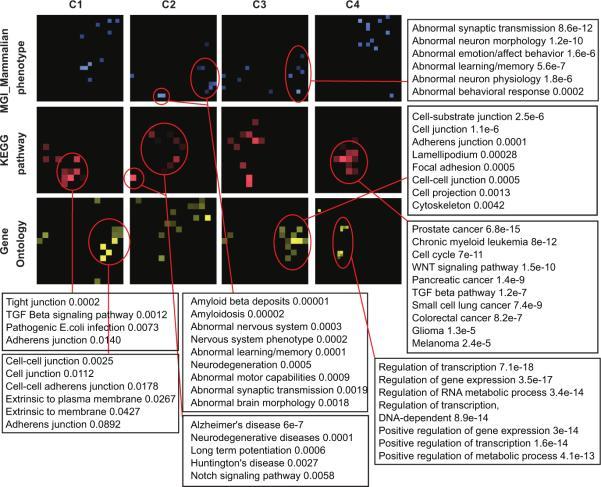
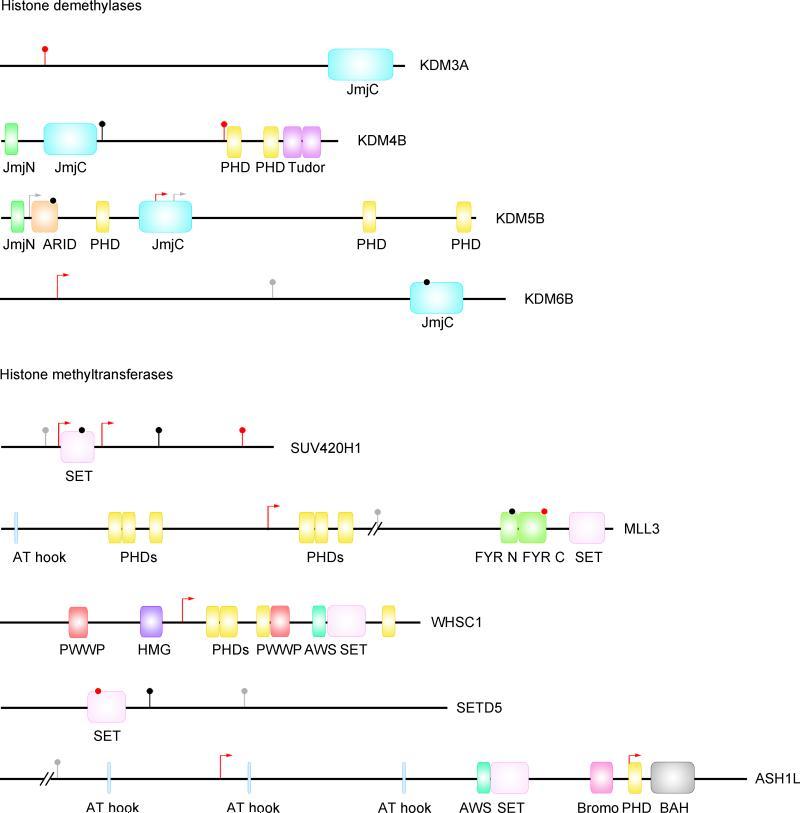
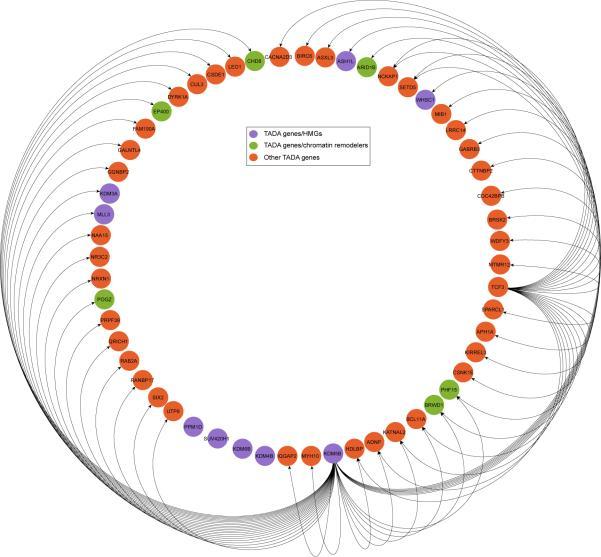
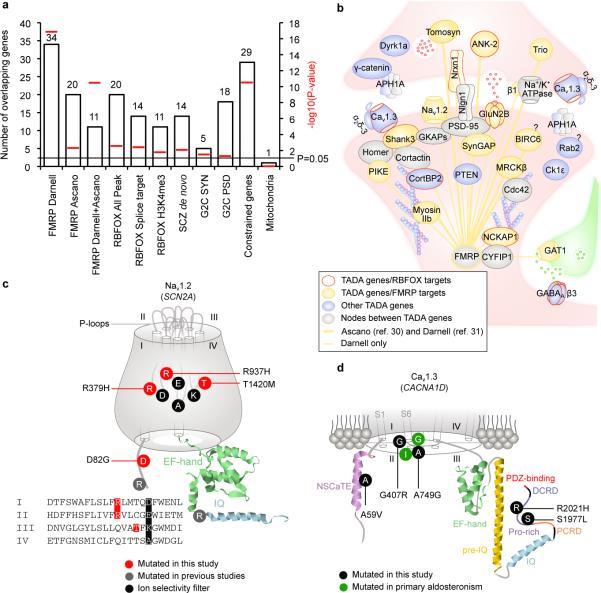
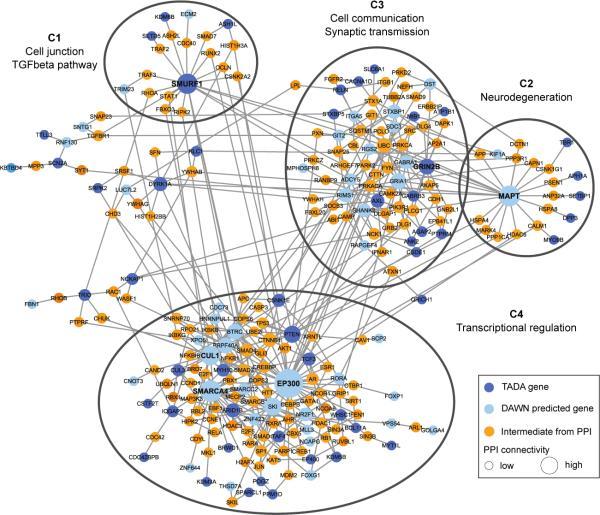
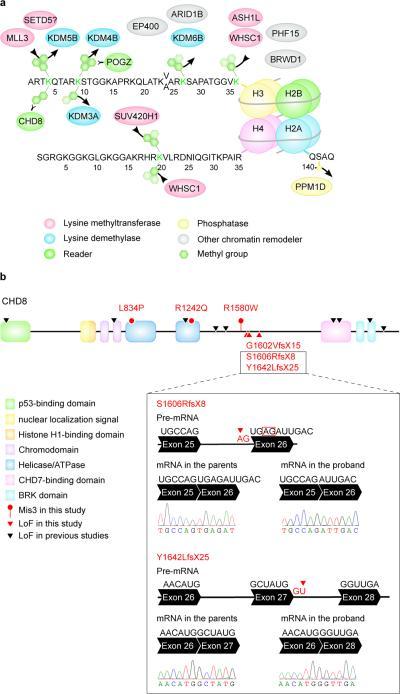
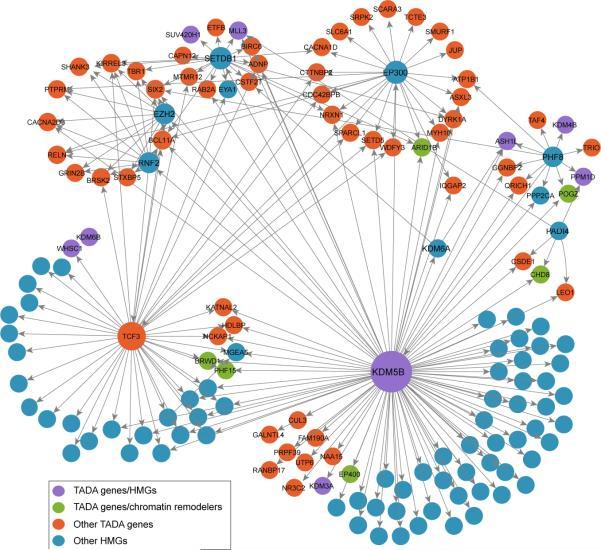
The genetic architecture of autism spectrum disorder involves the interplay of common and rare variants and their impact on hundreds of genes. Using exome sequencing, here we show that analysis of rare coding variation in 3,871 autism cases and 9,937 ancestry-matched or parental controls implicates 22 autosomal genes at a false discovery rate (FDR) < 0.05, plus a set of 107 autosomal genes strongly enriched for those likely to affect risk (FDR < 0.30). These 107 genes, which show unusual evolutionary constraint against mutations, incur de novo loss-of-function mutations in over 5% of autistic subjects. Many of the genes implicated encode proteins for synaptic formation, transcriptional regulation and chromatin-remodelling pathways. These include voltage-gated ion channels regulating the propagation of action potentials, pacemaking and excitability-transcription coupling, as well as histone-modifying enzymes and chromatin remodellers-most prominently those that mediate post-translational lysine methylation/demethylation modifications of histones.
自闭症谱系障碍的遗传结构涉及常见变异和罕见变异的相互作用及其对数百个基因的影响。利用外显子组测序,我们在此表明,对3871例自闭症病例和9937例血统匹配或父母对照中的罕见编码变异进行分析,在错误发现率(FDR)<0.05时涉及22个常染色体基因,另外还有一组107个常染色体基因,这些基因在可能影响风险的基因中高度富集(FDR<0.30)。这107个基因对突变表现出异常的进化限制,在超过5%的自闭症患者中发生新生功能丧失突变。许多涉及的基因编码突触形成、转录调控和染色质重塑途径的蛋白质。这些包括调节动作电位传播、起搏和兴奋性-转录偶联的电压门控离子通道,以及组蛋白修饰酶和染色质重塑因子——最突出的是那些介导组蛋白翻译后赖氨酸甲基化/去甲基化修饰的因子。


 Zotero 插件