
UniPROBE 2015年更新:用于蛋白质 - DNA相互作用的蛋白质结合微阵列数据在线数据库的新工具和内容。
UniPROBE, update 2015: new tools and content for the online database of protein-binding microarray data on protein-DNA interactions.
作者信息
Hume Maxwell A, Barrera Luis A, Gisselbrecht Stephen S, Bulyk Martha L
机构信息
Division of Genetics, Department of Medicine, Brigham and Women's Hospital and Harvard Medical School, Boston, MA 02115, USA Bioinformatics Graduate Program, Northeastern University, Boston, MA 02115, USA.
Division of Genetics, Department of Medicine, Brigham and Women's Hospital and Harvard Medical School, Boston, MA 02115, USA Committee on Higher Degrees in Biophysics, Harvard University, Cambridge, MA 02138, USA Bioinformatics and Integrative Genomics Graduate Program, Harvard-MIT Division of Health Sciences and Technology, Harvard Medical School, Boston, MA 02115, USA.
出版信息
Nucleic Acids Res. 2015 Jan;43(Database issue):D117-22. doi: 10.1093/nar/gku1045. Epub 2014 Nov 5.
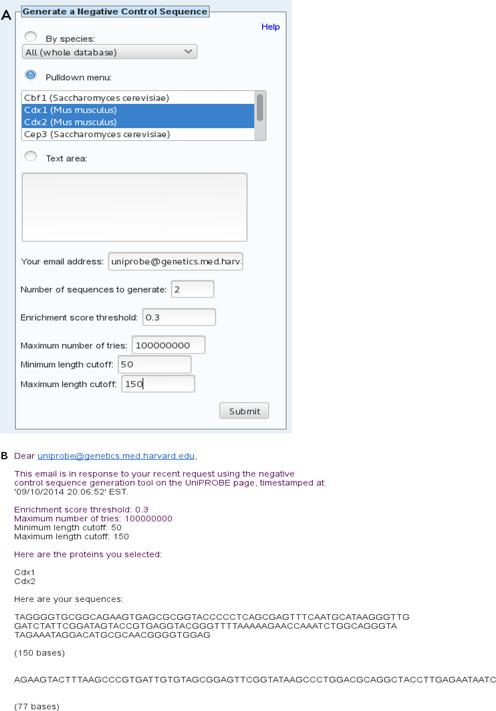
The Universal PBM Resource for Oligonucleotide Binding Evaluation (UniPROBE) serves as a convenient source of information on published data generated using universal protein-binding microarray (PBM) technology, which provides in vitro data about the relative DNA-binding preferences of transcription factors for all possible sequence variants of a length k ('k-mers'). The database displays important information about the proteins and displays their DNA-binding specificity data in terms of k-mers, position weight matrices and graphical sequence logos. This update to the database documents the growth of UniPROBE since the last update 4 years ago, and introduces a variety of new features and tools, including a new streamlined pipeline that facilitates data deposition by universal PBM data generators in the research community, a tool that generates putative nonbinding (i.e. negative control) DNA sequences for one or more proteins and novel motifs obtained by analyzing the PBM data using the BEEML-PBM algorithm for motif inference. The UniPROBE database is available at http://uniprobe.org.
寡核苷酸结合评估通用PBM资源库(UniPROBE)是已发表的使用通用蛋白质结合微阵列(PBM)技术生成的数据的便捷信息来源,该技术提供了转录因子对长度为k的所有可能序列变体(“k聚体”)的相对DNA结合偏好的体外数据。该数据库展示了有关蛋白质的重要信息,并以k聚体、位置权重矩阵和图形序列标识的形式展示其DNA结合特异性数据。本次数据库更新记录了自4年前上次更新以来UniPROBE的发展情况,并引入了多种新功能和工具,包括一种新的简化流程,便于研究界的通用PBM数据生成器进行数据存贮;一种为一种或多种蛋白质生成假定非结合(即阴性对照)DNA序列的工具;以及通过使用用于基序推断的BEEML-PBM算法分析PBM数据获得的新基序。可通过http://uniprobe.org访问UniPROBE数据库。


 Zotero 插件