
针灸系统评价/荟萃分析的报告质量。
Reporting quality of systematic reviews/meta-analyses of acupuncture.
作者信息
Liu Yali, Zhang Rui, Huang Jiao, Zhao Xu, Liu Danlu, Sun Wanting, Mai Yuefen, Zhang Peng, Wang Yajun, Cao Hua, Yang Ke hu
机构信息
Evidence-Based Medicine Center, School of Basic Medical Sciences, Lanzhou University, Lanzhou, China; Key Laboratory of Clinical Translational Research and Evidence-Based Medicine of Gansu Province, Lanzhou, China.
Evidence-Based Medicine Center, School of Basic Medical Sciences, Lanzhou University, Lanzhou, China; The First Clinical Medical College of Lanzhou University, Lanzhou, China.
出版信息
PLoS One. 2014 Nov 14;9(11):e113172. doi: 10.1371/journal.pone.0113172. eCollection 2014.
BACKGROUND
The QUOROM and PRISMA statements were published in 1999 and 2009, respectively, to improve the consistency of reporting systematic reviews (SRs)/meta-analyses (MAs) of clinical trials. However, not all SRs/MAs adhere completely to these important standards. In particular, it is not clear how well SRs/MAs of acupuncture studies adhere to reporting standards and which reporting criteria are generally ignored in these analyses.
OBJECTIVES
To evaluate reporting quality in SRs/MAs of acupuncture studies.
METHODS
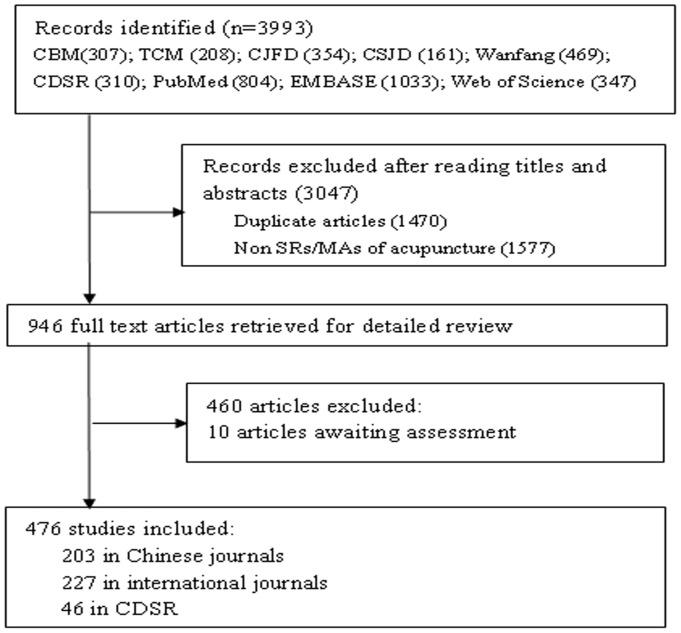
We performed a literature search for studies published prior to 2014 using the following public archives: PubMed, EMBASE, Web of Science, the Cochrane Database of Systematic Reviews (CDSR), the Chinese Biomedical Literature Database (CBM), the Traditional Chinese Medicine (TCM) database, the Chinese Journal Full-text Database (CJFD), the Chinese Scientific Journal Full-text Database (CSJD), and the Wanfang database. Data were extracted into pre-prepared Excel data-extraction forms. Reporting quality was assessed based on the PRISMA checklist (27 items).
RESULTS
Of 476 appropriate SRs/MAs identified in our search, 203, 227, and 46 were published in Chinese journals, international journals, and the Cochrane Database, respectively. In 476 SRs/MAs, only 3 reported the information completely. By contrast, approximately 4.93% (1/203), 8.81% (2/227) and 0.00% (0/46) SRs/Mas reported less than 10 items in Chinese journals, international journals and CDSR, respectively. In general, the least frequently reported items (reported≤50%) in SRs/MAs were "protocol and registration", "risk of bias across studies", and "additional analyses" in both methods and results sections.
CONCLUSIONS
SRs/MAs of acupuncture studies have not comprehensively reported information recommended in the PRISMA statement. Our study underscores that, in addition to focusing on careful study design and performance, attention should be paid to comprehensive reporting standards in SRs/MAs on acupuncture studies.
背景
QUOROM声明和PRISMA声明分别于1999年和2009年发布,旨在提高临床试验系统评价(SRs)/Meta分析(MAs)报告的一致性。然而,并非所有的SRs/MAs都完全遵守这些重要标准。特别是,目前尚不清楚针灸研究的SRs/MAs在多大程度上遵守报告标准,以及在这些分析中哪些报告标准通常被忽视。
目的
评估针灸研究的SRs/MAs的报告质量。
方法
我们使用以下公共数据库对2014年之前发表的研究进行文献检索:PubMed、EMBASE、科学引文索引(Web of Science)、Cochrane系统评价数据库(CDSR)、中国生物医学文献数据库(CBM)、中医药数据库、中国期刊全文数据库(CJFD)、中国科学期刊全文数据库(CSJD)和万方数据库。数据被提取到预先准备好的Excel数据提取表格中。根据PRISMA清单(27项)评估报告质量。
结果
在我们检索到的476篇合适的SRs/MAs中,分别有203篇、227篇和46篇发表在中国期刊、国际期刊和Cochrane数据库中。在476篇SRs/MAs中,只有3篇完整报告了相关信息。相比之下,在中国期刊、国际期刊和CDSR中,分别约有4.93%(1/203)、8.81%(2/227)和0.00%(0/46)的SRs/MAs报告的项目少于10项。总体而言,SRs/MAs中报告频率最低的项目(报告率≤50%)在方法和结果部分均为“方案和注册”“各研究的偏倚风险”以及“额外分析”。
结论
针灸研究的SRs/MAs并未全面报告PRISMA声明中推荐的信息。我们的研究强调,除了关注精心的研究设计和实施外,还应关注针灸研究的SRs/MAs中的全面报告标准。

 Zotero 插件