
通过聚唾液酸化修饰实现药代动力学优化的放射性标记抗体Fab片段用于高对比度肿瘤成像。
High contrast tumor imaging with radio-labeled antibody Fab fragments tailored for optimized pharmacokinetics via PASylation.
作者信息
Mendler Claudia T, Friedrich Lars, Laitinen Iina, Schlapschy Martin, Schwaiger Markus, Wester Hans-Jürgen, Skerra Arne
机构信息
a Munich Center for Integrated Protein Science (CIPS-M) and Lehrstuhl für Biologische Chemie ; Technische Universität München ; Freising-Weihenstephan , Germany.
出版信息
MAbs. 2015;7(1):96-109. doi: 10.4161/19420862.2014.985522.
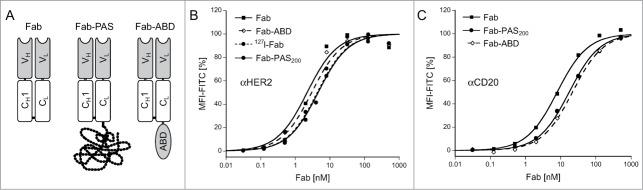
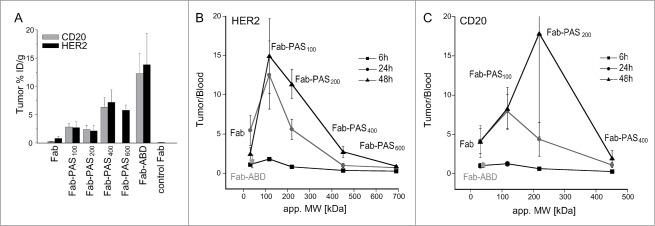
Although antigen-binding fragments (Fabs) of antibodies constitute established tracers for in vivo radiodiagnostics, their functionality is hampered by a very short circulation half-life. PASylation, the genetic fusion with a long, conformationally disordered amino acid chain comprising Pro, Ala and Ser, provides a convenient way to expand protein size and, consequently, retard renal filtration. Humanized αHER2 and αCD20 Fabs were systematically fused with 100 to 600 PAS residues and produced in E. coli. Cytofluorimetric titration analysis on tumor cell lines confirmed that antigen-binding activities of the parental antibodies were retained. The radio-iodinated PASylated Fabs were studied by positron emission tomography (PET) imaging and biodistribution analysis in mouse tumor xenograft models. While the unmodified αHER2 and αCD20 Fabs showed weak tumor uptake (0.8% and 0.2% ID/g, respectively; 24 h p.i.) tumor-associated radioactivity was boosted with increasing PAS length (up to 9 and 26-fold, respectively), approaching an optimum for Fab-PAS400. Remarkably, 6- and 5-fold higher tumor-to-blood ratios compared with the unmodified Fabs were measured in the biodistribution analysis (48 h p.i.) for αHER2 Fab-PAS100 and Fab-PAS200, respectively. These findings were confirmed by PET studies, showing high imaging contrast in line with tumor-to-blood ratios of 12.2 and 5.7 (24 h p.i.) for αHER2 Fab-PAS100 and Fab-PAS200. Even stronger tumor signals were obtained with the corresponding αCD20 Fabs, both in PET imaging and biodistribution analysis, with an uptake of 2.8% ID/g for Fab-PAS100 vs. 0.24% ID/g for the unmodified Fab. Hence, by engineering Fabs via PASylation, plasma half-life can be tailored to significantly improve tracer uptake and tumor contrast, thus optimally matching reagent/target interactions.
尽管抗体的抗原结合片段(Fabs)构成了用于体内放射性诊断的成熟示踪剂,但其功能因循环半衰期非常短而受到阻碍。聚唾液酸化(PASylation),即与包含脯氨酸、丙氨酸和丝氨酸的长的、构象无序的氨基酸链进行基因融合,提供了一种扩展蛋白质大小从而延缓肾滤过的便捷方法。人源化αHER2和αCD20 Fabs与100至600个PAS残基进行系统融合,并在大肠杆菌中产生。对肿瘤细胞系的细胞荧光滴定分析证实亲本抗体的抗原结合活性得以保留。通过正电子发射断层扫描(PET)成像和小鼠肿瘤异种移植模型中的生物分布分析研究了放射性碘化的聚唾液酸化Fabs。未修饰的αHER2和αCD20 Fabs显示出较弱的肿瘤摄取(分别为0.8%和0.2% ID/g;注射后24小时),随着PAS长度增加,肿瘤相关放射性增强(分别高达9倍和26倍),接近Fab-PAS400的最佳值。值得注意的是,在生物分布分析(注射后48小时)中,αHER2 Fab-PAS100和Fab-PAS200与未修饰的Fabs相比,肿瘤与血液的比率分别高出6倍和5倍。PET研究证实了这些发现,显示αHER2 Fab-PAS100和Fab-PAS200的成像对比度高,分别对应注射后24小时的肿瘤与血液比率为12.2和5.7。在PET成像和生物分布分析中,相应的αCD20 Fabs获得了更强的肿瘤信号,Fab-PAS100的摄取率为2.8% ID/g,而未修饰的Fab为0.24% ID/g。因此,通过聚唾液酸化对Fabs进行工程改造,可以调整血浆半衰期,显著提高示踪剂摄取和肿瘤对比度,从而优化试剂/靶点相互作用。


 Zotero 插件