
阿萨姆邦疟疾流行地区恶性疟原虫野外分离株中与磺胺多辛-乙胺嘧啶耐药性相关的基因多态性
Genetic polymorphisms associated with sulphadoxine-pyrimethamine drug resistance among Plasmodium falciparum field isolates in malaria endemic areas of Assam.
作者信息
Sharma J, Dutta P, Khan S A, Soni M, Dey D, Mahanta J
机构信息
Division of Entomology and Filariasis, Regional Medical Research Centre (ICMR), NER, Dibrugarh, Assam, India.
出版信息
J Postgrad Med. 2015 Jan-Mar;61(1):9-14. doi: 10.4103/0022-3859.147019.
BACKGROUND
The emergence of antimalarial drug resistance malaria parasite is widespread in North eastern region of India. During January 2012-December 2013, we conducted active surveillance for detection of antifolate resistance-associated genetic polymorphisms in Plasmodium falciparum malaria parasite from different malaria endemic areas of Assam.
MATERIALS AND METHODS
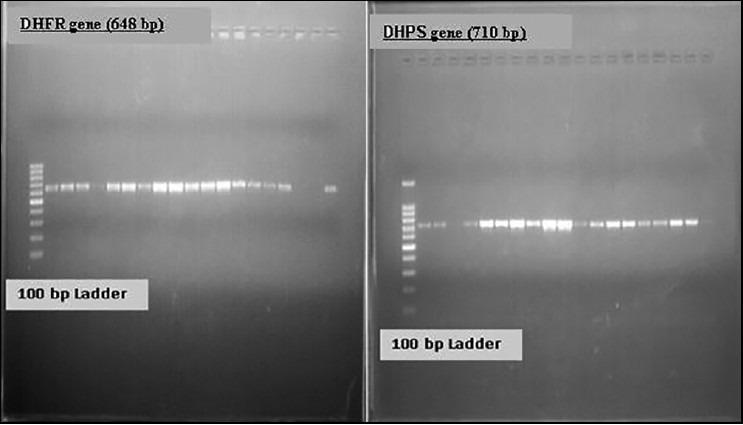
A total of 281 field samples were collected from suspected malaria patients of which 106 malaria P. falciparum positive cases were detected in microscopic slide examination. A nested PCR was done for amplification of a 648 bp portion of the dhfr gene and 710 bp portion of the dhps gene.
RESULTS
Mutation analysis revealed existence of three different haplotypes of the P. falciparum dhfr gene of which ANRNI was highly prevalent (90%). Triple mutant haplotypes AIRNI (N51I+C59R+S108N) of the dhfr gene associated with pyrimethamine resistance were prevalent in Chirang district of Assam. Whereas, dhps mutation study revealed that triple mutant haplotype AGEAA (S436A+A437G+K540E) associated with Sulphadoxine resistance was found among 26% of P. falciparum field isolates. However, P. falciparum dhfr-dhps two locus mutation analysis showed that there were a total of nine dhfr-dhps genotypes.
CONCLUSION
It was noticed that 93.62% (88/94) isolates had mutations in the sequences of both enzymes, which is an indication of prevalence of high grade of Sulphadoxine - pyrimethamine resistance in P. falciparum malaria parasites in Assam.
背景
抗疟药物耐药性疟原虫在印度东北地区广泛出现。在2012年1月至2013年12月期间,我们对来自阿萨姆邦不同疟疾流行地区的恶性疟原虫进行了主动监测,以检测与抗叶酸耐药相关的基因多态性。
材料与方法
从疑似疟疾患者中总共采集了281份现场样本,其中在显微镜玻片检查中检测到106例恶性疟原虫阳性病例。进行巢式PCR以扩增二氢叶酸还原酶(dhfr)基因的648 bp部分和二氢蝶酸合酶(dhps)基因的710 bp部分。
结果
突变分析显示恶性疟原虫dhfr基因存在三种不同的单倍型,其中ANRNI高度流行(90%)。与乙胺嘧啶耐药相关的dhfr基因三重突变单倍型AIRNI(N51I + C59R + S108N)在阿萨姆邦奇朗区流行。而dhps突变研究表明,在26%的恶性疟原虫现场分离株中发现了与磺胺多辛耐药相关的三重突变单倍型AGEAA(S436A + A437G + K540E)。然而,恶性疟原虫dhfr-dhps两位点突变分析表明共有九种dhfr-dhps基因型。
结论
注意到93.62%(88/94)的分离株在两种酶的序列中都有突变,这表明阿萨姆邦恶性疟原虫中磺胺多辛 - 乙胺嘧啶的高度耐药性普遍存在。
 Zotero 插件