
氯胺酮对有酒精使用障碍家族史的受试者的抗抑郁疗效可延长至少四周。
Ketamine's antidepressant efficacy is extended for at least four weeks in subjects with a family history of an alcohol use disorder.
作者信息
Niciu Mark J, Luckenbaugh David A, Ionescu Dawn F, Richards Erica M, Vande Voort Jennifer L, Ballard Elizabeth D, Brutsche Nancy E, Furey Maura L, Zarate Carlos A
机构信息
National Institutes of Health/National Institute of Mental Health, Experimental Therapeutics and Pathophysiology Branch, Bethesda, MD (Drs Niciu, Ionescu, Richards, Vande Voort, Ballard, Furey, and Zarate, Mr Luckenbaugh, and Ms Brutsche).
出版信息
Int J Neuropsychopharmacol. 2014 Oct 31;18(1):pyu039. doi: 10.1093/ijnp/pyu039.
BACKGROUND
A single subanesthetic infusion of the N-methyl-D-aspartate (NMDA) receptor antagonist ketamine has rapid and potent antidepressant properties in treatment-resistant major depressive disorder (TRD). As a family history of an alcohol use disorder is a positive predictor of ketamine's antidepressant response and the strength of the association increases over time, we hypothesized that depressed subjects with a family history of an alcohol use disorder would have greater antidepressant durability and that riluzole would augment and/or extend ketamine's antidepressant efficacy.
METHODS
Fifty-two TRD subjects received an open-label infusion of ketamine (0.5mg/kg over 40 minutes), and, four to six hours post-infusion, were randomized to either flexible-dose (100-200mg/day) riluzole or placebo in the following proportions: Family History Positive (FHP) riluzole (n = 10), FHP placebo (n = 9), Family History Negative (FHN) riluzole (n = 16), and FHN placebo (n = 17).
RESULTS
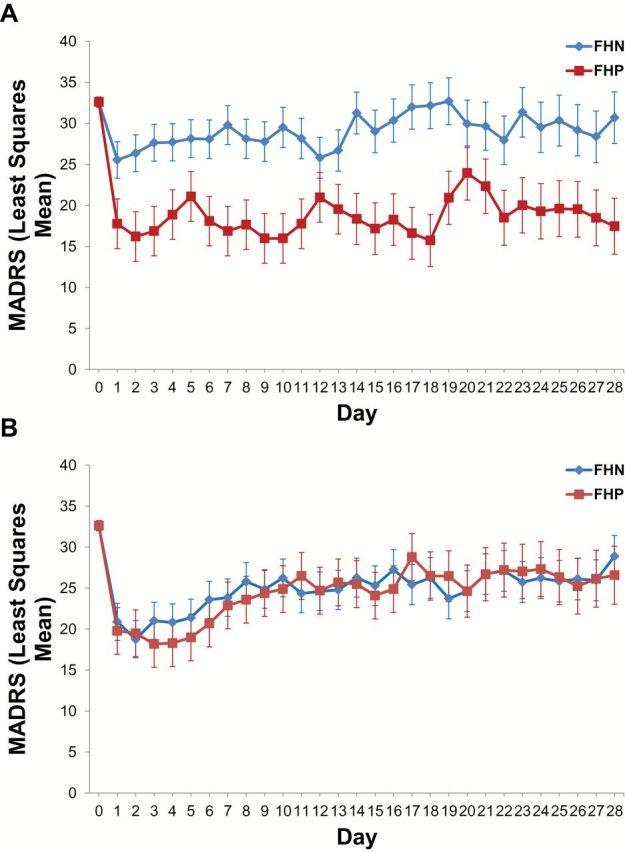
FHP subjects randomized to placebo had a greater antidepressant response than FHN subjects; however, contrary to our initial hypothesis, there was no significant difference in antidepressant efficacy with riluzole. Although potentially underpowered, there was no difference in overall time-to-relapse based on randomization status (riluzole responders: n = 15, placebo responders: n = 17). Yet, time-to-relapse was longer in FHP placebo responders (n = 8) compared to FHN placebo responders (n = 9) with, again, no significant difference in time-to-relapse in FHP riluzole responders (n = 6) compared to FHN riluzole responders (n = 9).
CONCLUSIONS
Ketamine's extended antidepressant durability in FHP TRD should be considered in the design and analysis of ketamine depression trials.
背景
对N-甲基-D-天冬氨酸(NMDA)受体拮抗剂氯胺酮进行单次亚麻醉剂量输注,在难治性重度抑郁症(TRD)中具有快速且强效的抗抑郁特性。由于酒精使用障碍家族史是氯胺酮抗抑郁反应的阳性预测指标,且这种关联的强度会随时间增加,我们推测有酒精使用障碍家族史的抑郁症患者会有更强的抗抑郁持久性,并且利鲁唑会增强和/或延长氯胺酮的抗抑郁疗效。
方法
52名TRD患者接受了氯胺酮的开放标签输注(40分钟内输注0.5mg/kg),输注后4至6小时,按以下比例随机分为灵活剂量(100 - 200mg/天)利鲁唑组或安慰剂组:家族史阳性(FHP)利鲁唑组(n = 10)、FHP安慰剂组(n = 9)、家族史阴性(FHN)利鲁唑组(n = 16)和FHN安慰剂组(n = 17)。
结果
随机分配到安慰剂组的FHP患者比FHN患者有更大的抗抑郁反应;然而,与我们最初的假设相反,利鲁唑在抗抑郁疗效方面没有显著差异。尽管可能样本量不足,但基于随机分组情况,复发的总体时间没有差异(利鲁唑反应者:n = 15,安慰剂反应者:n = 17)。然而,FHP安慰剂反应者(n = 8)的复发时间比FHN安慰剂反应者(n = 9)更长,同样,FHP利鲁唑反应者(n = 6)与FHN利鲁唑反应者(n = 9)的复发时间也没有显著差异。
结论
在氯胺酮治疗抑郁症试验的设计和分析中,应考虑氯胺酮在FHP - TRD中延长的抗抑郁持久性。

 Zotero 插件