
¹⁸F-氟脱氧葡萄糖正电子发射断层扫描标准化摄取值用于预测乳腺癌肿瘤负荷之外的肿瘤复发情况
Standardized uptake value of ¹⁸F-fluorodeoxyglucose positron emission tomography for prediction of tumor recurrence in breast cancer beyond tumor burden.
作者信息
Ahn Sung Gwe, Park Jong Tae, Lee Hak Min, Lee Hak Woo, Jeon Tae Joo, Han Kyunghwa, Lee Seung Ah, Dong Seung Myung, Ryu Young Hoon, Son Eun Ju, Jeong Joon
出版信息
Breast Cancer Res. 2014;16(6):502. doi: 10.1186/s13058-014-0502-y.
INTRODUCTION
18F-fluorodeoxyglucose positron emission tomography (FDG-PET) can reveal the metabolic activity of malignant tumors. Recent advances gained from molecular studies suggest that tumor biology can be a good predictor of prognosis in breast cancer. We compared the ability of maximum standardized uptake values (SUVmax) derived by FDG-PET with tumor burden in predicting tumor recurrence for patients with breast cancer.
METHODS
496 patients with breast cancer who underwent preoperative FDG-PET between April 2004 and May 2009 were retrospectively identified. SUVmax was obtained by FDG-PET, and the cutoff point was defined using a time-dependent receiver operating characteristic curve for recurrence-free survival (RFS). The primary endpoint was RFS.
RESULTS
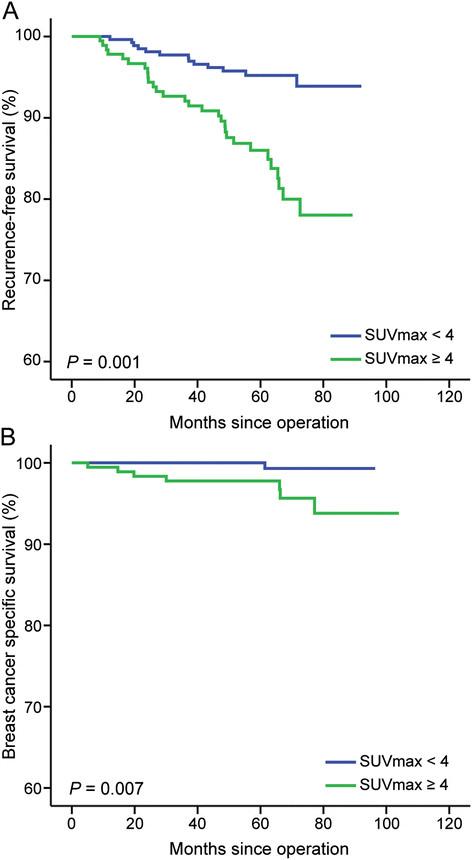
In multivariate analysis for RFS, SUVmax carried independent prognostic significance (hazard ratio, 2.39; 95% confidence interval, 1.20 to 4.76; P = 0.012). When the patients were classified into four groups according to the combined factors of tumor size (≤2 cm versus >2 cm) and SUVmax (<4 versus ≥4), RFS differed significantly (P < 0.001). Similarly, SUVmax had prognostic value in combination with nodal status (negative versus positive) or stage (I versus II and III) (P < 0.001 and P = 0.001, respectively). In hormone receptor-positive disease, SUVmax remained a significant prognostic factor for RFS based on multivariate analysis.
CONCLUSIONS
Our results highlight the prognostic value of FDG-PET in prediction of tumor relapse for patients with breast cancer. Particularly in patients with hormone receptor-positive disease, the tumor metabolic information provided by FDG-PET is more significantly correlated with prognosis than tumor burden.
引言
18F-氟脱氧葡萄糖正电子发射断层扫描(FDG-PET)可揭示恶性肿瘤的代谢活性。分子研究的最新进展表明,肿瘤生物学可能是乳腺癌预后的良好预测指标。我们比较了FDG-PET得出的最大标准化摄取值(SUVmax)与肿瘤负荷在预测乳腺癌患者肿瘤复发方面的能力。
方法
回顾性确定了2004年4月至2009年5月期间接受术前FDG-PET检查的496例乳腺癌患者。通过FDG-PET获得SUVmax,并使用无复发生存期(RFS)的时间依赖性受试者工作特征曲线确定截断点。主要终点是RFS。
结果
在RFS的多变量分析中,SUVmax具有独立的预后意义(风险比,2.39;95%置信区间,1.20至4.76;P = 0.012)。根据肿瘤大小(≤2 cm对>2 cm)和SUVmax(<4对≥4)的综合因素将患者分为四组时,RFS有显著差异(P < 0.001)。同样,SUVmax与淋巴结状态(阴性对阳性)或分期(I期对II期和III期)结合时具有预后价值(分别为P < 0.001和P = 0.001)。在激素受体阳性疾病中,基于多变量分析,SUVmax仍然是RFS的重要预后因素。
结论
我们的结果突出了FDG-PET在预测乳腺癌患者肿瘤复发方面的预后价值。特别是在激素受体阳性疾病患者中,FDG-PET提供的肿瘤代谢信息与预后的相关性比肿瘤负荷更显著。



 Zotero 插件