
基于出生登记系统的出生缺陷率调查。
The survey of birth defects rate based on birth registration system.
作者信息
Yu Min, Ping Zhiguang, Zhang Shuiping, He Yuying, Dong Rui, Guo Xiong
机构信息
School of Public Health, Health Science Center, Key Laboratory of Trace Elements and Endemic Diseases of Health Ministry, Xi'an Jiaotong University, Xi'an, Shaanxi 710061, China.
出版信息
Chin Med J (Engl). 2015 Jan 5;128(1):7-14. doi: 10.4103/0366-6999.147785.
BACKGROUND
To investigate the surveillance trend of birth defects, incidence, distribution, occurrence regularity, and their relevant factors in Xi'an City in the last 10 years for proposing control measures.
METHODS
The birth defects monitoring data of infants during perinatal period (28 weeks of gestation to 7 days after birth) were collected from obstetrics departments of all hospitals during 2003-2012. Microsoft Excel 2003 was used for data input, and Statistical Package for the Social Sciences version 16.0 (International Business Machines Corporation, New York, NY, USA) was used for descriptive analysis. χ2 test, Spearman correlation and linear-by-linear association trend test were used for statistical analyses.
RESULTS
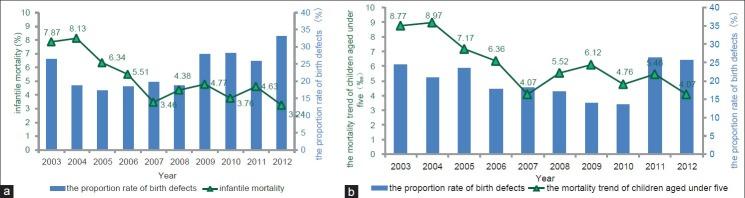
The birth defect rate declined from 9.18% in 2003 to 7.00% in 2012 (χ2 = 45.001, P < 0.01) with a mean value of 7.85%, which is below the Chinese national average level (χ2 = 20.451, P < 0.01). The order of five most common birth defects has changed. The incidence of congenital heart disease (CHD) increased with time, particularly after 2012, it became the most frequent type (r s = 0.808, P < 0.001). Till then, the number of neural tube defects (NTDs) declined significantly (χ2 = 76.254, P < 0.01). The average birth defects rate of 8.11% in rural areas was higher than that in urban areas (7.56%, χ2 = 7.919, P < 0.01) and much higher in males (8.28%) than that in females (7.18%, χ2 = 32.397, P < 0.01). Maternal age older than 35 years (χ2 = 35.298, P < 0.01) is the most dangerous age bracket of birth defects than maternal age younger than 20 years (χ2 = 7.128, P < 0.01).
CONCLUSIONS
A downward trend of birth defects was observed in Xi'an City from 2003 to 2012. NTDs significantly decreased after large-scale supplemental folic acid intervention, while the incidence rate of CHD significantly increased.
背景
调查西安市近10年出生缺陷的监测趋势、发病率、分布情况、发生规律及其相关因素,以提出防控措施。
方法
收集2003 - 2012年期间西安市所有医院产科围产期(孕28周 至出生后7天)婴儿的出生缺陷监测数据。采用Microsoft Excel 2003进行数据录入,使用社会科学统计软件包第16.0版(美国纽约州国际商业机器公司)进行描述性分析。采用χ2检验、Spearman相关性分析和线性 - 线性关联趋势检验进行统计分析。
结果
出生缺陷率从2003年的9.18%降至2012年的7.00%(χ2 = 45.001,P < 0.01),平均为7.85%,低于全国平均水平(χ2 = 20.451,P < 0.01)。五种最常见出生缺陷的排序发生了变化。先天性心脏病(CHD)的发病率随时间增加,特别是2012年后,成为最常见类型(rs = 0.808,P < 0.001)。此时,神经管缺陷(NTDs)数量显著下降(χ2 = 76.254,P < 0.01)。农村地区出生缺陷平均发生率为8.11%,高于城市地区(7.56%,χ2 = 7.919,P < 0.01),男性(8.28%)远高于女性(7.18%,χ2 = 32.397,P < 0.01)。母亲年龄大于35岁(χ2 = 35.298,P < 0.01)是出生缺陷最危险的年龄组,高于母亲年龄小于20岁(χ2 = 7.128,P < 0.01)。
结论
2003 - 2012年西安市出生缺陷呈下降趋势。大规模补充叶酸干预后神经管缺陷显著减少,而先天性心脏病发病率显著上升。
 Zotero 插件