
采用新型人类EML4-ALK肺癌细胞系建立骨转移、脑转移及胸膜癌病的体内成像模型。
In vivo imaging models of bone and brain metastases and pleural carcinomatosis with a novel human EML4-ALK lung cancer cell line.
作者信息
Nanjo Shigeki, Nakagawa Takayuki, Takeuchi Shinji, Kita Kenji, Fukuda Koji, Nakada Mitsutoshi, Uehara Hisanori, Nishihara Hiroshi, Hara Eiji, Uramoto Hidetaka, Tanaka Fumihiro, Yano Seiji
机构信息
Division of Medical Oncology, Cancer Research Institute, Kanazawa University, Kanazawa, Japan.
出版信息
Cancer Sci. 2015 Mar;106(3):244-52. doi: 10.1111/cas.12600. Epub 2015 Feb 17.
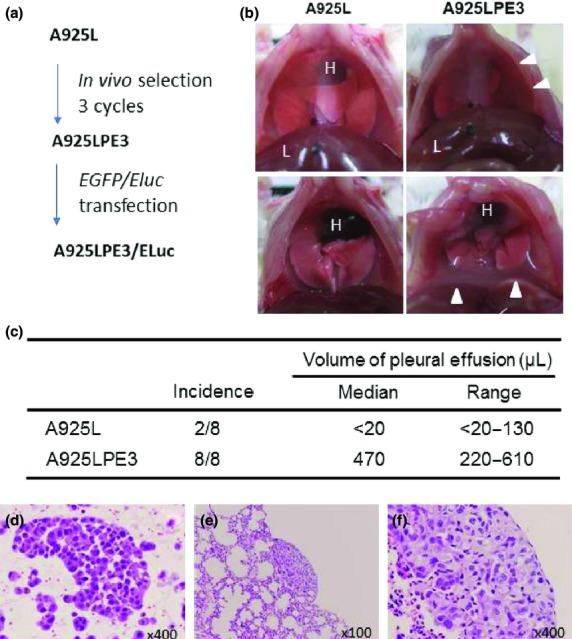
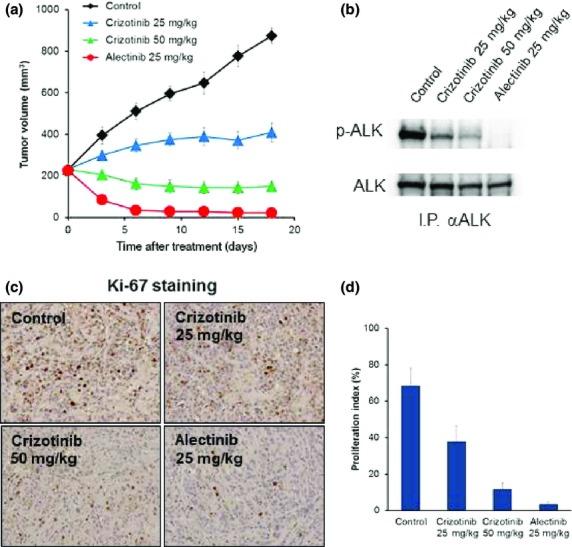
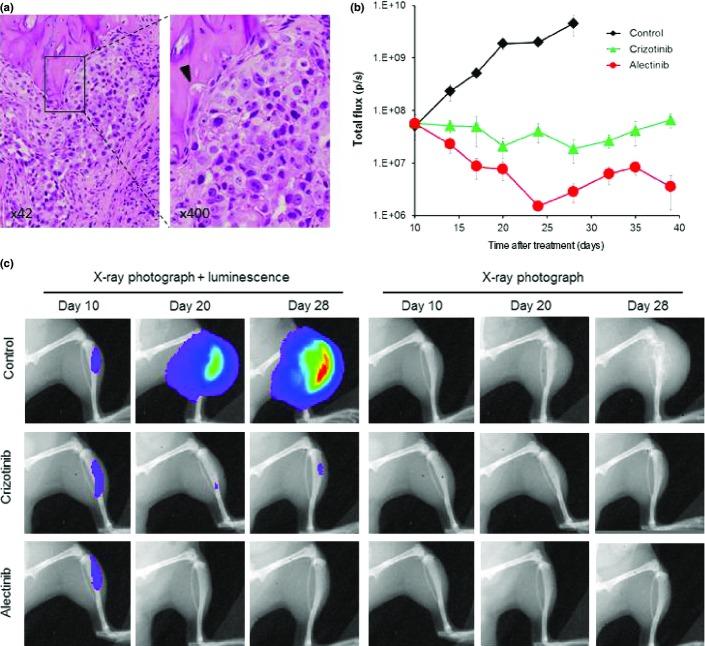
EML4-ALK lung cancer accounts for approximately 3-7% of non-small-cell lung cancer cases. To investigate the molecular mechanism underlying tumor progression and targeted drug sensitivity/resistance in EML4-ALK lung cancer, clinically relevant animal models are indispensable. In this study, we found that the lung adenocarcinoma cell line A925L expresses an EML4-ALK gene fusion (variant 5a, E2:A20) and is sensitive to the ALK inhibitors crizotinib and alectinib. We further established highly tumorigenic A925LPE3 cells, which also have the EML4-ALK gene fusion (variant 5a) and are sensitive to ALK inhibitors. By using A925LPE3 cells with luciferase gene transfection, we established in vivo imaging models for pleural carcinomatosis, bone metastasis, and brain metastasis, all of which are significant clinical concerns of advanced EML4-ALK lung cancer. Interestingly, crizotinib caused tumors to shrink in the pleural carcinomatosis model, but not in bone and brain metastasis models, whereas alectinib showed remarkable efficacy in all three models, indicative of the clinical efficacy of these ALK inhibitors. Our in vivo imaging models of multiple organ sites may provide useful resources to analyze further the pathogenesis of EML4-ALK lung cancer and its response and resistance to ALK inhibitors in various organ microenvironments.
EML4-ALK肺癌约占非小细胞肺癌病例的3%-7%。为了研究EML4-ALK肺癌肿瘤进展及靶向药物敏感性/耐药性的分子机制,临床相关动物模型必不可少。在本研究中,我们发现肺腺癌细胞系A925L表达EML4-ALK基因融合体(变体5a,E2:A20),且对ALK抑制剂克唑替尼和阿来替尼敏感。我们进一步建立了高致瘤性的A925LPE3细胞,其也具有EML4-ALK基因融合体(变体5a),并对ALK抑制剂敏感。通过对转染荧光素酶基因的A925LPE3细胞进行研究,我们建立了胸膜转移瘤、骨转移和脑转移的体内成像模型,这些都是晚期EML4-ALK肺癌重要的临床问题。有趣的是,克唑替尼使胸膜转移瘤模型中的肿瘤缩小,但在骨转移和脑转移模型中无效,而阿来替尼在所有三种模型中均显示出显著疗效,表明这些ALK抑制剂的临床疗效。我们的多器官部位体内成像模型可能为进一步分析EML4-ALK肺癌的发病机制及其在各种器官微环境中对ALK抑制剂的反应和耐药性提供有用资源。



 Zotero 插件