
S100P是一种钙结合蛋白,它与结直肠癌中息肉样肿瘤的生长密切相关。
S100P, a calcium-binding protein, is preferentially associated with the growth of polypoid tumors in colorectal cancer.
作者信息
Chiang Jy-Ming, Tan Reping, Wang Jen-Yi, Chen Jinn-Shium, Lee Yun-Shien, Hsieh Pao-Shiu, Changchien Chung Rong, Chen Jim-Ray
机构信息
Division of Colon and Rectal Surgery, Chang Gung Memorial Hospital at Linkou, Kwei-Shan, Tao-Yuan 333, Taiwan, R.O.C.
Genomic Medicine Research Core Laboratory, Chang Gung Memorial Hospital at Linkou, Kwei-Shan, Tao-Yuan 333, Taiwan, R.O.C.
出版信息
Int J Mol Med. 2015 Mar;35(3):675-83. doi: 10.3892/ijmm.2015.2065. Epub 2015 Jan 12.
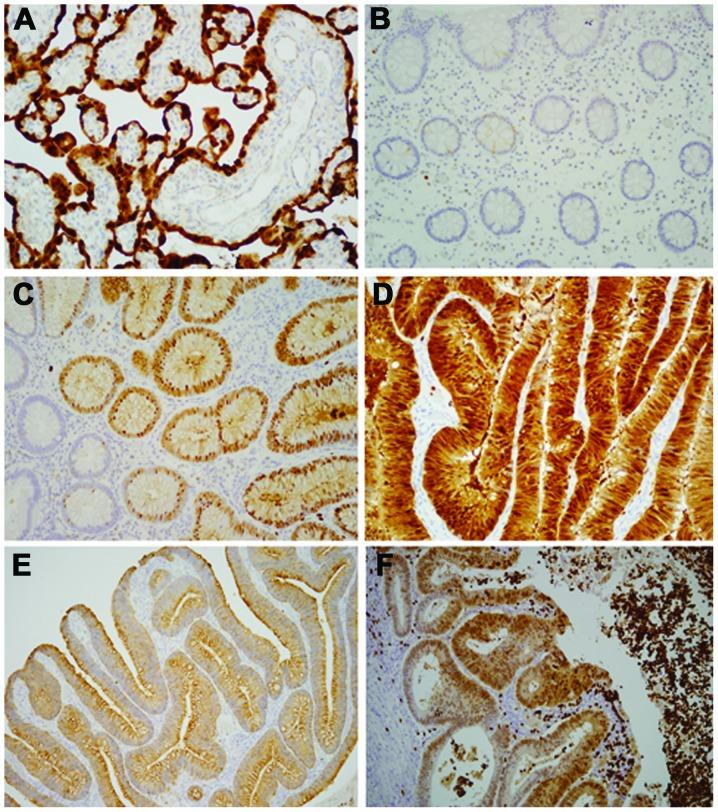
Colorectal cancer (CRC) is a genetically heterogeneous disease with distinct morphological patterns. It has been shown that polypoid and ulcerative CRC displays different genetic alterations. In the present study, we aimed to investigate genes with differential expression patterns between ulcerative and polypoid CRC. cDNA microarray analysis was performed to compare the gene expression profiles in samples of ulcerative and polypoid CRC with paired normal mucosa samples. Potential candidate genes were further validated using reverse transcription-quantitative polymerase chain reaction (RT-qPCR), western blot analysis and immunohistochemistry. The epigenetic regulation of gene expression was investigated using methylation-specific PCR (MSP). cDNA microarray analysis identified 11 upregulated and 14 downregulated genes which were differentially expressed in samples from both tumor types compared to the matched normal mucosa samples. Among these, S100P was the only upregulated gene preferentially associated with polypoid CRC (P=0.032). The samples of polypoid CRC displayed significantly higher S100P protein and mRNA expression levels than the samples of ulcerative CRC (P<0.05, respectively). Using semi-quantitative immunohistochemical analyses, S100P overexpression was found to be preferentially associated with polypoid CRC (24/30 vs. 14/40, P<0.001). The relative methylation level determined by MSP did not differ significantly between the samples of polypoid and ulcerative CRC (43.36 vs. 49.10%, P=0.168), indicating that promoter hypomethylation was not directly related to the upregulation of S100P mRNA. Our results demonstrate that the upregulation of S100P mRNA and protein expression is a predominant characteristic in polypoid CRC, whereas ulcerative CRC presents with a wide range of expression levels, indicating that S100P overexpression is not a key determinant in conferring invasion properties. The clinicopathological significance of S100P in CRC requires further investigation in well-controlled studies.
结直肠癌(CRC)是一种具有不同形态学模式的基因异质性疾病。研究表明,息肉样和溃疡性结直肠癌表现出不同的基因改变。在本研究中,我们旨在调查溃疡性和息肉样结直肠癌之间具有差异表达模式的基因。进行了cDNA微阵列分析,以比较溃疡性和息肉样结直肠癌样本与配对正常黏膜样本中的基因表达谱。使用逆转录定量聚合酶链反应(RT-qPCR)、蛋白质印迹分析和免疫组织化学进一步验证潜在的候选基因。使用甲基化特异性PCR(MSP)研究基因表达的表观遗传调控。cDNA微阵列分析确定了11个上调基因和14个下调基因,与匹配的正常黏膜样本相比,这两种肿瘤类型的样本中这些基因存在差异表达。其中,S100P是唯一优先与息肉样结直肠癌相关的上调基因(P = 0.032)。息肉样结直肠癌样本中S100P蛋白和mRNA表达水平显著高于溃疡性结直肠癌样本(分别为P < 0.05)。使用半定量免疫组织化学分析,发现S100P过表达优先与息肉样结直肠癌相关(24/30对14/40,P < 0.001)。通过MSP测定的息肉样和溃疡性结直肠癌样本之间的相对甲基化水平没有显著差异(43.36对49.10%,P = 0.168),表明启动子低甲基化与S100P mRNA的上调没有直接关系。我们的结果表明,S100P mRNA和蛋白表达上调是息肉样结直肠癌的主要特征,而溃疡性结直肠癌表现出广泛的表达水平,表明S100P过表达不是赋予侵袭特性的关键决定因素。S100P在结直肠癌中的临床病理意义需要在严格控制的研究中进一步调查。



 Zotero 插件