
对支气管肺泡灌洗液进行多重 PCR 可提高危重症肺炎患者的病原体检出率:一项初步研究。
Multiplex PCR performed of bronchoalveolar lavage fluid increases pathogen identification rate in critically ill patients with pneumonia: a pilot study.
机构信息
Assistance Publique - Hôpitaux de Paris (AP-HP), Hôpital Saint-Antoine, Service de Réanimation Médicale, Paris 75012, France.
AP-HP, Hôpital Saint-Antoine, Service de Microbiologie, Paris 75012, France.
出版信息
Ann Intensive Care. 2014 Nov 25;4:35. doi: 10.1186/s13613-014-0035-7. eCollection 2014.
BACKGROUND
In critically ill patients with pneumonia, accurate microorganism identification allows appropriate antibiotic treatment. In patients undergoing bronchoalveolar lavage (BAL), direct examination of the fluid using Gram staining provides prompt information but pathogen identification accuracy is low. Culture of BAL fluid is actually the reference, but it is not available before 24 to 48 h. In addition, pathogen identification rate observed with direct examination and culture is decreased when antibiotic therapy has been given prior to sampling. We therefore assessed, in critically ill patients with suspected pneumonia, the performance of a multiplex PCR (MPCR) to identify pathogens in BAL fluid. This study is a prospective pilot observation.
METHODS
We used a MPCR detecting 20 types of microorganisms. Direct examination, culture, and MPCR were performed on BAL fluid of critically ill patients with pneumonia suspicion. The final diagnosis of infective pneumonia was retained after the medical chart was reviewed by two experts. Pathogen identification rate of direct examination, culture, and MPCR in patients with confirmed pneumonia was compared.
RESULTS
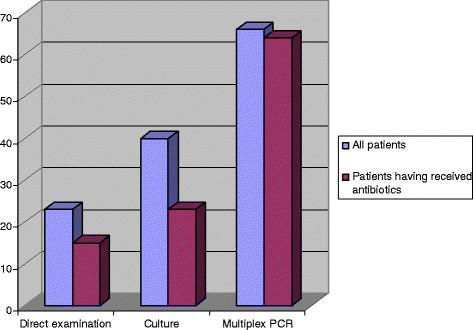
Among the 65 patients with pneumonia suspicion, the diagnosis of pneumonia was finally retained in 53 cases. Twenty nine (55%) were community-acquired pneumonia and 24 (45%) were hospital acquired. Pathogen identification rate with MPCR (66%) was greater than with culture (40%) and direct examination (23%) (p =0.01 and p <0.001, respectively). When considering only the microorganisms included in the MPCR panel, the pathogen identification rate provided by MPCR reached 82% and was still higher than with culture (35%, p <0.001) and direct examination (21%, p <0.001). Pathogen identification rate provided by MPCR was not modified in the case of previous antibiotic treatment (66% vs. 64%, NS) and was still better than with culture (23%, p <0.001).
CONCLUSIONS
The results of this pilot study suggest that in critically ill patients, MPCR performed on BAL fluid could provide higher identification rate of pathogens involved in pneumonia than direct examination and culture, especially in patients having received antimicrobial treatment.
背景
在患有肺炎的危重症患者中,准确识别微生物有助于进行适当的抗生素治疗。在接受支气管肺泡灌洗(BAL)的患者中,直接检查灌洗液的革兰氏染色可提供快速信息,但病原体识别准确性较低。BAL 液培养实际上是参考标准,但在 24 至 48 小时之前无法获得。此外,在采样前给予抗生素治疗时,直接检查和培养观察到的病原体识别率会降低。因此,我们评估了疑似肺炎的危重症患者中,BAL 液中使用多重 PCR(MPCR)识别病原体的性能。这是一项前瞻性试点观察。
方法
我们使用 MPCR 检测 20 种微生物。对疑似肺炎的危重症患者的 BAL 液进行直接检查、培养和 MPCR。通过两位专家对病历进行审查,保留感染性肺炎的最终诊断。比较了确诊肺炎患者直接检查、培养和 MPCR 的病原体识别率。
结果
在 65 例疑似肺炎患者中,最终保留肺炎诊断 53 例。29 例(55%)为社区获得性肺炎,24 例(45%)为医院获得性肺炎。MPCR(66%)的病原体识别率高于培养(40%)和直接检查(23%)(p=0.01 和 p<0.001)。仅考虑 MPCR 面板中包含的微生物时,MPCR 提供的病原体识别率达到 82%,仍高于培养(35%,p<0.001)和直接检查(21%,p<0.001)。在先前使用抗生素治疗的情况下,MPCR 提供的病原体识别率没有改变(66% vs. 64%,NS),仍然优于培养(23%,p<0.001)。
结论
这项试点研究的结果表明,在危重症患者中,BAL 液上的 MPCR 可提供比直接检查和培养更高的肺炎相关病原体识别率,特别是在接受抗菌治疗的患者中。
 Zotero 插件