
银等离子体改性增强钛牙种植体周围的骨附着:一项针对拉布拉多犬的动物研究。
Ag-plasma modification enhances bone apposition around titanium dental implants: an animal study in Labrador dogs.
作者信息
Qiao Shichong, Cao Huiliang, Zhao Xu, Lo Hueiwen, Zhuang Longfei, Gu Yingxin, Shi Junyu, Liu Xuanyong, Lai Hongchang
机构信息
Department of Oral and Maxillofacial Implantology, Shanghai Key Laboratory of Stomatology, Shanghai Ninth People's Hospital, School of Medicine, Shanghai Jiao Tong University, Shanghai, People's Republic of China.
State Key Laboratory of High Performance Ceramics and Superfine Microstructure, Shanghai Institute of Ceramics, Chinese Academy of Sciences, Shanghai, People's Republic of China.
出版信息
Int J Nanomedicine. 2015 Jan 14;10:653-64. doi: 10.2147/IJN.S73467. eCollection 2015.
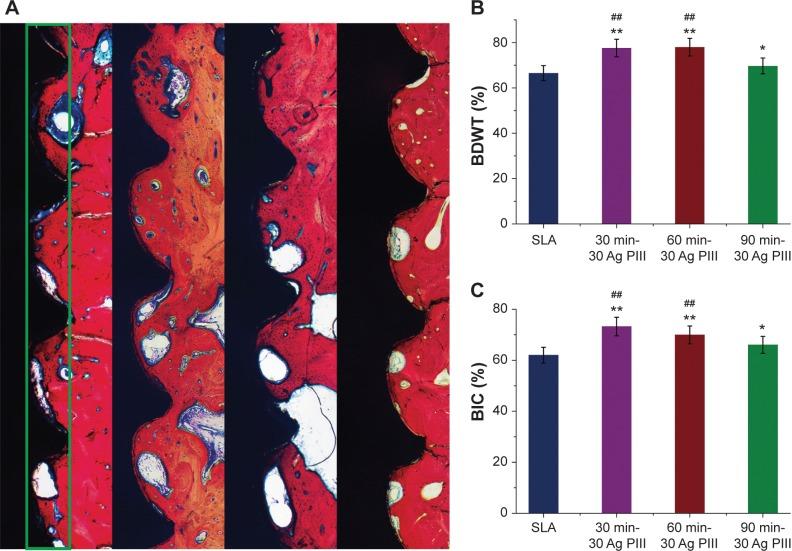
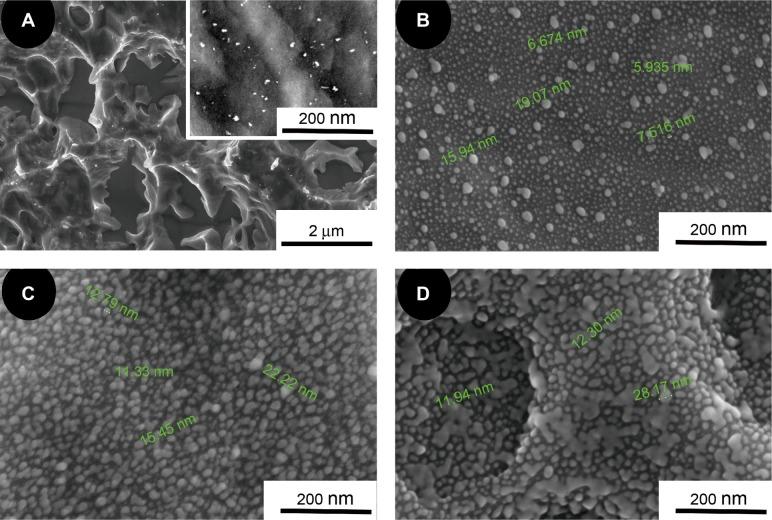
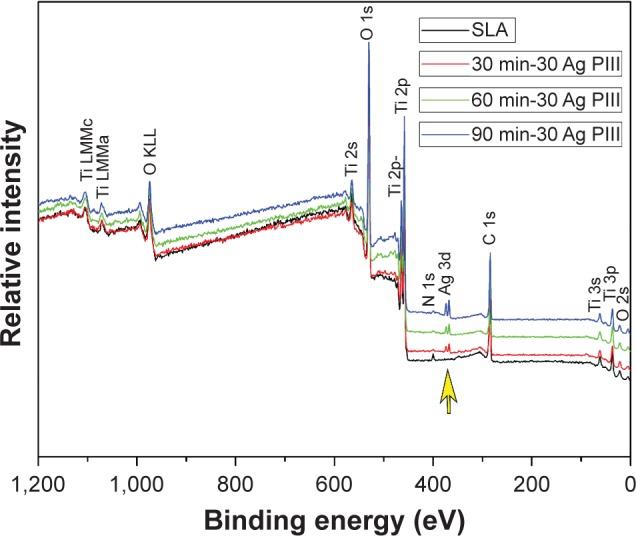
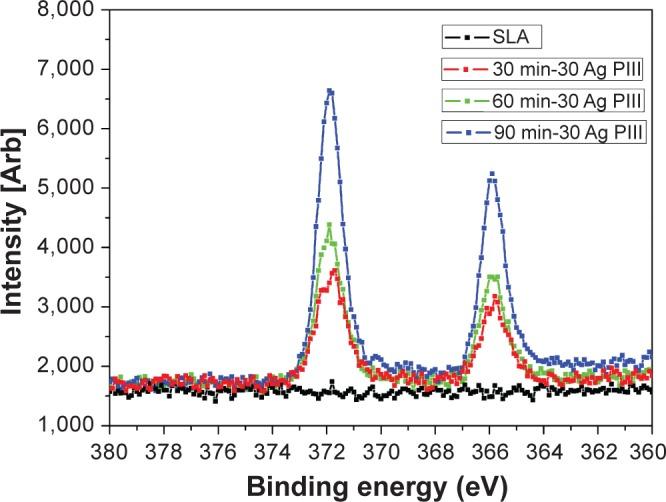
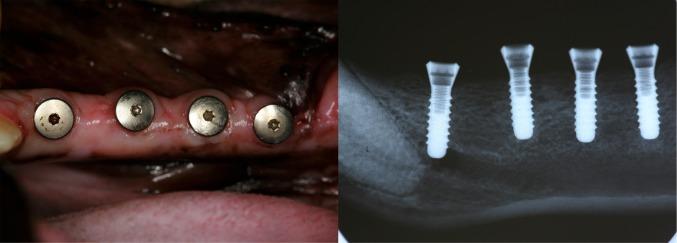
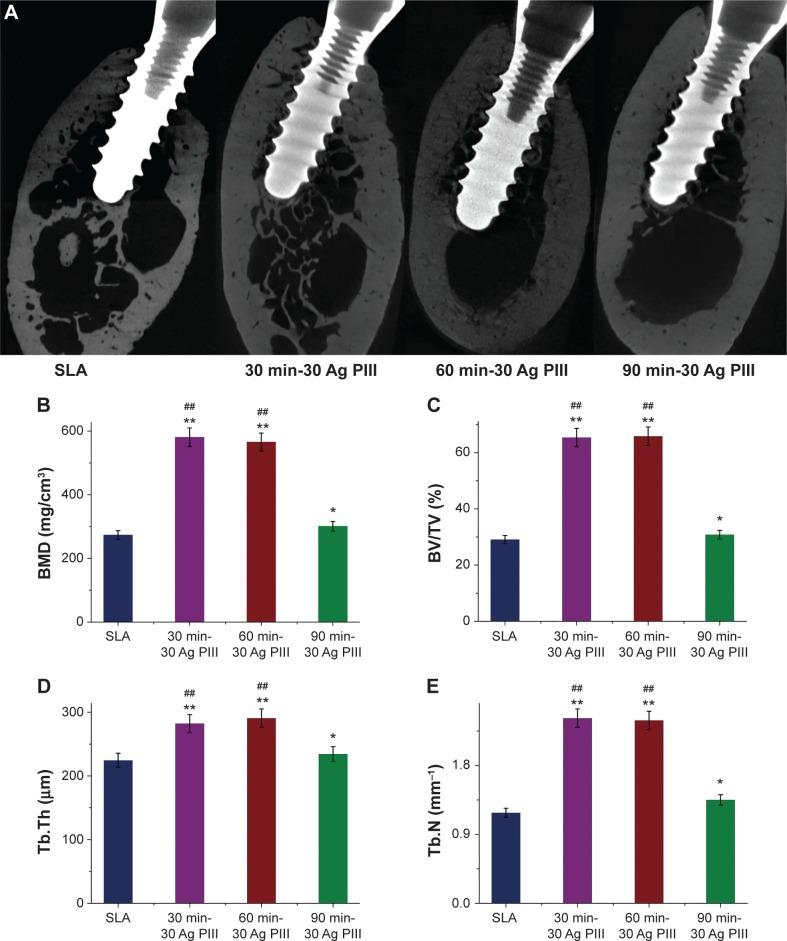
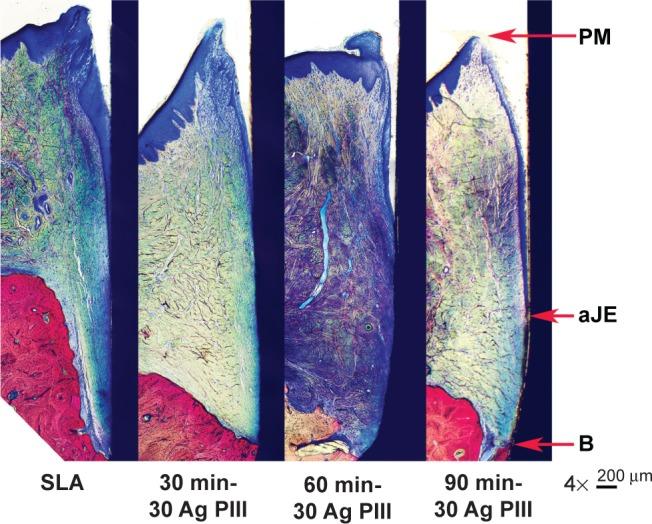
Dental implants with proper antibacterial ability as well as ideal osseointegration are being actively pursued. The antimicrobial ability of titanium implants can be significantly enhanced via modification with silver nanoparticles (Ag NPs). However, the high mobility of Ag NPs results in their potential cytotoxicity. The silver plasma immersion ion-implantation (Ag-PIII) technique may remedy the defect. Accordingly, Ag-PIII technique was employed in this study in an attempt to reduce the mobility of Ag NPs and enhance osseointegration of sandblasted and acid-etched (SLA) dental implants. Briefly, 48 dental implants, divided equally into one control and three test groups (further treated by Ag-PIII technique with three different implantation parameters), were inserted in the mandibles of six Labrador dogs. Scanning electron microscopy, X-ray photoelectron spectroscopy, and inductively coupled plasma optical emission spectrometry were used to investigate the surface topography, chemical states, and silver release of SLA- and Ag-PIII-treated titanium dental implants. The implant stability quotient examination, Microcomputed tomography evaluation, histological observations, and histomorphometric analysis were performed to assess the osseointegration effect in vivo. The results demonstrated that normal soft tissue healing around dental implants was observed in all the groups, whereas the implant stability quotient values in Ag-PIII groups were higher than that in the SLA group. In addition, all the Ag-PIII groups, compared to the SLA-group, exhibited enhanced new bone formation, bone mineral density, and trabecular pattern. With regard to osteogenic indicators, the implants treated with Ag-PIII for 30 minutes and 60 minutes, with the diameter of the Ag NPs ranging from 5-25 nm, were better than those treated with Ag-PIII for 90 minutes, with the Ag NPs diameter out of that range. These results suggest that Ag-PIII technique can reduce the mobility of Ag NPs and enhance the osseointegration of SLA surfaces and have the potential for future use.
人们正在积极寻求具有适当抗菌能力以及理想骨整合能力的牙科植入物。通过用银纳米颗粒(Ag NPs)进行改性,可以显著提高钛植入物的抗菌能力。然而,Ag NPs的高迁移率导致其具有潜在的细胞毒性。银等离子体浸没离子注入(Ag-PIII)技术可能弥补这一缺陷。因此,本研究采用Ag-PIII技术,试图降低Ag NPs的迁移率,并增强喷砂和酸蚀(SLA)牙科植入物的骨整合。简而言之,将48颗牙科植入物平均分为一个对照组和三个试验组(通过具有三种不同植入参数的Ag-PIII技术进一步处理),植入六只拉布拉多犬的下颌骨中。使用扫描电子显微镜、X射线光电子能谱和电感耦合等离子体发射光谱法来研究SLA和Ag-PIII处理的钛牙科植入物的表面形貌、化学状态和银释放情况。进行植入物稳定性商数检查、微型计算机断层扫描评估、组织学观察和组织形态计量分析,以评估体内的骨整合效果。结果表明,所有组均观察到牙科植入物周围正常的软组织愈合,而Ag-PIII组的植入物稳定性商数高于SLA组。此外,与SLA组相比,所有Ag-PIII组均表现出新骨形成、骨矿物质密度和小梁模式增强。关于成骨指标,用Ag-PIII处理30分钟和60分钟的植入物,其Ag NPs直径在5-25nm范围内,优于用Ag-PIII处理90分钟的植入物,其Ag NPs直径超出该范围。这些结果表明,Ag-PIII技术可以降低Ag NPs的迁移率,增强SLA表面的骨整合,并具有未来应用的潜力。
 Zotero 插件