
连续无创血红蛋白监测可减少神经外科手术中的红细胞输注:一项前瞻性队列研究。
Continuous and noninvasive hemoglobin monitoring reduces red blood cell transfusion during neurosurgery: a prospective cohort study.
作者信息
Awada Wael N, Mohmoued Maher F, Radwan Tarek M, Hussien Gomaa Z, Elkady Hany W
机构信息
Department of Anesthesia, ICU and Pain Management, Cairo University, Manyal, Cairo, Egypt.
出版信息
J Clin Monit Comput. 2015 Dec;29(6):733-40. doi: 10.1007/s10877-015-9660-4. Epub 2015 Feb 4.
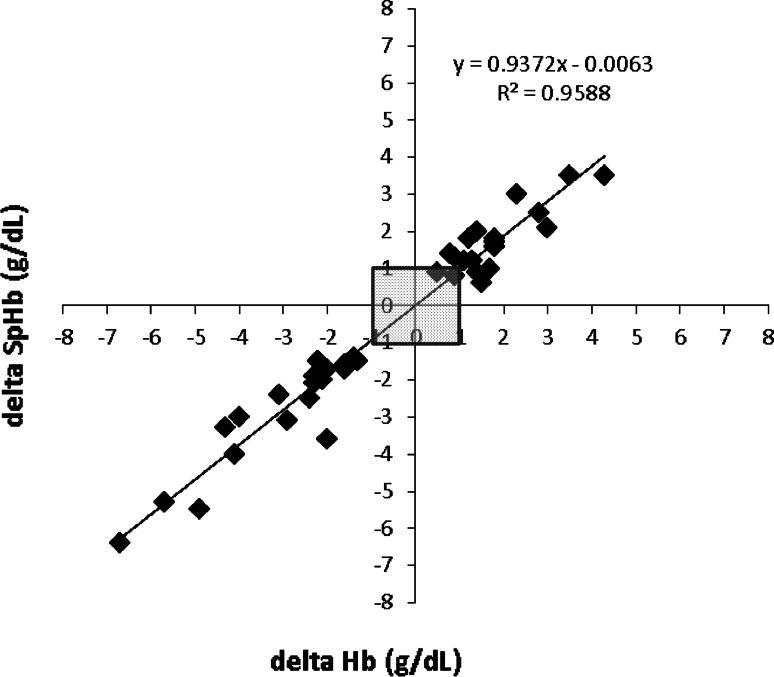
Continuous, noninvasive hemoglobin (SpHb) monitoring provides clinicians with the trending of changes in hemoglobin, which has the potential to alter red blood cell transfusion decision making. The objective of this study was to evaluate the impact of SpHb monitoring on blood transfusions in high blood loss surgery. In this prospective cohort study, eligible patients scheduled for neurosurgery were enrolled into either a Control Group or an intervention group (SpHb Group). The Control Group received intraoperative hemoglobin monitoring by intermittent blood sampling when there was an estimated 15% blood loss. If the laboratory value indicated a hemoglobin level of ≤10 g/dL, a red blood cell transfusion was started and continued until the estimated blood loss was replaced and a laboratory hemoglobin value was >l0 g/dL. In the SpHb Group patients were monitored with a Radical-7 Pulse CO-Oximeter for continuous noninvasive hemoglobin values. Transfusion was started when the SpHb value fell to ≤l0 g/dL and was continued until the SpHb was ≥l0 g/dL. Blood samples were taken pre and post transfusion. Percent of patients transfused, average amount of blood transfused in those who received transfusions and the delay time from the hemoglobin reading of <10 g/dL to the start of transfusion (transfusion delay) were compared between groups. The trending ability of SpHb, and the bias and precision of SpHb compared to the laboratory hemoglobin were calculated. Compared to the Control Group, the SpHb Group had fewer units of blood transfused (1.0 vs 1.9 units for all patients; p ≤ 0.001, and 2.3 vs 3.9 units in patients receiving transfusions; p ≤ 0.0 l), fewer patients receiving >3 units (32 vs 73%; p ≤ 0.01) and a shorter time to transfusion after the need was established (9.2 ± 1.7 vs 50.2 ± 7.9 min; p ≤ 0.00 l). The absolute accuracy of SpHb was 0.0 ± 0.8 g/dL and trend accuracy yielded a coefficient of determination of 0.93. Adding SpHb monitoring to standard of care blood management resulted in decreased blood utilization in high blood loss neurosurgery, while facilitating earlier transfusions.
连续无创血红蛋白(SpHb)监测为临床医生提供血红蛋白变化趋势,这有可能改变红细胞输血决策。本研究的目的是评估SpHb监测对高失血量手术中输血的影响。在这项前瞻性队列研究中,计划进行神经外科手术的符合条件的患者被纳入对照组或干预组(SpHb组)。对照组在估计失血15%时通过间歇性采血进行术中血红蛋白监测。如果实验室值显示血红蛋白水平≤10 g/dL,则开始输注红细胞并持续进行,直到估计失血量得到补充且实验室血红蛋白值>10 g/dL。在SpHb组,使用Radical-7脉搏血氧仪监测患者的连续无创血红蛋白值。当SpHb值降至≤10 g/dL时开始输血,并持续至SpHb≥10 g/dL。在输血前后采集血样。比较两组之间输血患者的百分比、接受输血者的平均输血量以及从血红蛋白读数<10 g/dL到开始输血的延迟时间(输血延迟)。计算SpHb的趋势能力以及与实验室血红蛋白相比SpHb的偏差和精密度。与对照组相比,SpHb组输注的血液单位较少(所有患者中分别为1.0单位和1.9单位;p≤0.001,接受输血的患者中分别为2.3单位和3.9单位;p≤0.01),接受>3单位输血的患者较少(32%对73%;p≤0.01),并且在确定需要输血后至输血的时间更短(9.2±1.7分钟对50.2±7.9分钟;p≤0.001)。SpHb的绝对准确度为0.0±0.8 g/dL,趋势准确度的决定系数为0.93。在标准护理血液管理中增加SpHb监测可降低高失血量神经外科手术中的血液利用率,同时促进更早输血。


 Zotero 插件