
头孢洛扎/他唑巴坦联合甲硝唑用于多重耐药时代复杂性腹腔内感染的治疗:一项随机、双盲、3期试验(ASPECT-cIAI)的结果
Ceftolozane/Tazobactam Plus Metronidazole for Complicated Intra-abdominal Infections in an Era of Multidrug Resistance: Results From a Randomized, Double-Blind, Phase 3 Trial (ASPECT-cIAI).
作者信息
Solomkin Joseph, Hershberger Ellie, Miller Benjamin, Popejoy Myra, Friedland Ian, Steenbergen Judith, Yoon Minjung, Collins Sylva, Yuan Guojun, Barie Philip S, Eckmann Christian
机构信息
Department of Surgery, University of Cincinnati College of Medicine, Cincinnati, Ohio.
Cubist Pharmaceuticals, Lexington, Massachusetts.
出版信息
Clin Infect Dis. 2015 May 15;60(10):1462-71. doi: 10.1093/cid/civ097. Epub 2015 Feb 10.
BACKGROUND
Increasing antimicrobial resistance among pathogens causing complicated intra-abdominal infections (cIAIs) supports the development of new antimicrobials. Ceftolozane/tazobactam, a novel antimicrobial therapy, is active against multidrug-resistant Pseudomonas aeruginosa and most extended-spectrum β-lactamase (ESBL)-producing Enterobacteriaceae.
METHODS
ASPECT-cIAI (Assessment of the Safety Profile and Efficacy of Ceftolozane/Tazobactam in Complicated Intra-abdominal Infections) was a prospective, randomized, double-blind trial. Hospitalized patients with cIAI received either ceftolozane/tazobactam (1.5 g) plus metronidazole (500 mg) every 8 hours or meropenem (1 g) every 8 hours intravenously for 4-14 days. The prospectively defined objectives were to demonstrate statistical noninferiority in clinical cure rates at the test-of-cure visit (24-32 days from start of therapy) in the microbiological intent-to-treat (primary) and microbiologically evaluable (secondary) populations using a noninferiority margin of 10%. Microbiological outcomes and safety were also evaluated.
RESULTS
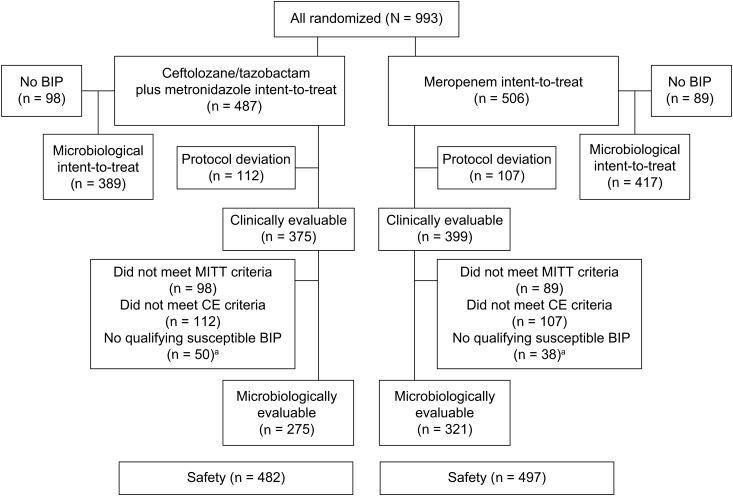
Ceftolozane/tazobactam plus metronidazole was noninferior to meropenem in the primary (83.0% [323/389] vs 87.3% [364/417]; weighted difference, -4.2%; 95% confidence interval [CI], -8.91 to .54) and secondary (94.2% [259/275] vs 94.7% [304/321]; weighted difference, -1.0%; 95% CI, -4.52 to 2.59) endpoints, meeting the prespecified noninferiority margin. In patients with ESBL-producing Enterobacteriaceae, clinical cure rates were 95.8% (23/24) and 88.5% (23/26) in the ceftolozane/tazobactam plus metronidazole and meropenem groups, respectively, and 100% (13/13) and 72.7% (8/11) in patients with CTX-M-14/15 ESBLs. The frequency of adverse events (AEs) was similar in both treatment groups (44.0% vs 42.7%); the most common AEs in either group were nausea and diarrhea.
CONCLUSIONS
Treatment with ceftolozane/tazobactam plus metronidazole was noninferior to meropenem in adult patients with cIAI, including infections caused by multidrug-resistant pathogens.
CLINICAL TRIALS REGISTRATION
NCT01445665 and NCT01445678.
背景
引起复杂性腹腔内感染(cIAIs)的病原体的抗菌耐药性不断增加,这推动了新型抗菌药物的研发。头孢他啶/阿维巴坦是一种新型抗菌疗法,对多重耐药铜绿假单胞菌和大多数产超广谱β-内酰胺酶(ESBL)的肠杆菌科细菌具有活性。
方法
ASPECT-cIAI(头孢他啶/阿维巴坦治疗复杂性腹腔内感染的安全性和疗效评估)是一项前瞻性、随机、双盲试验。患有cIAI的住院患者每8小时接受一次头孢他啶/阿维巴坦(1.5g)加甲硝唑(500mg)治疗,或每8小时静脉注射一次美罗培南(1g),持续4 - 14天。预先设定的目标是在微生物意向性治疗(主要)和微生物可评估(次要)人群的治疗结束访视(治疗开始后24 - 32天)时,证明临床治愈率在统计学上不劣于美罗培南,非劣效界值为10%。还评估了微生物学结果和安全性。
结果
在主要终点(83.0% [323/389] 对 87.3% [364/417];加权差异,-4.2%;95%置信区间[CI],-8.91至0.54)和次要终点(94.2% [259/275] 对 94.7% [304/321];加权差异,-1.0%;95% CI,-4.52至2.59)方面,头孢他啶/阿维巴坦加甲硝唑不劣于美罗培南,达到了预先设定的非劣效界值。在产ESBL的肠杆菌科细菌感染患者中,头孢他啶/阿维巴坦加甲硝唑组和美罗培南组的临床治愈率分别为95.8%(23/24)和88.5%(23/26),在CTX-M-14/15型ESBL感染患者中分别为100%(13/13)和72.7%(8/11)。两个治疗组的不良事件(AE)发生率相似(44.0%对42.7%);两组中最常见的AE是恶心和腹泻。
结论
对于患有cIAI的成年患者,包括由多重耐药病原体引起的感染,头孢他啶/阿维巴坦加甲硝唑治疗不劣于美罗培南。
临床试验注册
NCT01445665和NCT01445678。

 Zotero 插件