
线粒体和细胞质中的活性氧对寿命有相反的影响。
Mitochondrial and cytoplasmic ROS have opposing effects on lifespan.
作者信息
Schaar Claire E, Dues Dylan J, Spielbauer Katie K, Machiela Emily, Cooper Jason F, Senchuk Megan, Hekimi Siegfried, Van Raamsdonk Jeremy M
机构信息
Laboratory of Aging and Neurodegenerative Disease (LAND), Center for Neurodegenerative Science, Van Andel Research Institute, Grand Rapids, Michigan, United States of America.
Department of Biology, McGill University, Montreal, Quebec, Canada.
出版信息
PLoS Genet. 2015 Feb 11;11(2):e1004972. doi: 10.1371/journal.pgen.1004972. eCollection 2015 Feb.
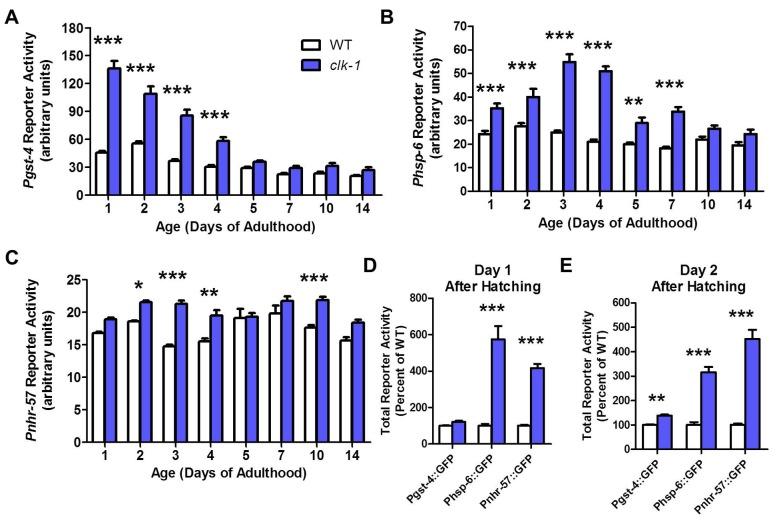
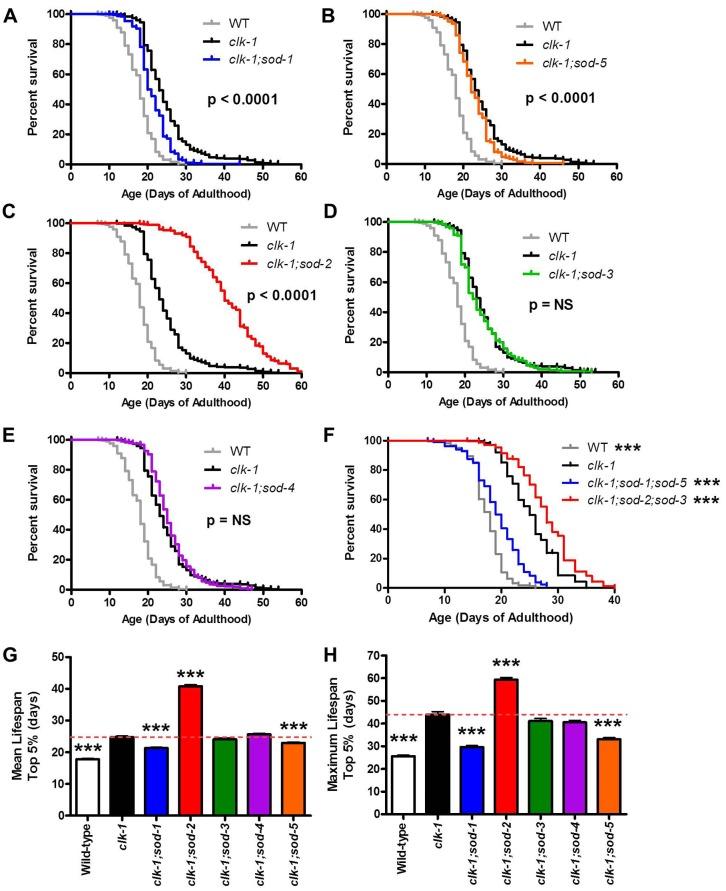
Reactive oxygen species (ROS) are highly reactive, oxygen-containing molecules that can cause molecular damage within the cell. While the accumulation of ROS-mediated damage is widely believed to be one of the main causes of aging, ROS also act in signaling pathways. Recent work has demonstrated that increasing levels of superoxide, one form of ROS, through treatment with paraquat, results in increased lifespan. Interestingly, treatment with paraquat robustly increases the already long lifespan of the clk-1 mitochondrial mutant, but not other long-lived mitochondrial mutants such as isp-1 or nuo-6. To genetically dissect the subcellular compartment in which elevated ROS act to increase lifespan, we deleted individual superoxide dismutase (sod) genes in clk-1 mutants, which are sensitized to ROS. We find that only deletion of the primary mitochondrial sod gene, sod-2 results in increased lifespan in clk-1 worms. In contrast, deletion of either of the two cytoplasmic sod genes, sod-1 or sod-5, significantly decreases the lifespan of clk-1 worms. Further, we show that increasing mitochondrial superoxide levels through deletion of sod-2 or treatment with paraquat can still increase lifespan in clk-1;sod-1 double mutants, which live shorter than clk-1 worms. The fact that mitochondrial superoxide can increase lifespan in worms with a detrimental level of cytoplasmic superoxide demonstrates that ROS have a compartment specific effect on lifespan - elevated ROS in the mitochondria acts to increase lifespan, while elevated ROS in the cytoplasm decreases lifespan. This work also suggests that both ROS-dependent and ROS-independent mechanisms contribute to the longevity of clk-1 worms.
活性氧(ROS)是一类具有高度反应性的含氧化合物分子,可在细胞内造成分子损伤。虽然人们普遍认为ROS介导的损伤积累是衰老的主要原因之一,但ROS也参与信号传导途径。最近的研究表明,通过百草枯处理提高超氧化物(ROS的一种形式)水平,可延长寿命。有趣的是,百草枯处理能显著延长clk-1线粒体突变体本就较长的寿命,但对isp-1或nuo-6等其他长寿线粒体突变体却没有这种效果。为了从基因层面剖析ROS水平升高从而延长寿命所作用的亚细胞区室,我们在对ROS敏感的clk-1突变体中逐个删除超氧化物歧化酶(sod)基因。我们发现,只有删除主要的线粒体sod基因sod-2才能延长clk-1线虫的寿命。相反,删除两个细胞质sod基因sod-1或sod-5中的任何一个,都会显著缩短clk-1线虫的寿命。此外,我们还表明,通过删除sod-2或用百草枯处理来提高线粒体超氧化物水平,仍可延长clk-1;sod-1双突变体的寿命,该双突变体的寿命比clk-1线虫短。线粒体超氧化物能延长细胞质超氧化物水平有害的线虫的寿命,这一事实表明ROS对寿命具有区室特异性影响——线粒体中升高的ROS可延长寿命,而细胞质中升高的ROS则会缩短寿命。这项研究还表明,ROS依赖性和ROS非依赖性机制都有助于clk-1线虫的长寿。





 Zotero 插件