
对健康指标不平等现象的影响:印度哈里亚纳邦实施新生儿和儿童疾病综合管理项目的效果
Impact on inequities in health indicators: Effect of implementing the integrated management of neonatal and childhood illness programme in Haryana, India.
作者信息
Taneja Sunita, Bahl Shikhar, Mazumder Sarmila, Martines Jose, Bhandari Nita, Bhan Maharaj Kishan
机构信息
Centre for Health Research and Development, Society for Applied Studies, New Delhi, India.
Centre for Intervention Science in Maternal and Child Health, Centre for International Health, University of Bergen, Norway.
出版信息
J Glob Health. 2015 Jun;5(1):010401. doi: 10.7189/jogh.05.010401.
BACKGROUND
A trial to evaluate the Integrated Management of Neonatal and Childhood Illness (IMNCI) strategy showed that the intervention resulted in lower infant mortality and improved infant care practices. In this paper, we present the results of a secondary analysis to examine the effect of the IMNCI strategy on inequities in health indicators.
METHODS
The trial was a cluster-randomized controlled trial in 18 primary health centre areas. For this analysis, the population was divided into subgroups by wealth status (using Principal Component Analysis), religion and caste, education of mother and sex of the infant. Multiple linear regression analysis was used to examine inequity gradients in neonatal and post-neonatal mortality, care practices and care seeking, and the differences in these gradients between intervention and control clusters.
FINDINGS
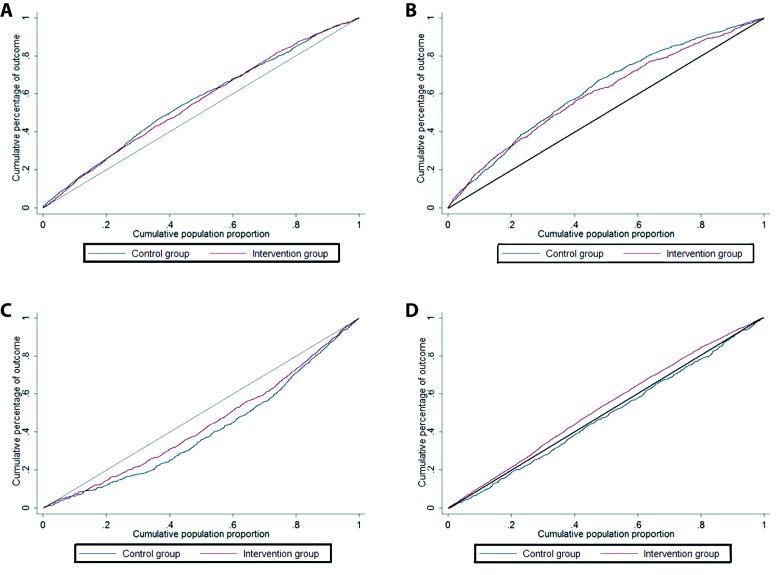
Inequity in post-neonatal infant mortality by wealth status was lower in the intervention as compared to control clusters (adjusted difference in gradients 2.2 per 1000, 95% confidence interval (CI) 0 to 4.4 per 1000, P = 0.053). The intervention had no effect on inequities in neonatal mortality. The intervention resulted in a larger effect on breastfeeding within one hour of birth in poorer families (difference in inequity gradients 3.0%, CI 1.5 to 4.5, P < 0.001), in lower caste and minorities families, and in infants of mothers with fewer years of schooling. The intervention also reduced gender inequity in care seeking for severe neonatal illness from an appropriate provider (difference in inequity gradients 9.3%, CI 0.4 to 18.2, P = 0.042).
CONCLUSIONS
Implementation of IMNCI reduced inequities in post-neonatal mortality, and newborn care practices (particularly starting breastfeeding within an hour of birth) and health care-seeking for severe illness. In spite of the intervention substantial inequities remained in the intervention group and therefore further efforts to ensure that health programs reach the vulnerable population subgroups are required.
TRIAL REGISTRATION
Clinicaltrials.gov NCT00474981; ICMR Clinical Trial Registry CTRI/2009/091/000715.
背景
一项评估新生儿和儿童疾病综合管理(IMNCI)策略的试验表明,该干预措施降低了婴儿死亡率并改善了婴儿护理做法。在本文中,我们呈现了一项二次分析的结果,以检验IMNCI策略对健康指标不平等现象的影响。
方法
该试验是在18个初级卫生中心地区进行的整群随机对照试验。对于此次分析,根据财富状况(使用主成分分析)、宗教和种姓、母亲的教育程度以及婴儿性别将人群分为亚组。采用多元线性回归分析来检验新生儿和新生儿期后死亡率、护理做法和寻求护理方面的不平等梯度,以及干预组和对照组在这些梯度上的差异。
研究结果
与对照组相比,干预组中按财富状况划分的新生儿期后婴儿死亡率不平等程度较低(梯度调整差异为每1000例中有2.2例,95%置信区间(CI)为每1000例中0至4.4例,P = 0.053)。该干预措施对新生儿死亡率的不平等现象没有影响。在较贫困家庭、低种姓和少数族裔家庭以及母亲受教育年限较少的婴儿中,干预措施对出生后一小时内的母乳喂养产生了更大影响(不平等梯度差异为3.0%,CI为1.5至4.5,P < 0.001)。该干预措施还减少了从合适的医疗服务提供者处寻求严重新生儿疾病护理方面的性别不平等(不平等梯度差异为9.3%,CI为0.4至18.2,P = 0.042)。
结论
实施IMNCI减少了新生儿期后死亡率、新生儿护理做法(尤其是出生后一小时内开始母乳喂养)以及严重疾病医疗服务寻求方面的不平等。尽管采取了干预措施,但干预组中仍存在大量不平等现象,因此需要进一步努力确保卫生项目覆盖弱势群体亚组。
试验注册
Clinicaltrials.gov NCT00474981;ICMR临床试验注册中心CTRI/2009/091/000715。
 Zotero 插件