
将总胆固醇诊断临界值从7.5毫摩尔/升提高到9.3毫摩尔/升会提高单基因家族性高胆固醇血症患者的检出率吗?
Would raising the total cholesterol diagnostic cut-off from 7.5 mmol/L to 9.3 mmol/L improve detection rate of patients with monogenic familial hypercholesterolaemia?
作者信息
Futema M, Kumari M, Boustred C, Kivimaki M, Humphries S E
机构信息
Centre for Cardiovascular Genetics, British Heart Foundation Laboratories, Institute of Cardiovascular Science, The Rayne Building, University College London, London, WC1E 6JF, UK.
University of Essex, Wivenhoe Park, Colchester, Essex, CO4 3SQ, UK.
出版信息
Atherosclerosis. 2015 Apr;239(2):295-8. doi: 10.1016/j.atherosclerosis.2015.01.028. Epub 2015 Jan 28.
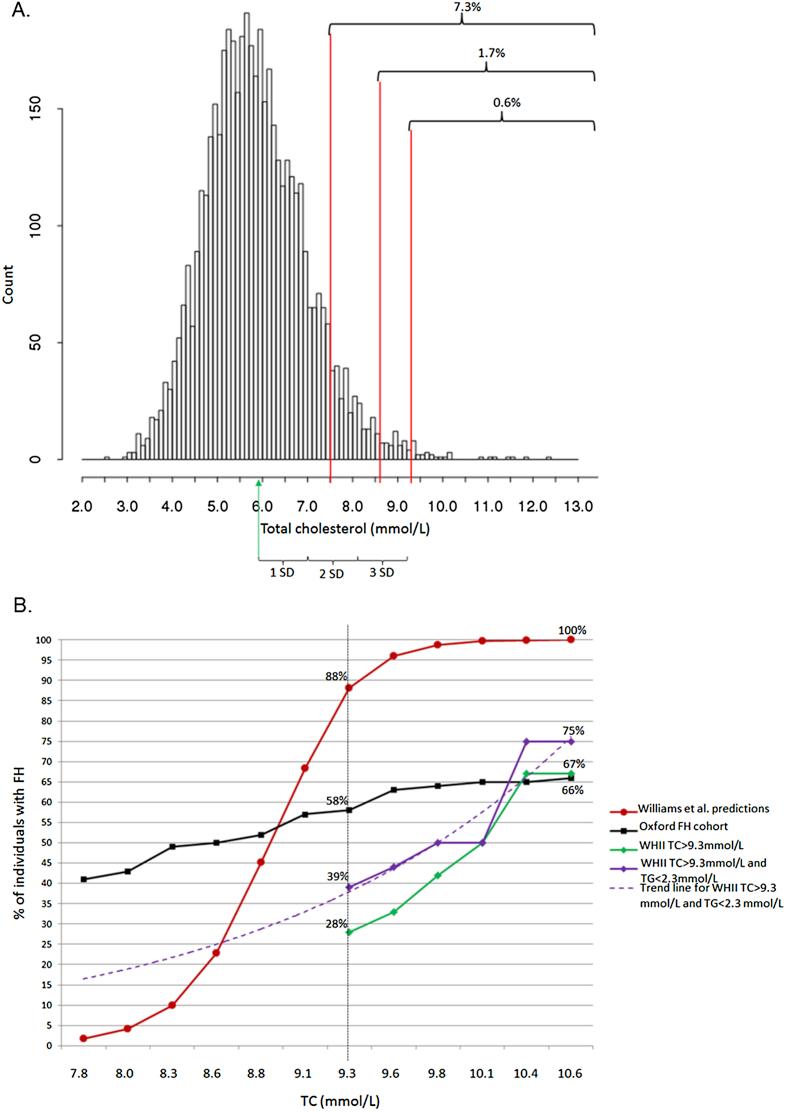
A previous report suggested that 88% of individuals in the general population with total cholesterol (TC) > 9.3 mmol/L have familial hypercholesterolaemia (FH). We tested this hypothesis in a cohort of 4896 UK civil servants, mean (SD) age 44 (±6) years, using next generation sequencing to achieve a comprehensive genetic diagnosis. 25 (0.5%) participants (mean age 49.2 years) had baseline TC > 9.3 mmol/L, and overall we found an FH-causing mutation in the LDLR gene in seven (28%) subjects. The detection rate increased to 39% by excluding eight participants with triglyceride levels over 2.3 mmol/L, and reached 75% in those with TC > 10.4 mmol/L. By extrapolation, the detection rate would be ∼25% by including all participants with TC > 8.6 mmol/L (2.5 standard deviations from the mean). Based on the 1/500 FH frequency, 30% of all FH-cases in this cohort would be missed using the 9.3 mmol/L cut-off. Given that an overall detection rate of 25% is considered economically acceptable, these data suggest that a diagnostic TC cut-off of 8.6 mmol/L, rather than 9.3 mmol/L would be clinically useful for FH in the general population.
先前的一份报告表明,在普通人群中,总胆固醇(TC)> 9.3 mmol/L的个体中有88%患有家族性高胆固醇血症(FH)。我们在4896名英国公务员队列中对这一假设进行了检验,这些公务员的平均(标准差)年龄为44(±6)岁,采用新一代测序技术以实现全面的基因诊断。25名(0.5%)参与者(平均年龄49.2岁)基线TC> 9.3 mmol/L,总体而言,我们在7名(28%)受试者的低密度脂蛋白受体(LDLR)基因中发现了导致FH的突变。通过排除8名甘油三酯水平超过2.3 mmol/L的参与者,检测率提高到39%,而在TC> 10.4 mmol/L的参与者中达到75%。通过推断,纳入所有TC> 8.6 mmol/L(比均值高2.5个标准差)的参与者,检测率将约为25%。基于1/500的FH发生率,使用9.3 mmol/L的临界值将遗漏该队列中所有FH病例的30%。鉴于25%的总体检测率在经济上被认为是可接受的,这些数据表明,对于普通人群中的FH,8.6 mmol/L而非9.3 mmol/L的诊断性TC临界值在临床上将是有用的。
 Zotero 插件