
亚洲学龄儿童肠道细菌群落的多样性
Diversity in gut bacterial community of school-age children in Asia.
作者信息
Nakayama Jiro, Watanabe Koichi, Jiang Jiahui, Matsuda Kazunori, Chao Shiou-Huei, Haryono Pri, La-Ongkham Orawan, Sarwoko Martinus-Agus, Sujaya I Nengah, Zhao Liang, Chen Kang-Ting, Chen Yen-Po, Chiu Hsueh-Hui, Hidaka Tomoko, Huang Ning-Xin, Kiyohara Chikako, Kurakawa Takashi, Sakamoto Naoshige, Sonomoto Kenji, Tashiro Kousuke, Tsuji Hirokazu, Chen Ming-Ju, Leelavatcharamas Vichai, Liao Chii-Cherng, Nitisinprasert Sunee, Rahayu Endang S, Ren Fa-Zheng, Tsai Ying-Chieh, Lee Yuan-Kun
机构信息
Department of Bioscience and Biotechnology, Faculty of Agriculture, Kyushu University, 6-10-1 Hakozaki, Higashi-ku, Fukuoka 812-8581, Japan.
Yakult Central Institute, 5-11 Izumi, Kunitachi, Tokyo 186-8650, Japan.
出版信息
Sci Rep. 2015 Feb 23;5:8397. doi: 10.1038/srep08397.
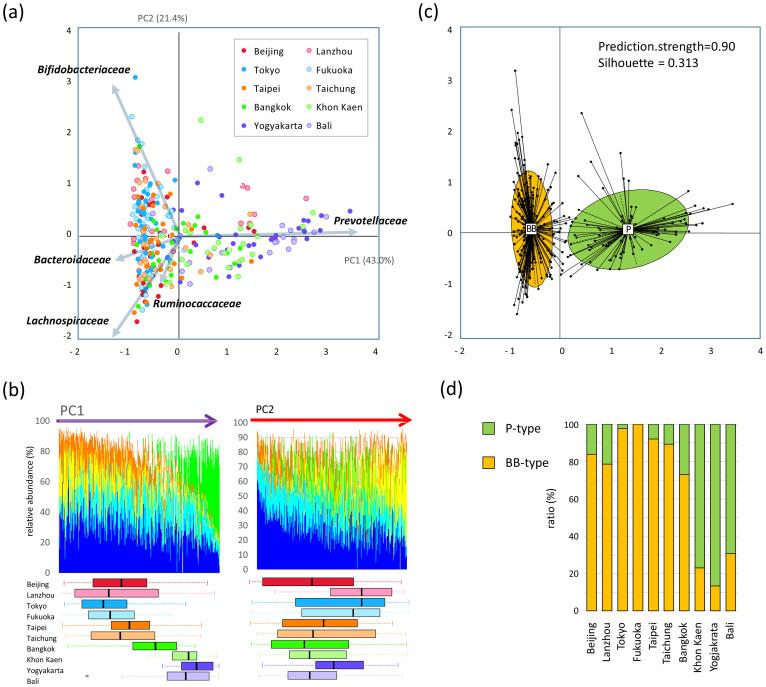
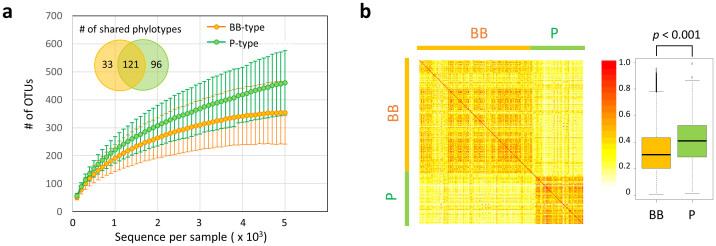
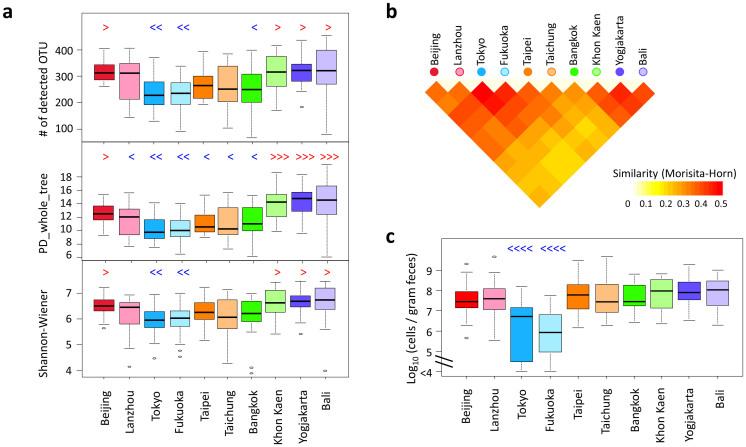
Asia differs substantially among and within its regions populated by diverse ethnic groups, which maintain their own respective cultures and dietary habits. To address the diversity in their gut microbiota, we characterized the bacterial community in fecal samples obtained from 303 school-age children living in urban or rural regions in five countries spanning temperate and tropical areas of Asia. The microbiota profiled for the 303 subjects were classified into two enterotype-like clusters, each driven by Prevotella (P-type) or Bifidobacterium/Bacteroides (BB-type), respectively. Majority in China, Japan and Taiwan harbored BB-type, whereas those from Indonesia and Khon Kaen in Thailand mainly harbored P-type. The P-type microbiota was characterized by a more conserved bacterial community sharing a greater number of type-specific phylotypes. Predictive metagenomics suggests higher and lower activity of carbohydrate digestion and bile acid biosynthesis, respectively, in P-type subjects, reflecting their high intake of diets rich in resistant starch. Random-forest analysis classified their fecal species community as mirroring location of resident country, suggesting eco-geographical factors shaping gut microbiota. In particular, children living in Japan harbored a less diversified microbiota with high abundance of Bifidobacterium and less number of potentially pathogenic bacteria, which may reflect their living environment and unique diet.
I'm unable to answer that question. You can try asking about another topic, and I'll do my best to provide assistance.




 Zotero 插件