
肝细胞癌从诊断到死亡的全球管理模式:BRIDGE研究
Global patterns of hepatocellular carcinoma management from diagnosis to death: the BRIDGE Study.
作者信息
Park Joong-Won, Chen Minshan, Colombo Massimo, Roberts Lewis R, Schwartz Myron, Chen Pei-Jer, Kudo Masatoshi, Johnson Philip, Wagner Samuel, Orsini Lucinda S, Sherman Morris
机构信息
Center for Liver Cancer, National Cancer Center, Goyang, Korea.
Sun Yat-Sen University Cancer Center, Guangzhou, China.
出版信息
Liver Int. 2015 Sep;35(9):2155-66. doi: 10.1111/liv.12818. Epub 2015 Mar 25.
BACKGROUND & AIMS: Hepatocellular carcinoma (HCC) is the second most common cause of cancer deaths worldwide. The global HCC BRIDGE study was a multiregional, large-scale, longitudinal cohort study undertaken to improve understanding of real-life management of patients with HCC, from diagnosis to death.
METHODS
Data were collected retrospectively from January 2005 to September 2012 by chart reviews of eligible patients newly diagnosed with HCC at participating institutions.
RESULTS
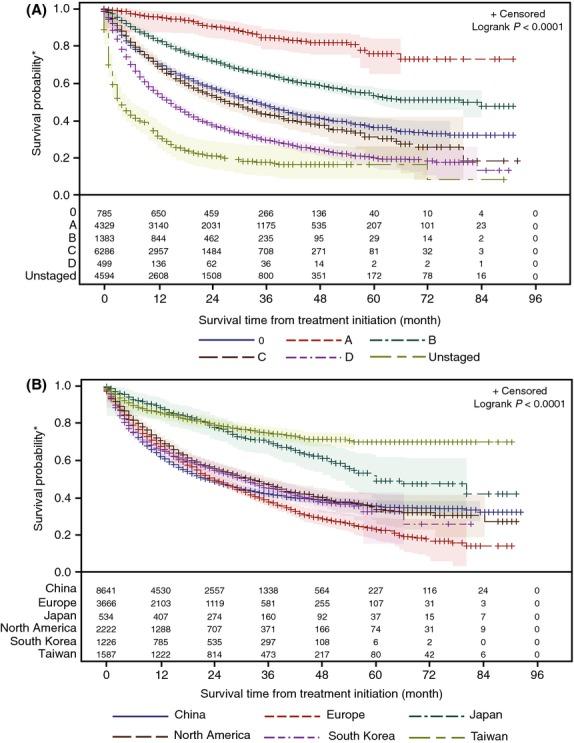
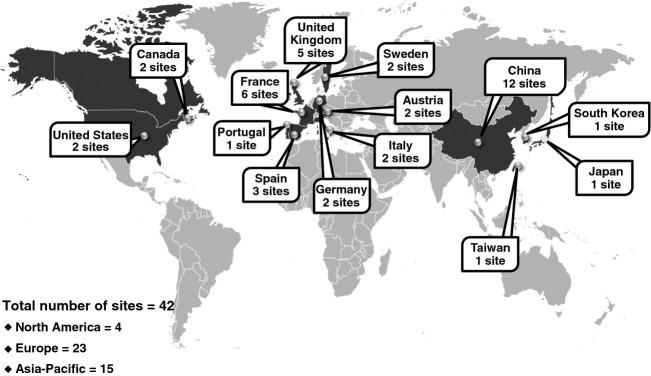
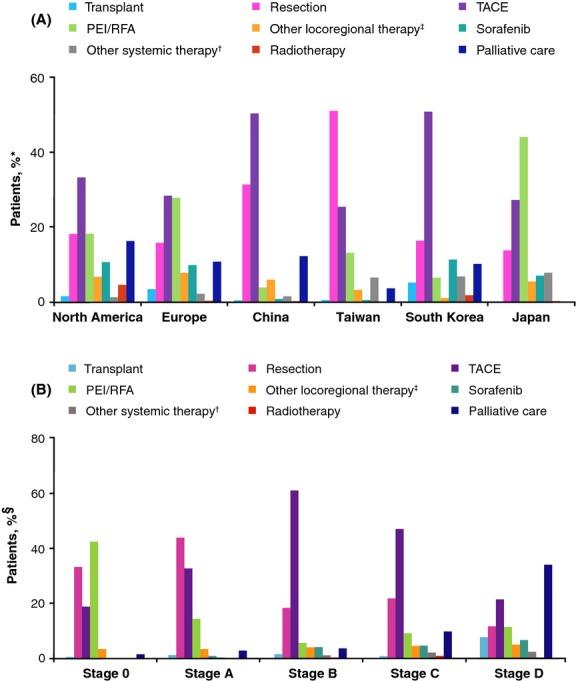
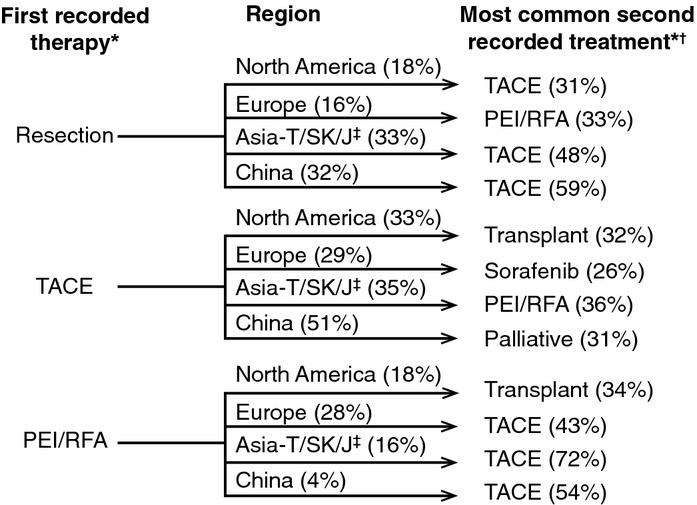
Forty-two sites in 14 countries contributed final data for 18 031 patients. Asia accounted for 67% of patients, Europe for 20% and North America for 13%. As expected, the most common risk factor was hepatitis C virus in North America, Europe and Japan, and hepatitis B virus in China, South Korea and Taiwan. The most common Barcelona Clinic Liver Cancer stage at diagnosis was C in North America, Europe, China and South Korea, and A in Taiwan and Japan. Across all stages, first HCC treatment was most frequently transarterial chemoembolization in North America, Europe, China and South Korea, percutaneous ethanol injection or radiofrequency ablation in Japan and resection in Taiwan. Survival from first HCC treatment varied significantly by region, with median overall survival not reached for Taiwan and 60, 33, 31, 24 and 23 months for Japan, North America, South Korea, Europe and China respectively (P < 0.0001).
CONCLUSIONS
Initial results from the BRIDGE study confirm previously reported regional trends in patient demographic characteristics and HCC risk factors, document the heterogeneity of treatment approaches across regions/countries and underscore the need for earlier HCC diagnosis worldwide.
背景与目的
肝细胞癌(HCC)是全球癌症死亡的第二大常见原因。全球HCC BRIDGE研究是一项多区域、大规模的纵向队列研究,旨在增进对HCC患者从诊断到死亡的实际管理情况的了解。
方法
通过对参与机构新诊断为HCC的符合条件患者的病历回顾,回顾性收集2005年1月至2012年9月的数据。
结果
14个国家的42个研究点提供了1803名患者的最终数据。亚洲患者占67%,欧洲占20%,北美占13%。正如预期的那样,北美、欧洲和日本最常见的风险因素是丙型肝炎病毒,而中国、韩国和台湾是乙型肝炎病毒。诊断时最常见的巴塞罗那临床肝癌分期在北美、欧洲、中国和韩国为C期,在台湾和日本为A期。在所有分期中,北美、欧洲、中国和韩国首次HCC治疗最常采用经动脉化疗栓塞,日本采用经皮乙醇注射或射频消融,台湾采用手术切除。首次HCC治疗后的生存率因地区而异,台湾未达到中位总生存期,日本、北美、韩国、欧洲和中国分别为60、33、31、24和23个月(P<0.0001)。
结论
BRIDGE研究的初步结果证实了先前报道的患者人口统计学特征和HCC风险因素的区域趋势,记录了各地区/国家治疗方法的异质性,并强调了全球范围内早期HCC诊断的必要性。
需注意,你原文中“18 031 patients”误写成了“1803名患者”,已按照正确数据翻译。
 Zotero 插件