
在感染过程早期,R5嗜T细胞型HIV-1在中枢神经系统中的分隔复制。
Compartmentalized replication of R5 T cell-tropic HIV-1 in the central nervous system early in the course of infection.
作者信息
Sturdevant Christa Buckheit, Joseph Sarah B, Schnell Gretja, Price Richard W, Swanstrom Ronald, Spudich Serena
机构信息
Department of Microbiology and Immunology, University of North Carolina at Chapel Hill, Chapel Hill, North Carolina, United States of America.
Lineberger Comprehensive Cancer Center, University of North Carolina at Chapel Hill, Chapel Hill, North Carolina, United States of America.
出版信息
PLoS Pathog. 2015 Mar 26;11(3):e1004720. doi: 10.1371/journal.ppat.1004720. eCollection 2015 Mar.
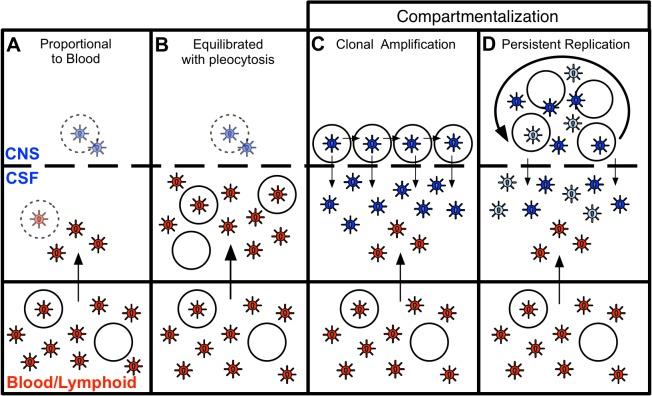
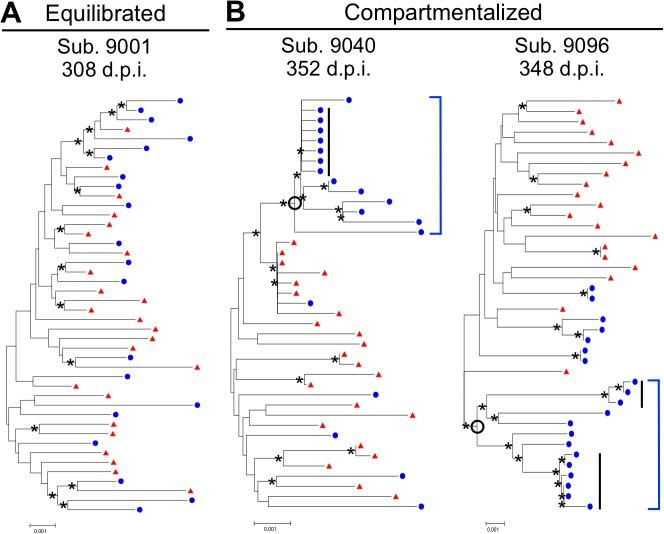
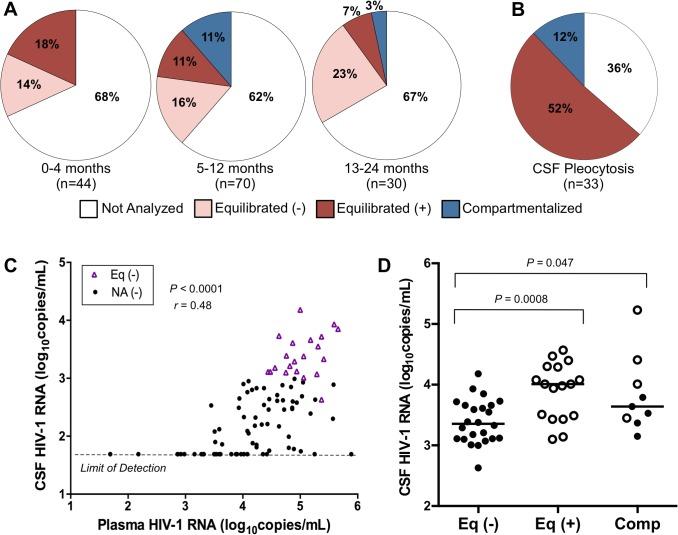
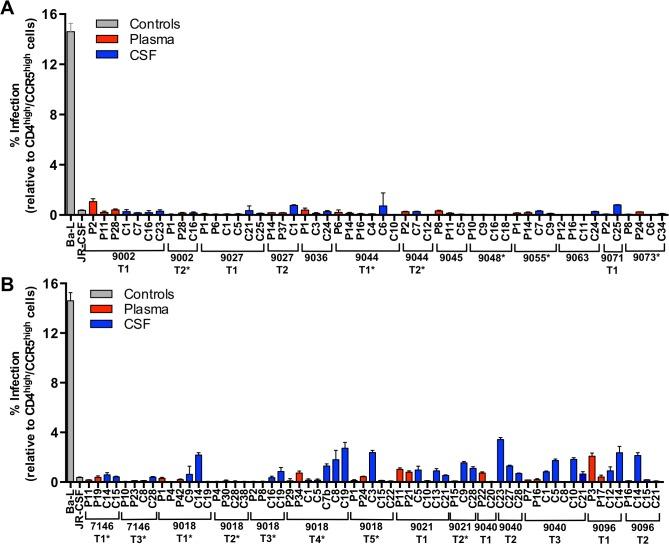
Compartmentalized HIV-1 replication within the central nervous system (CNS) likely provides a foundation for neurocognitive impairment and a potentially important tissue reservoir. The timing of emergence and character of this local CNS replication has not been defined in a population of subjects. We examined the frequency of elevated cerebrospinal fluid (CSF) HIV-1 RNA concentration, the nature of CSF viral populations compared to the blood, and the presence of a cellular inflammatory response (with the potential to bring infected cells into the CNS) using paired CSF and blood samples obtained over the first two years of infection from 72 ART-naïve subjects. Using single genome amplification (SGA) and phylodynamics analysis of full-length env sequences, we compared CSF and blood viral populations in 33 of the 72 subjects. Independent HIV-1 replication in the CNS (compartmentalization) was detected in 20% of sample pairs analyzed by SGA, or 7% of all sample pairs, and was exclusively observed after four months of infection. In subjects with longitudinal sampling, 30% showed evidence of CNS viral replication or pleocytosis/inflammation in at least one time point, and in approximately 16% of subjects we observed evolving CSF/CNS compartmentalized viral replication and/or a marked CSF inflammatory response at multiple time points suggesting an ongoing or recurrent impact of the infection in the CNS. Two subjects had one of two transmitted lineages (or their recombinant) largely sequestered within the CNS shortly after transmission, indicating an additional mechanism for establishing early CNS replication. Transmitted variants were R5 T cell-tropic. Overall, examination of the relationships between CSF viral populations, blood and CSF HIV-1 RNA concentrations, and inflammatory responses suggested four distinct states of viral population dynamics, with associated mechanisms of local viral replication and the early influx of virus into the CNS. This study considerably enhances the generalizability of our results and greatly expands our knowledge of the early interactions of HIV-1 in the CNS.
中枢神经系统(CNS)内HIV-1的分区复制可能是神经认知障碍的基础以及一个潜在的重要组织储存库。在一群受试者中,这种局部CNS复制出现的时间和特征尚未明确。我们使用从72名未接受抗逆转录病毒治疗(ART)的受试者感染后的头两年内获取的配对脑脊液(CSF)和血液样本,检测了脑脊液中HIV-1 RNA浓度升高的频率、脑脊液病毒群体与血液相比的性质,以及细胞炎症反应(有可能将感染细胞带入中枢神经系统)的存在情况。通过对全长env序列进行单基因组扩增(SGA)和系统动力学分析,我们比较了72名受试者中33名的脑脊液和血液病毒群体。通过SGA分析的样本对中有20%检测到中枢神经系统内独立的HIV-1复制(分区化),即所有样本对的7%,且仅在感染四个月后观察到。在进行纵向采样的受试者中,30%在至少一个时间点显示出中枢神经系统病毒复制或脑脊液细胞增多/炎症的证据,并且在约16%的受试者中,我们在多个时间点观察到不断演变的脑脊液/中枢神经系统分区化病毒复制和/或明显的脑脊液炎症反应,表明感染在中枢神经系统中持续或反复产生影响。两名受试者在传播后不久,两个传播谱系之一(或其重组体)在很大程度上隔离于中枢神经系统内,这表明存在另一种建立早期中枢神经系统复制的机制。传播的变体是R5 T细胞嗜性的。总体而言,对脑脊液病毒群体、血液和脑脊液中HIV-1 RNA浓度以及炎症反应之间关系的研究表明存在四种不同的病毒群体动态状态,以及局部病毒复制和病毒早期进入中枢神经系统的相关机制。这项研究显著提高了我们结果的普遍性,并极大地扩展了我们对HIV-1在中枢神经系统中早期相互作用的认识。


 Zotero 插件