
在过去十年中,冠状动脉搭桥术和瓣膜手术后的30天死亡率有了显著改善,但1年死亡率仍保持不变。
30-day mortality after coronary artery bypass grafting and valve surgery has greatly improved over the last decade, but the 1-year mortality remains constant.
作者信息
Hansen Laura Sommer, Hjortdal Vibeke Elisabeth, Andreasen Jan Jesper, Mortensen Poul Erik, Jakobsen Carl-Johan
机构信息
Department of Anaesthesiology and Intensive Care, Aarhus University Hospital, Aarhus, Denmark.
出版信息
Ann Card Anaesth. 2015 Apr-Jun;18(2):138-42. doi: 10.4103/0971-9784.154462.
INTRODUCTION
European system for cardiac operative risk evaluation (EuroSCORE) is a valuable tool in control of the quality of cardiac surgery. However, the validity of the risk score for the individual patient may be questioned. The present study was carried out to investigate whether the continued fall in short-term mortality reflects an actual improvement in late mortality, and subsequently, to investigate EuroSCORE as predictor of 1-year mortality.
METHODS
A population-based cohort study of 25,602 patients from a 12-year period from three public university hospitals undergoing coronary artery bypass grafting (CABG) or valve surgery. Analysis was carried out based on EuroSCORE, age and co-morbidity factors (residual EuroSCORE).
RESULTS
During the period the average age increased from 65.1 ± 10.0 years to 68.9 ± 10.7 years (P < 0.001, one-way ANOVA), and the number of females increased from 26.0% to 28.2% (P = 0.0012, Chi-square test). The total EuroSCORE increased from 4.67 to 5.68 while the residual EuroSCORE decreased from 2.64 to 1.83. Thirty-day mortality decreased from 4.07% in 1999-2000 to 2.44% in 2011-2012 (P = 0.0056; Chi-square test), while 1-year mortality was unchanged (6.50% in 1999-2000 vs. 6.25% in 2011-2012 [P = 0.8086; Chi-square test]).
DISCUSSION
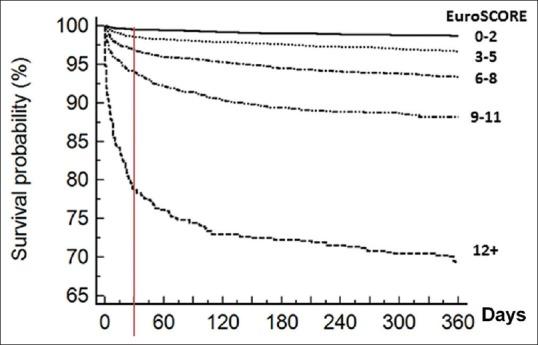
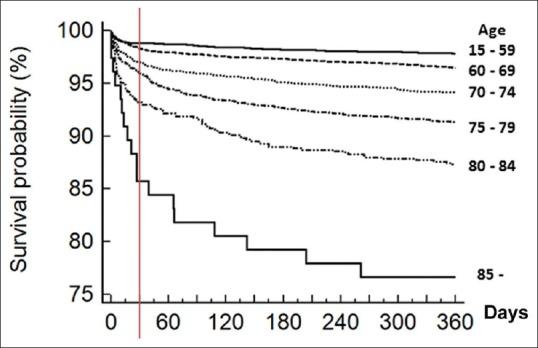
The study demonstrates that both co-morbidity and age has a great impact on 30-day mortality. However, with time the impact of co-morbidity seems less. Thus, age is more important than co-morbidity in late mortality. The various developments in short and long-term mortality are not readily explained.
CONCLUSION
Although 30-day mortality of CABG and valve surgery patients has decreased during the 12-year period, the 1-year mortality remains the same.
引言
欧洲心脏手术风险评估系统(EuroSCORE)是控制心脏手术质量的一项重要工具。然而,该风险评分对个体患者的有效性可能受到质疑。本研究旨在调查短期死亡率的持续下降是否反映了长期死亡率的实际改善,随后,研究EuroSCORE作为1年死亡率预测指标的情况。
方法
一项基于人群的队列研究,研究对象为来自三家公立大学医院的25602例患者,这些患者在12年期间接受了冠状动脉旁路移植术(CABG)或瓣膜手术。基于EuroSCORE、年龄和合并症因素(残余EuroSCORE)进行分析。
结果
在此期间,平均年龄从65.1±10.0岁增加到68.9±10.7岁(P<0.001,单因素方差分析),女性患者数量从26.0%增加到28.2%(P=0.0012,卡方检验)。总EuroSCORE从4.67增加到5.68,而残余EuroSCORE从2.64下降到1.83。30天死亡率从1999 - 2000年的4.07%降至2011 - 2012年的2.44%(P=0.0056;卡方检验),而1年死亡率未变(1999 - 2000年为6.50%,2011 - 2012年为6.25%[P=0.8086;卡方检验])。
讨论
该研究表明,合并症和年龄对30天死亡率均有重大影响。然而,随着时间推移,合并症的影响似乎变小。因此,在长期死亡率方面,年龄比合并症更重要。短期和长期死亡率的各种变化难以轻易解释。
结论
尽管在12年期间CABG和瓣膜手术患者的30天死亡率有所下降,但1年死亡率保持不变。


 Zotero 插件