
1型糖尿病患者内皮功能障碍、炎症及凝血生物标志物与亚临床动脉粥样硬化的纵向关联:糖尿病控制与并发症试验/糖尿病干预与并发症流行病学研究队列评估
Longitudinal Association Between Endothelial Dysfunction, Inflammation, and Clotting Biomarkers With Subclinical Atherosclerosis in Type 1 Diabetes: An Evaluation of the DCCT/EDIC Cohort.
作者信息
Hunt Kelly J, Baker Nathaniel L, Cleary Patricia A, Klein Richard, Virella Gabriel, Lopes-Virella Maria F
机构信息
Department of Public Health Sciences, Medical University of South Carolina, Charleston, SC Ralph H. Johnson VA Medical Center, Charleston, SC
Department of Public Health Sciences, Medical University of South Carolina, Charleston, SC.
出版信息
Diabetes Care. 2015 Jul;38(7):1281-9. doi: 10.2337/dc14-2877. Epub 2015 Apr 7.
OBJECTIVE
There is considerable interest in identifying biomarkers that predict high risk for the development of macrovascular complications in patients with diabetes. Therefore, the longitudinal association between subclinical atherosclerosis as measured by internal carotid artery intima-media thickness (IMT) and acute-phase reactants, cytokines/adipokines, thrombosis, and adhesion molecules was examined.
RESEARCH DESIGN AND METHODS
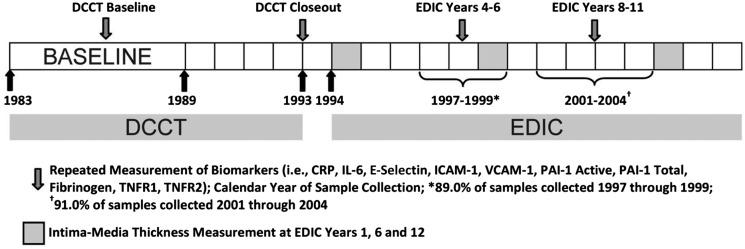
Biomarkers were measured at four time points over 20 years in 886 DCCT/EDIC participants with type 1 diabetes. Four composite scores were created by combining z scores generated from within the data set of individual biomarkers: acute-phase reactants (fibrinogen, C-reactive protein), thrombosis (fibrinogen, active and total plasminogen activator inhibitor [PAI]-1), cytokines/adipokines (tumor necrosis factor receptor-1 and -2, active and total PAI-1, IL-6), and endothelial dysfunction (soluble intracellular adhesion molecule-1, soluble vascular cell adhesion molecule-1, and soluble E-selectin). Internal carotid IMT was measured at EDIC years 1, 6, and 12, with elevated IMT defined at each time point as being in the upper quintile of its distribution.
RESULTS
Logistic regression models indicate that while individual biomarkers were not predictive of or associated with subclinical atherosclerosis, composite scores of acute-phase reactants (odds ratio [OR] 2.78 [95% CI 1.42, 5.42]), thrombolytic factors (OR 2.83 [95% CI 1.45, 5.52]), and cytokines/adipokines (OR 2.83 [95% CI 1.48, 5.41]) measured at our final time point EDIC years 8-11 were associated with higher levels of atherosclerosis at EDIC year 12, but findings were not consistent at early time points. The endothelial dysfunction score was not appreciably predictive of or associated with subclinical atherosclerosis at any of the time points measured.
CONCLUSIONS
The pathophysiologic relationship between higher biomarker levels and progression of subclinical atherosclerosis remains unclear.
目的
人们对识别预测糖尿病患者发生大血管并发症高风险的生物标志物有着浓厚兴趣。因此,研究了通过颈内动脉内膜中层厚度(IMT)测量的亚临床动脉粥样硬化与急性期反应物、细胞因子/脂肪因子、血栓形成和黏附分子之间的纵向关联。
研究设计与方法
在886名1型糖尿病的糖尿病控制与并发症试验/糖尿病干预和并发症研究(DCCT/EDIC)参与者中,于20年期间的四个时间点测量生物标志物。通过合并从各个生物标志物数据集中生成的z分数创建了四个综合评分:急性期反应物(纤维蛋白原、C反应蛋白)、血栓形成(纤维蛋白原、活性和总纤溶酶原激活物抑制剂[PAI]-1)、细胞因子/脂肪因子(肿瘤坏死因子受体-1和-2、活性和总PAI-1、白细胞介素-6)以及内皮功能障碍(可溶性细胞间黏附分子-1、可溶性血管细胞黏附分子-1和可溶性E选择素)。在糖尿病干预和并发症研究(EDIC)第1、6和12年测量颈内动脉IMT,每个时间点将IMT升高定义为处于其分布的上五分位数。
结果
逻辑回归模型表明,虽然单个生物标志物不能预测亚临床动脉粥样硬化或与之相关,但在我们的最后时间点(EDIC第8 - 11年)测量的急性期反应物综合评分(比值比[OR] 2.78 [95%置信区间1.42, 5.42])、溶栓因子(OR 2.83 [95%置信区间1.45, 5.52])和细胞因子/脂肪因子(OR 2.83 [95%置信区间1.48, 5.41])与EDIC第12年更高水平的动脉粥样硬化相关,但在早期时间点结果并不一致。在内皮功能障碍评分在任何测量时间点均未明显预测亚临床动脉粥样硬化或与之相关。
结论
生物标志物水平升高与亚临床动脉粥样硬化进展之间的病理生理关系仍不清楚。
 Zotero 插件