
整合网络分析揭示血压调节的分子机制。
Integrative network analysis reveals molecular mechanisms of blood pressure regulation.
作者信息
Huan Tianxiao, Meng Qingying, Saleh Mohamed A, Norlander Allison E, Joehanes Roby, Zhu Jun, Chen Brian H, Zhang Bin, Johnson Andrew D, Ying Saixia, Courchesne Paul, Raghavachari Nalini, Wang Richard, Liu Poching, O'Donnell Christopher J, Vasan Ramachandran, Munson Peter J, Madhur Meena S, Harrison David G, Yang Xia, Levy Daniel
机构信息
The National Heart Lung and Blood Institute's Framingham Heart Study, Framingham, MA, USA The Population Sciences Branch and the Division of Intramural Research, National Heart, Lung and Blood Institute, Bethesda, MD, USA.
Department of Integrative Biology and Physiology, University of California, Los Angeles, CA, USA.
出版信息
Mol Syst Biol. 2015 Apr 16;11(1):799. doi: 10.15252/msb.20145399.
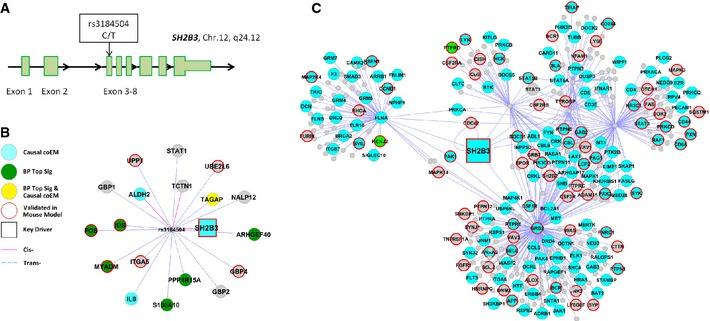
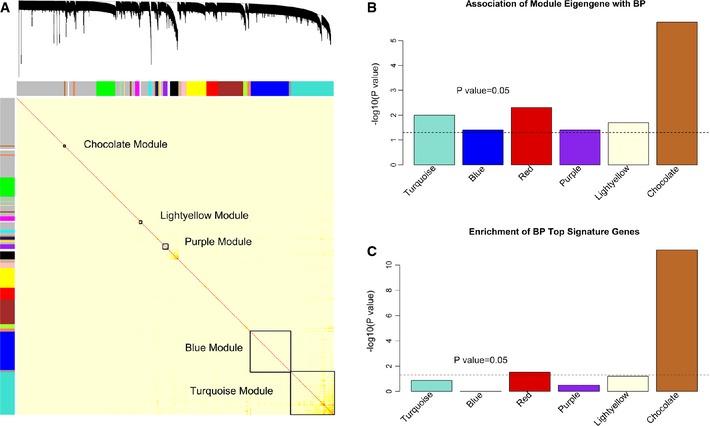
Genome-wide association studies (GWAS) have identified numerous loci associated with blood pressure (BP). The molecular mechanisms underlying BP regulation, however, remain unclear. We investigated BP-associated molecular mechanisms by integrating BP GWAS with whole blood mRNA expression profiles in 3,679 individuals, using network approaches. BP transcriptomic signatures at the single-gene and the coexpression network module levels were identified. Four coexpression modules were identified as potentially causal based on genetic inference because expression-related SNPs for their corresponding genes demonstrated enrichment for BP GWAS signals. Genes from the four modules were further projected onto predefined molecular interaction networks, revealing key drivers. Gene subnetworks entailing molecular interactions between key drivers and BP-related genes were uncovered. As proof-of-concept, we validated SH2B3, one of the top key drivers, using Sh2b3(-/-) mice. We found that a significant number of genes predicted to be regulated by SH2B3 in gene networks are perturbed in Sh2b3(-/-) mice, which demonstrate an exaggerated pressor response to angiotensin II infusion. Our findings may help to identify novel targets for the prevention or treatment of hypertension.
全基因组关联研究(GWAS)已经确定了许多与血压(BP)相关的基因座。然而,血压调节的分子机制仍不清楚。我们通过将血压GWAS与3679名个体的全血mRNA表达谱整合,采用网络方法研究了与血压相关的分子机制。在单基因和共表达网络模块水平上确定了血压转录组特征。基于遗传推断,四个共表达模块被确定为可能具有因果关系,因为其相应基因的表达相关单核苷酸多态性(SNP)显示出血压GWAS信号的富集。来自这四个模块的基因进一步投射到预定义的分子相互作用网络上,揭示了关键驱动因素。发现了关键驱动因素与血压相关基因之间存在分子相互作用的基因子网。作为概念验证,我们使用Sh2b3(-/-)小鼠验证了关键驱动因素之一SH2B3。我们发现,基因网络中预计受SH2B3调控的大量基因在Sh2b3(-/-)小鼠中受到干扰,这些小鼠对血管紧张素II输注表现出过度的升压反应。我们的研究结果可能有助于确定预防或治疗高血压的新靶点。

 Zotero 插件