
卤虫作为纳米颗粒毒性评估中的模式生物。
Artemia salina as a model organism in toxicity assessment of nanoparticles.
作者信息
Rajabi Somayeh, Ramazani Ali, Hamidi Mehrdad, Naji Tahereh
机构信息
Cell and Molecular Biology Departments, Pharmaceutical Sciences Branch, Islamic Azad University, Tehran, Iran.
Biotechnology Departments, School of Pharmacy, Zanjan University of Medical Sciences, Zanjan, Iran.
出版信息
Daru. 2015 Feb 24;23(1):20. doi: 10.1186/s40199-015-0105-x.
BACKGROUND
Because of expanding presence of nanomaterials, there has been an increase in the exposure of humans to nanoparticles that is why nanotoxicology studies are important. A number of studies on the effects of nanomatrials in in vitro and in vivo systems have been published. Currently cytotoxicity of different nanoparticles is assessed using the 3-(4,5-dimethylthiazol-2-yl)-2,5-diphenyltetrazolium bromide (MTT) assay on different cell lines to determine cell viability, a tedious and expensive method. The aim of this study was to evaluate the Artemia salina test in comparison with the MTT assay in the assessment of cytotoxicity of nanostructures because the former method is more rapid and convenient and less expensive.
METHODS
At the first stage, toxicity of different nanoparticles with different concentrations (1.56-400 μg/mL) was measured by means of the brine shrimp lethality test. At the second stage, the effect of nanoparticles on the viability of the L929 cell line was assessed using the MTT assay. Experiments were conducted with each concentration in triplicate.
RESULTS
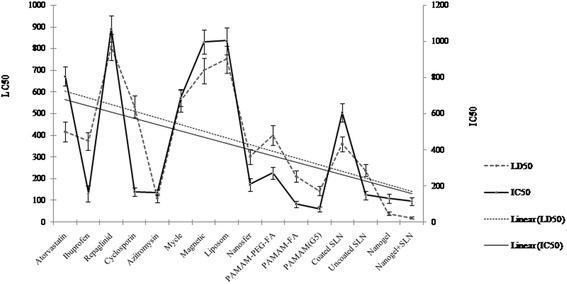
The results obtained from both tests (A. salina test and MTT assay) did not have statistically significant differences (P>0.05).
CONCLUSIONS
These findings suggest that the A. salina test may expedite toxicity experiments and decrease costs, and therefore, may be considered an alternative to the in vitro cell culture assay.
背景
由于纳米材料的存在范围不断扩大,人类接触纳米颗粒的情况有所增加,这就是纳米毒理学研究很重要的原因。已经发表了许多关于纳米材料在体外和体内系统中作用的研究。目前,使用3-(4,5-二甲基噻唑-2-基)-2,5-二苯基四氮唑溴盐(MTT)法在不同细胞系上评估不同纳米颗粒的细胞毒性以确定细胞活力,这是一种繁琐且昂贵的方法。本研究的目的是在评估纳米结构的细胞毒性时,将卤虫试验与MTT法进行比较,因为前一种方法更快速、方便且成本更低。
方法
在第一阶段,通过卤虫致死试验测量不同浓度(1.56 - 400μg/mL)的不同纳米颗粒的毒性。在第二阶段,使用MTT法评估纳米颗粒对L929细胞系活力的影响。每个浓度的实验均重复三次。
结果
从两种试验(卤虫试验和MTT法)获得的结果没有统计学上的显著差异(P>0.05)。
结论
这些发现表明卤虫试验可能会加快毒性实验并降低成本,因此,可以被视为体外细胞培养试验的一种替代方法。
 Zotero 插件