
间接作用和氧气对相对生物学效应的影响:γ射线和氦离子诱导的双链断裂产生及转化的评估
Effects of indirect actions and oxygen on relative biological effectiveness: estimate of DSB induction and conversion induced by gamma rays and helium ions.
作者信息
Tsai Ju-Ying, Chen Fang-Hsin, Hsieh Tsung-Yu, Hsiao Ya-Yun
机构信息
Institute of Biotechnology and Department of Life Science, National Tsing Hua University, Hsinchu, Taiwan, Republic of China.
Department of Medical Imaging and Radiological Sciences, Chang Gung University, Kweishan, Taiwan, Republic of China Radiation Biology Research Center, Institute for Radiological Research, Chang Gung University/Chang Gung Memorial Hospital, Linkou, Taoyuan, Taiwan, Republic of China.
出版信息
J Radiat Res. 2015 Jul;56(4):691-9. doi: 10.1093/jrr/rrv025. Epub 2015 Apr 22.
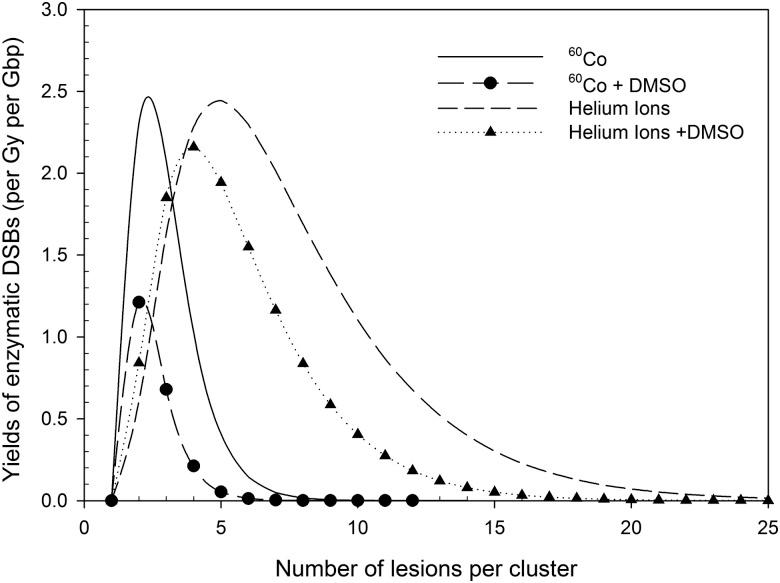
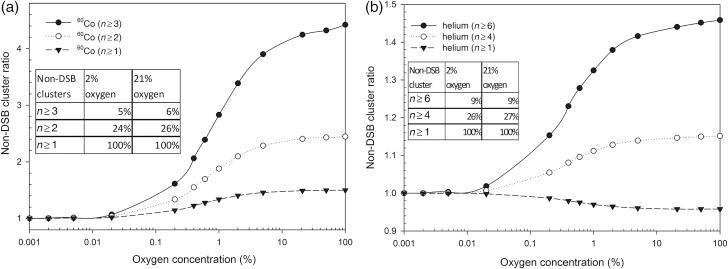
Clustered DNA damage other than double-strand breaks (DSBs) can be detrimental to cells and can lead to mutagenesis or cell death. In addition to DSBs induced by ionizing radiation, misrepair of non-DSB clustered damage contributes extra DSBs converted from DNA misrepair via pathways for base excision repair and nucleotide excision repair. This study aimed to quantify the relative biological effectiveness (RBE) when DSB induction and conversion from non-DSB clustered damage misrepair were used as biological endpoints. The results showed that both linear energy transfer (LET) and indirect action had a strong impact on the yields for DSB induction and conversion. RBE values for DSB induction and maximum DSB conversion of helium ions (LET = 120 keV/μm) to (60)Co gamma rays were 3.0 and 3.2, respectively. These RBE values increased to 5.8 and 5.6 in the absence of interference of indirect action initiated by addition of 2-M dimethylsulfoxide. DSB conversion was ∼1-4% of the total non-DSB damage due to gamma rays, which was lower than the 10% estimate by experimental measurement. Five to twenty percent of total non-DSB damage due to helium ions was converted into DSBs. Hence, it may be possible to increase the yields of DSBs in cancerous cells through DNA repair pathways, ultimately enhancing cell killing.
除双链断裂(DSB)外的簇状DNA损伤可能对细胞有害,并可能导致诱变或细胞死亡。除了电离辐射诱导的DSB外,非DSB簇状损伤的错误修复还会通过碱基切除修复和核苷酸切除修复途径,将额外的DSB从DNA错误修复中转化而来。本研究旨在将DSB诱导以及非DSB簇状损伤错误修复导致的转化作为生物学终点,来量化相对生物效能(RBE)。结果表明,线性能量传递(LET)和间接作用对DSB诱导和转化的产率都有很大影响。氦离子(LET = 120 keV/μm)相对于(60)Coγ射线的DSB诱导和最大DSB转化的RBE值分别为3.0和3.2。在添加2-M二甲基亚砜引发的间接作用不受干扰的情况下,这些RBE值分别增至5.8和5.6。γ射线导致的DSB转化占总非DSB损伤的1%至4%,低于实验测量估计的10%。氦离子导致的总非DSB损伤中有5%至20%转化为DSB。因此,有可能通过DNA修复途径提高癌细胞中DSB的产率,最终增强细胞杀伤作用。
 Zotero 插件