
康柏西普治疗新生血管性年龄相关性黄斑变性的概况
Profile of conbercept in the treatment of neovascular age-related macular degeneration.
作者信息
Lu Xinmin, Sun Xiaodong
机构信息
Department of Ophthalmology, Shanghai First People's Hospital, School of Medicine, Shanghai Jiao Tong University, Shanghai, People's Republic of China.
Department of Ophthalmology, Shanghai First People's Hospital, School of Medicine, Shanghai Jiao Tong University, Shanghai, People's Republic of China ; Eye Research Institute of Shanghai Jiao Tong University, Shanghai, People's Republic of China ; Shanghai Key Laboratory of Fundus Disease, Shanghai, People's Republic of China.
出版信息
Drug Des Devel Ther. 2015 Apr 22;9:2311-20. doi: 10.2147/DDDT.S67536. eCollection 2015.
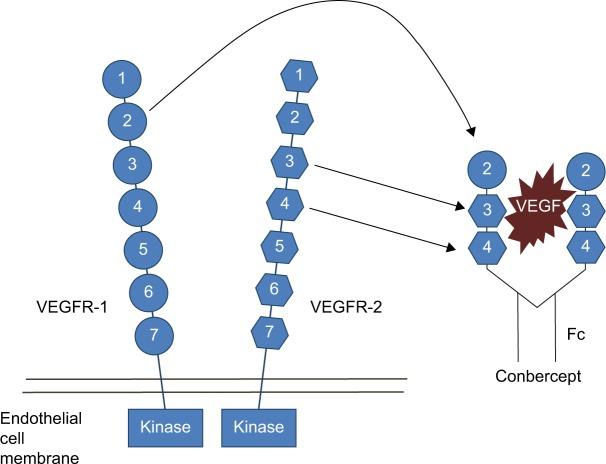
In developed countries, age-related macular degeneration (AMD) is the leading cause of irreversible blindness in individuals over the age of 65 years. Vascular endothelial growth factor (VEGF) plays a vital role in the formation of neovascular AMD. VEGF regulates angiogenesis, enhances vascular permeability, and drives the formation of choroidal neovascularization. As a result of the introduction of anti-VEGF drugs, the incidence of blindness from neovascular AMD has greatly reduced. Anti-VEGF drugs are used as a first-line treatment for neovascular AMD. The most recent anti-VEGF drug is conbercept, also named KH902, which was approved for the treatment of neovascular AMD by the China Food and Drug Administration in December 2013. In this review, recent clinical information regarding the use of conbercept to treat neovascular AMD is summarized. Conbercept is a soluble receptor decoy that blocks all isoforms of VEGF-A, VEGF-B, VEGF-C, and PlGF, which has a high binding affinity to VEGF and a long half-life in vitreous. Preclinical studies have demonstrated its anti-angiogenesis activity in both ocular neovascular disease models and tumor models. Clinical trials of conbercept have shown its superior efficacy and safety. Patients respond well even with 3-month treatment intervals following loading doses once a month for 3 months. The potential therapeutic effect of conbercept on the treatment of polypoidal choroidal vasculopathy, a special type of neovascular AMD, is also promising. In summary, conbercept is a new treatment option for ophthalmologists and their patients and may help address the limitations of current anti-VEGF drugs.
在发达国家,年龄相关性黄斑变性(AMD)是65岁以上人群不可逆失明的主要原因。血管内皮生长因子(VEGF)在新生血管性AMD的形成中起着至关重要的作用。VEGF调节血管生成,增强血管通透性,并促使脉络膜新生血管形成。由于抗VEGF药物的引入,新生血管性AMD导致的失明发生率大幅降低。抗VEGF药物被用作新生血管性AMD的一线治疗药物。最新的抗VEGF药物是康柏西普,也称为KH902,于2013年12月被中国食品药品监督管理总局批准用于治疗新生血管性AMD。在本综述中,总结了有关使用康柏西普治疗新生血管性AMD的最新临床信息。康柏西普是一种可溶性受体诱饵,可阻断VEGF-A、VEGF-B、VEGF-C和胎盘生长因子(PlGF)的所有亚型,它对VEGF具有高结合亲和力,在玻璃体中的半衰期较长。临床前研究已证明其在眼部新生血管疾病模型和肿瘤模型中均具有抗血管生成活性。康柏西普的临床试验已显示出其卓越的疗效和安全性。即使在每月一次负荷剂量连续3个月后,以3个月的治疗间隔给药,患者的反应也良好。康柏西普对息肉状脉络膜血管病变(一种特殊类型的新生血管性AMD)的潜在治疗效果也很有前景。总之,康柏西普是眼科医生及其患者的一种新的治疗选择,可能有助于解决当前抗VEGF药物的局限性。
 Zotero 插件