
“我想要有在家的感觉”:确定环境设计的哪些方面对临终痴呆症患者至关重要。
'I want to feel at home': establishing what aspects of environmental design are important to people with dementia nearing the end of life.
作者信息
Fleming Richard, Kelly Fiona, Stillfried Gillian
机构信息
School of Nursing, University of Wollongong, Northfields Avenue, Wollongong, Australia.
Bournemouth University Dementia Institute, Bournemouth, UK.
出版信息
BMC Palliat Care. 2015 May 12;14:26. doi: 10.1186/s12904-015-0026-y.
BACKGROUND
The design of environments in which people with dementia live should be understandable, reinforce personal identity and maintain their abilities. The focus on supporting people with dementia to live well has omitted considering the needs or wishes for a supportive physical environment of those who are nearing the end of their lives. Using a combination of focus groups and a Delphi survey, this study explored the views of people with dementia, family carers and professionals on what aspects of the physical environment would be important to support a good quality of life to the very end.
METHODS
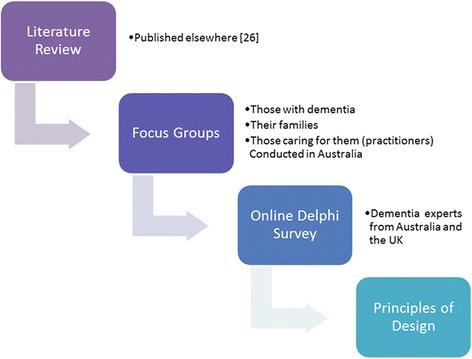
Three focus groups were carried out in three cities along the East Coast of Australia using a discussion guide informed by a literature review. Focus groups comprised recently bereaved family carers of people with dementia (FG1), people with dementia and family carers of people with dementia (FG2) and practitioners caring for people with dementia nearing or at the end of their lives (FG3). Focus group conversations were audio-recorded with participants' consent. Audio files were transcribed verbatim and analysed thematically to identify environmental features that could contribute to achieving the goal of providing a comfortable life to the end. A list of design features derived from analysis of focus group transcripts was distributed to a range of experts in the dementia field and a consensus sought on their appropriateness. From this, a set of features to inform the design of environments for people with dementia nearing the end of life was defined.
RESULTS
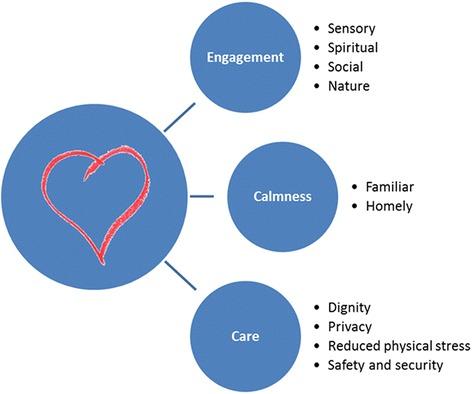
Eighteen people took part in three focus groups: two with dementia, eleven current or recently bereaved family carers and five practitioners. There were differences in opinion on what were important environmental considerations. People with dementia and family carers identified comfort through engagement, feeling at home, a calm environment, privacy and dignity and use of technology to remain connected as important. For practitioners, design to facilitate duty of care and institutional influences on their practice were salient themes. Twenty one experts in the dementia field took part in the survey to agree a consensus on the desirable features derived from analysis of focus group transcripts, with fifteen features agreed.
CONCLUSIONS
The fifteen features are compatible with the design principles for people with dementia who are mobile, but include a stronger focus on sensory engagement. We suggest that considering these features as part of a continuum of care will support good practice and offer those with dementia the opportunity to live well until the end and give their families a more positive experience in the last days of their lives together.
背景
痴呆症患者居住环境的设计应易于理解,强化个人身份认同并维持其能力。关注支持痴呆症患者过上美好生活,却忽略了考虑那些生命即将结束的患者对支持性物理环境的需求或愿望。本研究通过焦点小组和德尔菲调查相结合的方式,探讨了痴呆症患者、家庭护理人员和专业人员对于物理环境的哪些方面对于支持高质量的生命末期生活至关重要的看法。
方法
在澳大利亚东海岸的三个城市开展了三个焦点小组,使用基于文献综述编写的讨论指南。焦点小组包括近期失去亲人的痴呆症患者家庭护理人员(FG1)、痴呆症患者及其家庭护理人员(FG2)以及照顾生命接近末期或处于末期的痴呆症患者的从业者(FG3)。经参与者同意,焦点小组对话进行了录音。音频文件逐字转录并进行主题分析,以确定有助于实现为生命末期提供舒适生活这一目标的环境特征。从焦点小组转录本分析得出的一系列设计特征清单分发给了痴呆症领域的一系列专家,并就其适用性寻求共识。据此,定义了一组用于指导为生命接近末期的痴呆症患者设计环境的特征。
结果
18人参与了三个焦点小组:2名痴呆症患者、11名现任或近期失去亲人的家庭护理人员以及5名从业者。对于重要的环境考量因素存在意见分歧。痴呆症患者和家庭护理人员认为通过参与获得舒适感、有家的感觉、平静的环境、隐私和尊严以及使用技术保持联系很重要。对于从业者而言,便于履行护理职责的设计以及机构对其实践的影响是突出主题。21名痴呆症领域的专家参与了该调查,就从焦点小组转录本分析得出的理想特征达成共识,共达成15项特征。
结论
这15项特征与行动自如的痴呆症患者的设计原则相符,但更加强调感官参与。我们建议将这些特征视为连续护理的一部分,这将有助于良好实践,并为痴呆症患者提供机会直至生命末期都能过上美好生活,同时让他们的家人在共同生活的最后日子里有更积极的体验。
 Zotero 插件