
对40岁及以上有结直肠癌家族史的美国成年人进行结肠镜检查筛查。
Colonoscopy screening among US adults aged 40 or older with a family history of colorectal cancer.
作者信息
Tsai Meng-Han, Xirasagar Sudha, Li Yi-Jhen, de Groen Piet C
机构信息
University of South Carolina, Columbia, South Carolina.
Department of Health Services Policy and Management, University of South Carolina, Arnold School of Public Health, 915 Greene St, Room 352, Columbia, SC 29208. Email:
出版信息
Prev Chronic Dis. 2015 May 21;12:E80. doi: 10.5888/pcd12.140533.
INTRODUCTION
Colonoscopy screening reduces colorectal cancer (CRC) incidence and mortality. CRC screening is recommended at age 50 for average-risk people. Screening of first-degree relatives of CRC patients is recommended to begin at age 40 or 10 years before the age at diagnosis of the youngest relative diagnosed with CRC. CRC incidence has increased recently among younger Americans while it has declined among older Americans. The objective of this study was to determine whether first-degree relatives of CRC patients are being screened according to recommended guidelines.
METHODS
We studied colonoscopy screening rates among the US population reporting a CRC family history using 2005 and 2010 National Health Interview Survey data.
RESULTS
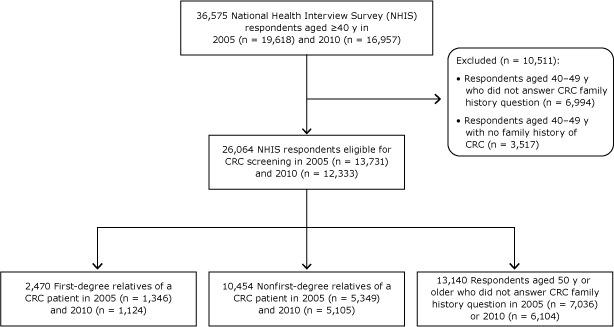
Of 26,064 study-eligible respondents, 2,470 reported a CRC family history; of those with a family history, 45.6% had a colonoscopy (25.2% in 2005 and 65.8% 2010). The colonoscopy rate among first-degree relatives aged 40 to 49 in 2010 (38.3%) was about half that of first-degree relatives aged 50 or older (69.7%). First-degree relatives were nearly twice as likely as nonfirst-degree relatives to have a colonoscopy (adjusted odds ratio [AOR], 1.7; 95% confidence interval, 1.5-1.9), but those aged 40 to 49 were less likely to have a colonoscopy than those in older age groups (AOR, 2.6 for age 50-64; AOR, 3.6 for age ≥65). Interactions with age, insurance, and race/ethnicity were not significant. Having health insurance tripled the likelihood of screening.
CONCLUSION
Despite a 5-fold increase in colonoscopy screening rates since 2005, rates among first-degree relatives younger than the conventional screening age have lagged. Screening promotion targeted to this group may halt the recent rising trend of CRC among younger Americans.
引言
结肠镜检查筛查可降低结直肠癌(CRC)的发病率和死亡率。对于平均风险人群,建议在50岁时进行CRC筛查。对于CRC患者的一级亲属,建议在40岁或在最年轻的患CRC亲属确诊年龄前10年开始筛查。近年来,美国年轻人群中的CRC发病率有所上升,而老年人群中的发病率则有所下降。本研究的目的是确定CRC患者的一级亲属是否按照推荐指南进行筛查。
方法
我们使用2005年和2010年的国家健康访谈调查数据,研究了报告有CRC家族史的美国人群的结肠镜检查筛查率。
结果
在26,064名符合研究条件的受访者中,2,470人报告有CRC家族史;在有家族史的人群中,45.6%进行了结肠镜检查(2005年为25.2%,2010年为65.8%)。2010年,40至49岁一级亲属的结肠镜检查率(38.3%)约为50岁及以上一级亲属(69.7%)的一半。一级亲属进行结肠镜检查的可能性是非一级亲属的近两倍(调整后的优势比[AOR],1.7;95%置信区间,1.5 - 1.9),但40至49岁的人进行结肠镜检查的可能性低于年龄较大的人群(50 - 64岁的AOR为2.6;≥65岁的AOR为3.6)。年龄、保险和种族/民族之间的交互作用不显著。拥有医疗保险使筛查的可能性增加了两倍。
结论
尽管自2005年以来结肠镜检查筛查率增加了5倍,但低于传统筛查年龄的一级亲属的筛查率仍然滞后。针对该群体的筛查推广可能会遏制美国年轻人群中近期CRC上升的趋势。
 Zotero 插件