
持续胸外按压 1 或 2 分钟的质量。
Quality of continuous chest compressions performed for one or two minutes.
机构信息
Hospital das Clinicas, Faculdade de Medicina, Universidade de São Paulo, Sao Paulo, SP, Brazil.
Medicine School, Anhembi Morumbi University, Sao Paulo, SP, Brazil.
出版信息
Clinics (Sao Paulo). 2015 Mar;70(3):190-5. doi: 10.6061/clinics/2015(03)07. Epub 2015 Mar 1.
OBJECTIVES
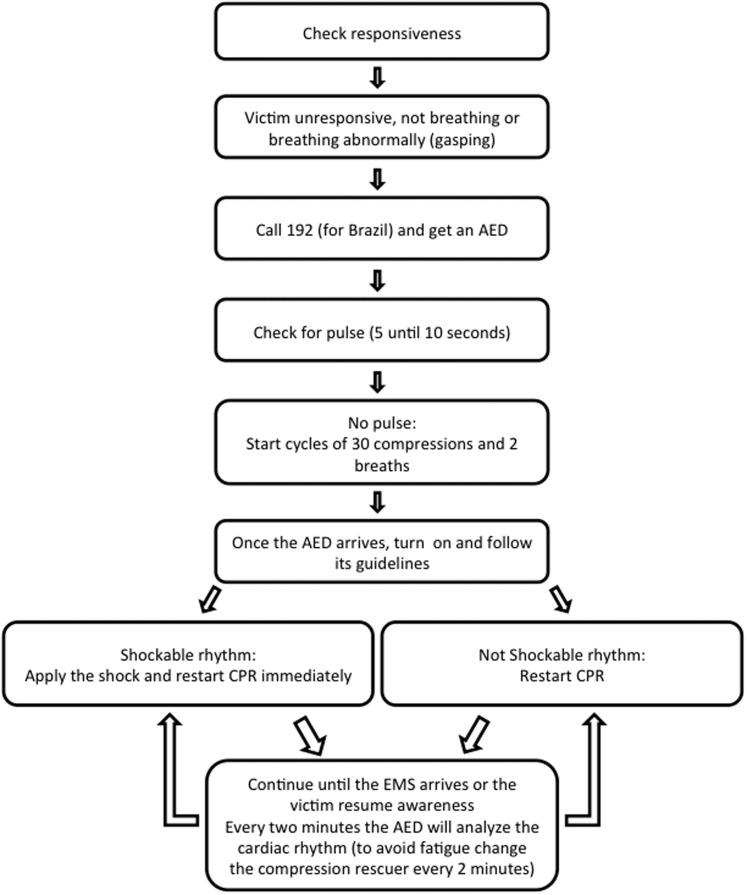
This study was designed to assess cardiopulmonary resuscitation quality and rescuer fatigue when rescuers perform one or two minutes of continuous chest compressions.
METHODS
This prospective crossover study included 148 lay rescuers who were continuously trained in a cardiopulmonary resuscitation course. The subjects underwent a 120-min training program comprising continuous chest compressions. After the course, half of the volunteers performed one minute of continuous chest compressions, and the others performed two minutes, both on a manikin model. After 30 minutes, the volunteers who had previously performed one minute now performed two minutes on the same manikin and vice versa.
RESULTS
A comparison of continuous chest compressions performed for one and two minutes, respectively, showed that there were significant differences in the average rate of compressions per minute (121 vs. 124), the percentage of compressions of appropriate depth (76% vs. 54%), the average depth (53 vs. 47 mm), and the number of compressions with no errors (62 vs. 47%). No parameters were significantly different when comparing participants who performed regular physical activity with those who did not and participants who had a normal body mass index with overweight/obese participants.
CONCLUSION
The quality of continuous chest compressions by lay rescuers is superior when it is performed for one minute rather than for two minutes, independent of the body mass index or regular physical activity, even if they are continuously trained in cardiopulmonary resuscitation. It is beneficial to rotate rescuers every minute when performing continuous chest compressions to provide higher quality and to achieve greater success in assisting a victim of cardiac arrest.
目的
本研究旨在评估心肺复苏质量和抢救者的疲劳程度,当抢救者进行 1 或 2 分钟的连续胸外按压时。
方法
这是一项前瞻性交叉研究,纳入了 148 名接受过心肺复苏课程连续培训的非专业急救人员。受试者接受了 120 分钟的培训计划,包括连续的胸外按压。课程结束后,一半的志愿者进行 1 分钟的连续胸外按压,另一半进行 2 分钟的按压,均在模型上进行。30 分钟后,之前进行 1 分钟按压的志愿者现在在同一个模型上进行 2 分钟按压,反之亦然。
结果
比较 1 分钟和 2 分钟连续胸外按压,每分钟平均按压频率(121 次比 124 次)、适当深度按压比例(76%比 54%)、平均深度(53 毫米比 47 毫米)和无错误按压次数(62 次比 47 次)均有显著差异。与定期进行体育锻炼的参与者相比,不进行体育锻炼的参与者以及体重指数正常的参与者与超重/肥胖参与者之间,没有参数存在显著差异。
结论
非专业急救人员进行 1 分钟而不是 2 分钟的连续胸外按压,其质量更高,即使他们接受过心肺复苏的连续培训,也与体重指数或定期体育锻炼无关。在进行连续胸外按压时,每 1 分钟轮换抢救者,有助于提供更高质量的按压,并在协助心脏骤停患者方面取得更大成功。

 Zotero 插件