
信号序列诱导信号识别颗粒中的构象变化。
Signal-sequence induced conformational changes in the signal recognition particle.
作者信息
Hainzl Tobias, Sauer-Eriksson A Elisabeth
机构信息
Department of Chemistry, Umeå University, Umeå SE-901 87, Sweden.
出版信息
Nat Commun. 2015 Jun 8;6:7163. doi: 10.1038/ncomms8163.
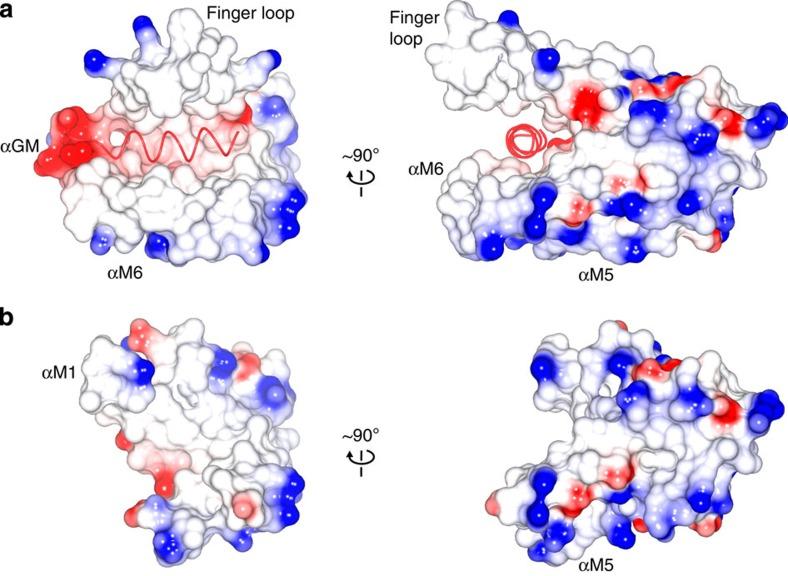
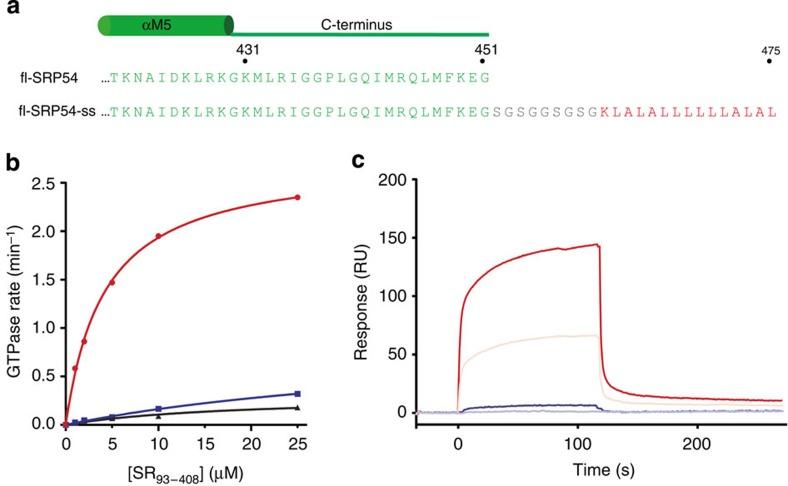
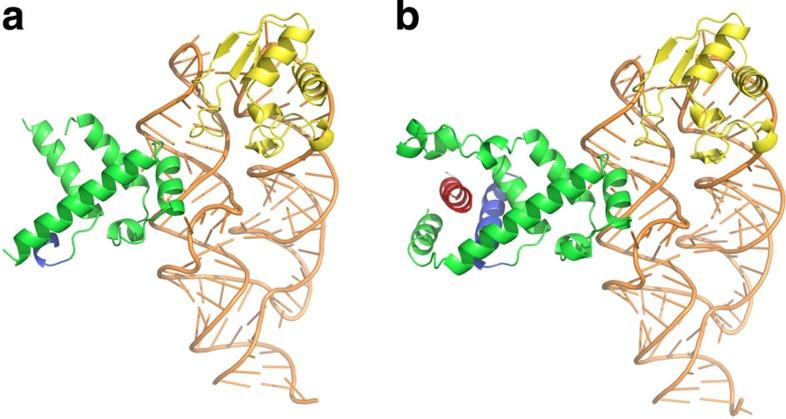
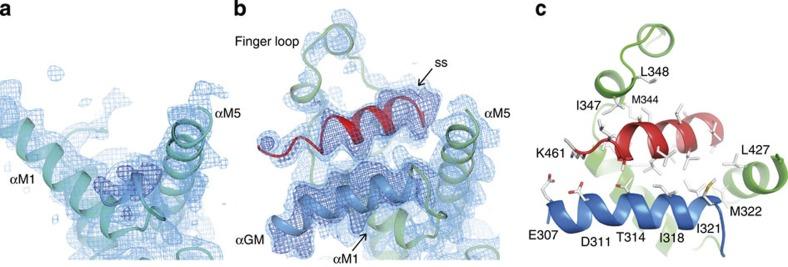
Co-translational protein targeting is an essential, evolutionarily conserved pathway for delivering nascent proteins to the proper cellular membrane. In this pathway, the signal recognition particle (SRP) first recognizes the N-terminal signal sequence of nascent proteins and subsequently interacts with the SRP receptor. For this, signal sequence binding in the SRP54 M domain must be effectively communicated to the SRP54 NG domain that interacts with the receptor. Here we present the 2.9 Å crystal structure of unbound- and signal sequence bound SRP forms, both present in the asymmetric unit. The structures provide evidence for a coupled binding and folding mechanism in which signal sequence binding induces the concerted folding of the GM linker helix, the finger loop, and the C-terminal alpha helix αM6. This mechanism allows for a high degree of structural adaptability of the binding site and suggests how signal sequence binding in the M domain is coupled to repositioning of the NG domain.
共翻译蛋白质靶向是一种将新生蛋白质输送到适当细胞膜的重要且进化保守的途径。在这条途径中,信号识别颗粒(SRP)首先识别新生蛋白质的N端信号序列,随后与SRP受体相互作用。为此,SRP54 M结构域中的信号序列结合必须有效地传递到与受体相互作用的SRP54 NG结构域。在这里,我们展示了未结合信号序列和结合信号序列的SRP形式的2.9 Å晶体结构,二者均存在于不对称单元中。这些结构为一种耦合结合和折叠机制提供了证据,其中信号序列结合诱导GM连接螺旋、指状环和C端α螺旋αM6的协同折叠。这种机制允许结合位点具有高度的结构适应性,并表明M结构域中的信号序列结合如何与NG结构域的重新定位相耦合。
 Zotero 插件