
为什么田本系数是基于指纹的相似性计算的合适选择?
Why is Tanimoto index an appropriate choice for fingerprint-based similarity calculations?
作者信息
Bajusz Dávid, Rácz Anita, Héberger Károly
机构信息
Medicinal Chemistry Research Group, Research Centre for Natural Sciences, Hungarian Academy of Sciences, Magyar tudósok körútja 2, H-1117 Budapest XI, Hungary.
Plasma Chemistry Research Group, Research Centre for Natural Sciences, Hungarian Academy of Sciences, Magyar tudósok körútja 2, H-1117 Budapest XI, Hungary ; Department of Applied Chemistry, Faculty of Food Science, Corvinus University of Budapest, Villányi út 29-43, H-1118 Budapest XI, Hungary.
出版信息
J Cheminform. 2015 May 20;7:20. doi: 10.1186/s13321-015-0069-3. eCollection 2015.
BACKGROUND
Cheminformaticians are equipped with a very rich toolbox when carrying out molecular similarity calculations. A large number of molecular representations exist, and there are several methods (similarity and distance metrics) to quantify the similarity of molecular representations. In this work, eight well-known similarity/distance metrics are compared on a large dataset of molecular fingerprints with sum of ranking differences (SRD) and ANOVA analysis. The effects of molecular size, selection methods and data pretreatment methods on the outcome of the comparison are also assessed.
RESULTS
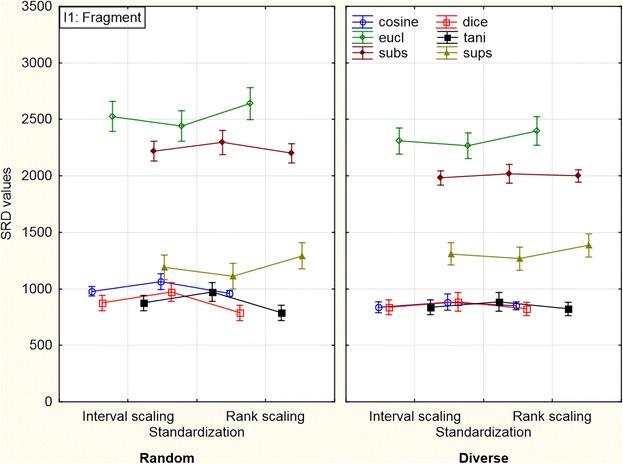
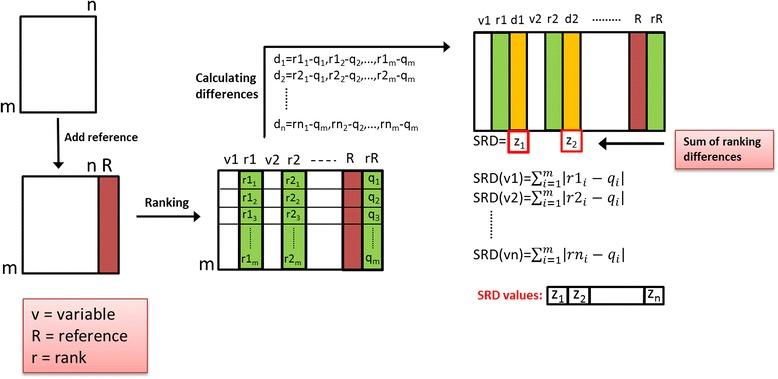
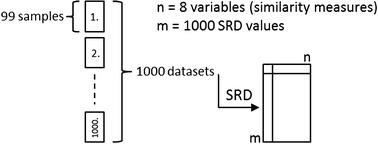
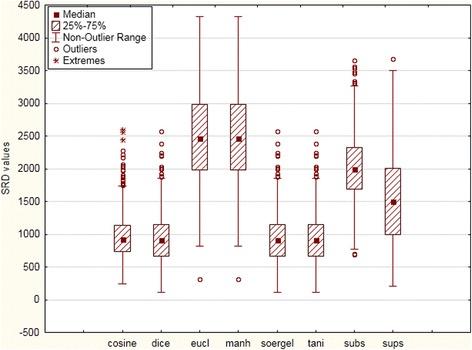
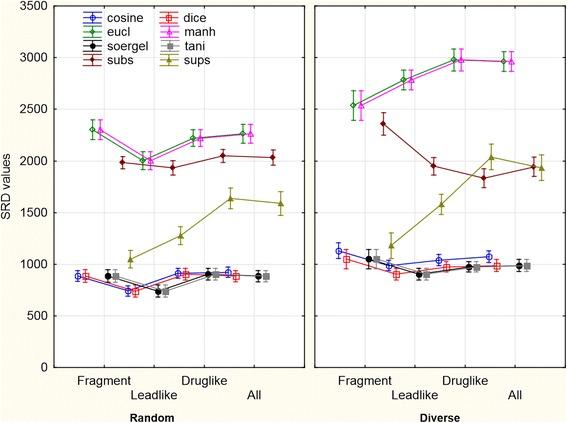
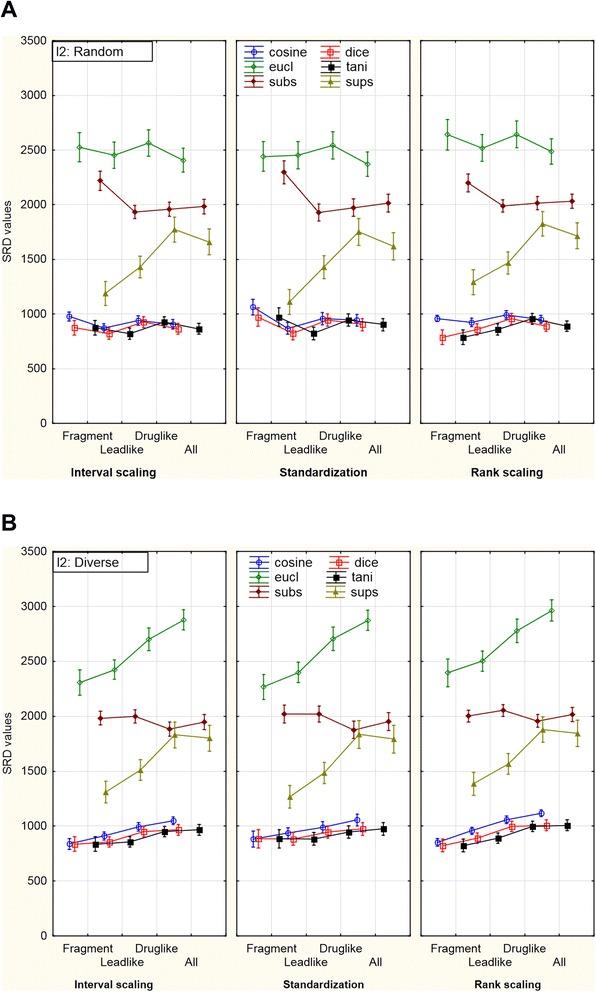
A supplier database (https://mcule.com/) was used as the source of compounds for the similarity calculations in this study. A large number of datasets, each consisting of one hundred compounds, were compiled, molecular fingerprints were generated and similarity values between a randomly chosen reference compound and the rest were calculated for each dataset. Similarity metrics were compared based on their ranking of the compounds within one experiment (one dataset) using sum of ranking differences (SRD), while the results of the entire set of experiments were summarized on box and whisker plots. Finally, the effects of various factors (data pretreatment, molecule size, selection method) were evaluated with analysis of variance (ANOVA).
CONCLUSIONS
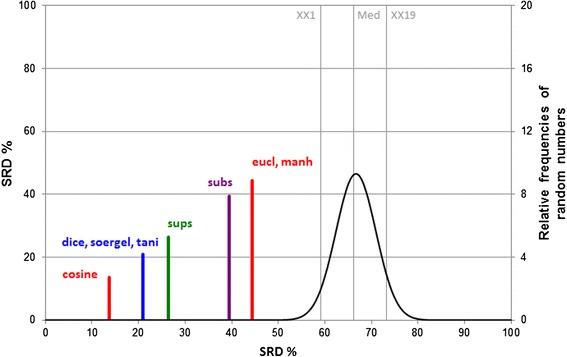
This study complements previous efforts to examine and rank various metrics for molecular similarity calculations. Here, however, an entirely general approach was taken to neglect any a priori knowledge on the compounds involved, as well as any bias introduced by examining only one or a few specific scenarios. The Tanimoto index, Dice index, Cosine coefficient and Soergel distance were identified to be the best (and in some sense equivalent) metrics for similarity calculations, i.e. these metrics could produce the rankings closest to the composite (average) ranking of the eight metrics. The similarity metrics derived from Euclidean and Manhattan distances are not recommended on their own, although their variability and diversity from other similarity metrics might be advantageous in certain cases (e.g. for data fusion). Conclusions are also drawn regarding the effects of molecule size, selection method and data pretreatment on the ranking behavior of the studied metrics. Graphical AbstractA visual summary of the comparison of similarity metrics with sum of ranking differences (SRD).
背景
在进行分子相似性计算时,化学信息学家拥有非常丰富的工具集。存在大量的分子表示形式,并且有几种方法(相似性和距离度量)来量化分子表示形式的相似性。在这项工作中,使用排名差异总和(SRD)和方差分析,在一个大型分子指纹数据集上比较了八种著名的相似性/距离度量。还评估了分子大小、选择方法和数据预处理方法对比较结果的影响。
结果
结论
本研究补充了先前对分子相似性计算的各种度量进行检查和排名的工作。然而,这里采用了一种完全通用的方法,忽略了关于所涉及化合物的任何先验知识,以及仅检查一个或几个特定场景所引入的任何偏差。Tanimoto指数、Dice指数、余弦系数和Soergel距离被确定为相似性计算的最佳(并且在某种意义上等效)度量,即这些度量可以产生最接近八个度量的综合(平均)排名的排名。不单独推荐从欧几里得距离和曼哈顿距离导出的相似性度量,尽管它们与其他相似性度量的可变性和多样性在某些情况下(例如用于数据融合)可能是有利的。还得出了关于分子大小、选择方法和数据预处理对所研究度量的排名行为的影响的结论。图形摘要:相似性度量与排名差异总和(SRD)比较的可视化总结。

 Zotero 插件