
朊病毒污染生长激素致克雅病患者的不同病理表型
Distinct pathological phenotypes of Creutzfeldt-Jakob disease in recipients of prion-contaminated growth hormone.
机构信息
Department of Pathology, Case Western Reserve University, School of Medicine, Cleveland, OH, USA.
Department of Clinical and Experimental Medicine, Second University of Naples, Naples, Italy.
出版信息
Acta Neuropathol Commun. 2015 Jun 25;3:37. doi: 10.1186/s40478-015-0214-2.
INTRODUCTION
The present study compares the clinical, pathological and molecular features of a United States (US) case of growth hormone (GH)-associated Creutzfeldt-Jakob disease (GH-CJD) (index case) to those of two earlier referred US cases of GH-CJD and one case of dura mater (d)-associated CJD (dCJD). All iatrogenic CJD (iCJD) subjects were methionine (M) homozygous at codon 129 (129MM) of the prion protein (PrP) gene and had scrapie prion protein (PrP(Sc)) type 1 (iCJDMM1).
RESULTS
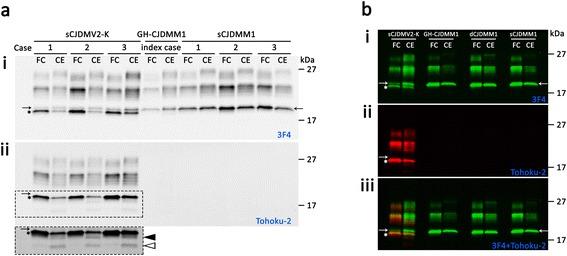
The index subject presented with ataxia, weight loss and changes in the sleep pattern about 38 years after the midpoint of GH treatment. Autopsy examination revealed a neuropathological phenotype reminiscent of both sCJDMV2-K (a sporadic CJD subtype in subjects methionine/valine heterozygous at codon 129 with PrP(Sc) type 2 and the presence of kuru plaques) and variant CJD (vCJD). The two earlier cases of GH-CJDMM1 and the one of dCJDMM1 were associated with neuropathological phenotypes that differed from that of the index case mainly because they lacked PrP plaques. The phenotype of the earlier GH-CJDMM1 cases shared several, but not all, characteristics with sCJDMM1, whereas dCJDMM1 was phenotypically indistinguishable from sCJDMM1. Two distinct groups of dCJDMM1 have also been described in Japan based on clinical features, the presence or absence of PrP plaques and distinct PK-resistant PrP(Sc) (resPrP(Sc)) electrophoretic mobilities. The resPrP(Sc) electrophoretic mobility was, however, identical in our GH-CJDMM1 and dCJDMM1 cases, and matched that of sCJDMM1.
CONCLUSIONS
Our study shows that receipt of prion-contaminated GH can lead to a prion disease with molecular features (129MM and PrP(Sc) type 2) and phenotypic characteristics that differ from those of sporadic prion disease (sCJDMM1), a difference that may reflect adaptation of "heterologous" prion strains to the 129MM background.
简介
本研究比较了美国(美国)生长激素(GH)相关克雅氏病(GH-CJD)(索引病例)的临床、病理和分子特征与另外两例先前转诊的美国 GH-CJD 病例和一例硬脑膜(d)相关克雅氏病(dCJD)的特征。所有医源性克雅氏病(iCJD)患者的朊病毒蛋白(PrP)基因第 129 位密码子均为蛋氨酸(M)纯合子(129MM),且具有瘙痒病朊病毒蛋白(PrP(Sc))1 型(iCJDMM1)。
结果
索引病例在 GH 治疗中点后约 38 年出现共济失调、体重减轻和睡眠模式改变。尸检检查显示出一种神经病理学表型,既类似于 sCJDMV2-K(129 位密码子蛋氨酸/缬氨酸杂合的散发性 CJD 亚型,PrP(Sc)为 2 型,存在库鲁斑块),也类似于变异型克雅氏病(vCJD)。两例较早的 GH-CJDMM1 病例和一例 dCJDMM1 病例的神经病理学表型与索引病例不同,主要是因为它们缺乏 PrP 斑块。较早的 GH-CJDMM1 病例的表型具有一些,但不是全部,与 sCJDMM1 相似,而 dCJDMM1 在表型上与 sCJDMM1 无法区分。日本也根据临床特征、PrP 斑块的存在与否以及独特的 PK 抗性 PrP(Sc)(resPrP(Sc))电泳迁移率,将两组不同的 dCJDMM1 进行了描述。然而,我们的 GH-CJDMM1 和 dCJDMM1 病例中的 resPrP(Sc)电泳迁移率与 sCJDMM1 相同。
结论
我们的研究表明,接受污染的朊病毒生长激素可能导致一种具有分子特征(129MM 和 PrP(Sc)2 型)和表型特征(与散发性朊病毒疾病(sCJDMM1)不同)的朊病毒疾病,这种差异可能反映了“异源”朊病毒株对 129MM 背景的适应性。


 Zotero 插件